
Stenocereus marginatus (Stenocereus marginatus)
Sources describe the habit differently, but Stenocereus marginatus is described as a large, upright columnar cactus whose stems may cluster or branch from the base; young plants are often single-stemmed, while mature plants are more likely to branch from the base. It is reported to be an evergreen perennial cactus.
Overview
Sources describe the habit differently, but Stenocereus marginatus is described as a large, upright columnar cactus whose stems may cluster or branch from the base; young plants are often single-stemmed, while mature plants are more likely to branch from the base. It is reported to be an evergreen perennial cactus.
Origin and habitat
Sources differ on its precise geographic origin: accounts generally point to central Mexico, including Hidalgo, Guanajuato, Querétaro, and Oaxaca, while long-standing widespread cultivation as a living fence makes the exact origin uncertain.
Characteristics
Sources differ on mature height, placing it at about 1200–1500 cm, while a single source reports a mature spread of about 250–400 cm. Growth can be slow overall, although plants grown in the ground during warm periods can grow substantially when supplied with ample water and fertilizer. Mature plants flower in spring; sources differ on flower descriptions, reporting funnel-shaped flowers in red, pink, green, white, or purple, with RHS also reporting that they open at night. The fruit is nearly spherical, yellow-red to red when mature, spiny, and relatively dry in flesh or texture, with many black seeds.
Light
Stenocereus marginatus takes full sun; indoors it needs bright light with some direct sunlight.
Watering
During the growing season, water moderately to amply, allowing the growing medium to dry after each watering before watering again; keep it dry in winter and stop or greatly reduce watering.
Humidity and airflow
A specialist source reports that it prefers high humidity.
Temperature and dormancy
Sources differ on the lower temperature limit, with limited reports placing it around -4 °C. Specialist sources report that it tolerates brief light frost. It rests cool and dry in winter.
Growing medium and mounting
Use a fertile, well-drained growing medium; a fast-draining cactus mix is suitable, and the soil may be loamy or sandy with an acidic to alkaline pH.
Feeding
A specialist source recommends feeding during the warm growing season to promote growth and stopping fertilizer in winter.
Propagation
It can be propagated from seed or stem-tip cuttings; RHS recommends sowing in spring and taking stem-tip cuttings in summer.
Common problems
Scale insects and mealybugs are reported as possible pests. RHS describes it as generally having few diseases, while Llifle notes a risk of fungal disease with excessive watering. A specialist source reports that continued winter watering or feeding under low light can cause elongated, thinner stems, while excessive watering can increase the risk of fungal disease. A specialist source reports limited cold tolerance and notes that prolonged moisture in the growing medium during cold periods can cause damage.
Identification
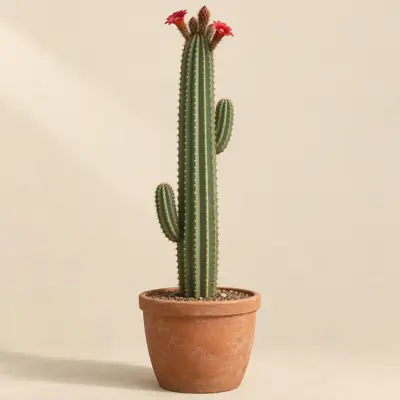
Stenocereus marginatus has dark green, upright columnar stems with ribs; white, slightly woolly areoles line the ribs and often connect to form conspicuous pale longitudinal lines, and the spines are relatively short.
Sources
- GBIF Backbone: Stenocereus marginatus (DC.) A.Berger & Buxb. — CC BY 4.0 · link
- Wikipedia (en): Marginatocereus marginatus — CC BY-SA 4.0 · link
- Wikipedia (en): Stenocereus marginatus — CC BY-SA 4.0 · link
- LLIFLE Encyclopedia of living forms: Stenocereus marginatus — CC BY-SA · link
- RHS Plants: Stenocereus marginatus — © RHS, facts only · link