
mother of thousands (Soleirolia soleirolii)
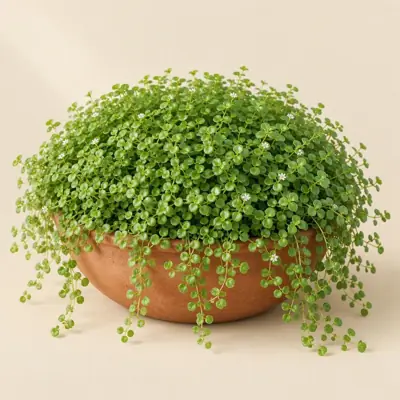
Soleirolia soleirolii is a low-growing, creeping perennial herb that forms dense mats, with stems able to root at the nodes.
Overview
Soleirolia soleirolii is a low-growing, creeping perennial herb that forms dense mats, with stems able to root at the nodes.
Origin and habitat
Sources differ on its native range, but describe its core native distribution as western Mediterranean islands, including Corsica and Sardinia. It favors shaded, continually moist places and occurs on woodland soils, damp rocks and wall crevices, between paving stones or rocks, beside water, in wet grassland and gardens, and in marsh or riverbank environments. Its native climate is reported to range from Mediterranean to subtropical, with warmer, drier summers and mild, wet winters; it can grow vigorously in continually moist, shaded environments from temperate to subtropical climates.
Characteristics
Sources differ, with few independent sources supporting the estimates: mature height is reported at about 2–25 cm and mature spread at about 50–100 cm. It grows rapidly and can quickly form extensive ground cover in suitable conditions, sometimes becoming a difficult-to-control weed. The alternate, simple leaves are round to oblong with entire margins; the wild type is bright to dark green, while cultivars may be golden, silver-green, or variegated. The very small, inconspicuous flowers are white to pink and appear in summer; the plant is monoecious, with separate female flowers mainly on the lower stems and male flowers above, and its fruit is reported to be a glossy pale-brown, egg-shaped achene with a pointed tip.
Light
Sources differ on light exposure: bright indirect light to partial shade is described as more suitable, strong hot direct sun should be avoided, while full sun can also be acceptable outdoors in some environments.
Watering
Keep the soil consistently moist but well drained, watering as needed during the growing season and keeping it slightly moist in winter; the plant has relatively high water needs and can also grow beside water, in wetlands, and with its roots submerged.
Temperature and dormancy
Hardiness guidance indicates that Soleirolia soleirolii can remain evergreen in milder conditions and may regrow after its above-ground growth dies back in colder conditions; an RHS hardiness rating is also given.
Growing medium and mounting
It prefers fertile, humus-rich, moist but well-drained soil and can grow in loam, clay, sand, and chalky soils. Sources differ on soil reaction: horticultural sources accept acidic, neutral, and alkaline conditions, while native-habitat information leans toward neutral to acidic conditions.
Propagation
It can be propagated by seed or division; stems can root at the nodes, and remaining stem or root pieces may also resprout.
Common problems
Aphids, whiteflies, and scale insects may occur, although serious pest problems are generally reported to be uncommon. No major specific disease is identified, and horticultural sources describe serious disease problems as generally uncommon. In suitable conditions it can spread rapidly and become difficult to remove because remaining roots or stem pieces can resprout; over time it may also crowd other plants in miniature landscapes or terrariums. Strong direct sun can scorch the leaves, while frost may cause the above-ground growth to become deciduous or die back in winter; escaped populations in Germany have been recorded surviving severe winters, but this observation from specific outdoor populations does not establish a general minimum temperature for potted plants.
Identification
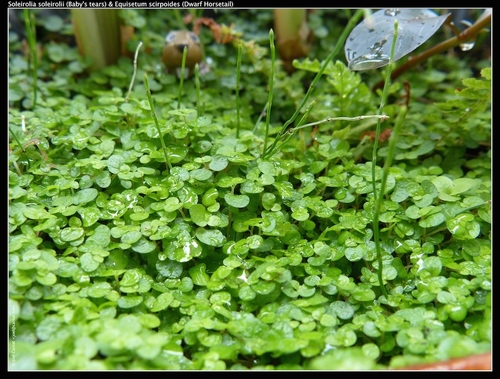
Very fine, branching, creeping stems bearing numerous tiny round leaves form a dense, moss-like green carpet close to the ground, and the stems can root at their nodes.
Photos



Sources
- Wikipedia (en): Soleirolia — CC BY-SA 4.0 · link
- Wikipedia (de): Bubikopf (Pflanze) — CC BY-SA 4.0 · link
- Wikipedia (fr): Soleirolia soleirolii — CC BY-SA 4.0 · link
- GBIF descriptions: Manual of the Alien Plants of Belgium; Lista de especies de plantas exóticas y trasplantadas de Colo — per dataset · link
- NC State Plant Toolbox: Soleirolia soleirolii — copyright (facts only) · link
- RHS Plants: Soleirolia soleirolii — © RHS, facts only · link
- USDA PLANTS Database: Soleirolia soleirolii — Public domain (US Government work) · link