
Cobweb House-leek (Sempervivum arachnoideum)
Sempervivum arachnoideum is a small evergreen succulent that forms tight rosettes and spreads by offsets into mat-like colonies. It is perennial; an individual rosette dies after flowering and setting seed, while its offsets can continue growing.
Overview
Sempervivum arachnoideum is a small evergreen succulent that forms tight rosettes and spreads by offsets into mat-like colonies. It is perennial; an individual rosette dies after flowering and setting seed, while its offsets can continue growing.
Origin and habitat
Sources differ on its native range in European mountains, with accounts including the Pyrenees, Alps, Apennines, Carpathians, and Corsica, while early floras also record the Italian and Swiss Alps. Its habitats include rocks, scree, rock crevices, pastures, and grasslands in European mountains, often on siliceous substrates and in acidic conditions. It is adapted to dry, strongly sunlit mountain environments in Europe and tolerates drought and low temperatures.
Characteristics
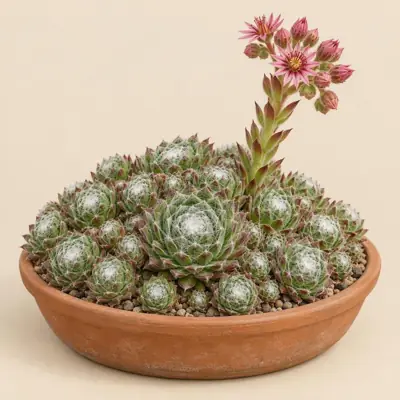
Sources differ on mature size, reporting a height of about 8–10 cm and a spread of about 10–50 cm. Fleshy leaves form small, dense rosettes and may be green, red, or dark red; long white hairs along the leaf margins or tips can interweave between neighboring leaves to create a cobweb-like covering, and the leaves store water. Sources differ in their descriptions of the flowers; they are generally pink to deep pink, star-shaped or with radiating petals, borne on flower stalks above the rosettes, and bisexual. Flowering occurs in summer and may extend into early autumn on some plants; growth is reported to be very slow, with colonies gradually forming through offsets.
Light
Sempervivum arachnoideum takes full sun and does best there, while also accepting bright to lightly shaded conditions; in hot regions, excessively strong summer sun should be avoided.
Watering
It is drought tolerant and should be watered sparingly without allowing waterlogging; during growth, let the growing medium dry somewhat after watering before watering again, and greatly reduce water in winter, when wet conditions should be especially avoided.
Humidity and airflow
It is generally reported to prefer low humidity and need good airflow.
Temperature and dormancy
It is frost hardy, with a minimum temperature of -12 °C. It has reported USDA and RHS hardiness classifications. Dormancy is reported to vary. Its heat tolerance is relatively limited; in hot summers, a sheltered, well-ventilated, partly shaded setting is preferable, and excessively strong sun should also be avoided in warmer climates.
Growing medium and mounting
It needs a fast-draining mix, which may be sandy, gravelly, or formulated for succulents. Sources differ on substrate conditions: wild plants are often found on siliceous, acidic substrates, while cultivation information indicates growth in acidic, neutral, or alkaline soils. It is prone to rot.
Feeding
A small amount of slow-release chemical fertilizer or liquid fertilizer is reported to be used during the spring and autumn growing periods.
Propagation
It can be propagated by offsets, division, seed, and stem cuttings; sources also mention cuttings made from plantlets at the ends of stolons.
Common problems
RHS records possible weevil damage, while NHK additionally lists scale insects, aphids, and root mealybugs for Sempervivum. Frequent watering or prolonged wetness, especially in winter, can increase the risk of rot, and the cobweb-like hairs can retain rainwater and further increase that risk. It tolerates frost and drought but is sensitive to persistent winter wetness, while prolonged excessive heat can also result in poor growth.
Identification
Small fleshy rosettes bear long white hairs on the leaf tips and margins that connect to form a conspicuous white, cobweb-like filamentous covering.
Photos


Sources
- GBIF Backbone: Sempervivum arachnoideum L. — CC BY 4.0 · link
- Wikipedia (en): Sempervivum arachnoideum — CC BY-SA 4.0 · link
- Wikipedia (de): Spinnweb-Hauswurz — CC BY-SA 4.0 · link
- Wikipedia (fr): Joubarbe à toile d'araignée — CC BY-SA 4.0 · link
- Wikipedia (es): Sempervivum arachnoideum — CC BY-SA 4.0 · link
- GBIF descriptions: DAISIE - Inventory of alien invasive species in Europe; Nordic Crop Wild Relative (CWR) Checklist; S — per dataset · link
- LLIFLE Encyclopedia of living forms: Sempervivum arachnoideum — CC BY-SA · link
- Useful Tropical/Temperate Plants: Sempervivum arachnoideum — CC BY-NC-SA 3.0 (facts only) · link
- RHS Plants: Sempervivum arachnoideum — © RHS, facts only · link
- Desert-Tropicals: Sempervivum arachnoideum — © Philippe Faucon (desert-tropicals.com), facts only · link
- The Succulent Plant Page: Sempervivum (genus-level) — © R.J. Hodgkiss, facts only · link
- NHK みんなの趣味の園芸 植物図鑑: Sempervivum arachnoideum — © NHK出版, facts only · link
- Sempervivum arachnoideum | Giromagi cactus and succulents for sale | Buy plants (www.giromagi.com) — facts only (§12) · link
- PUKUBOOK: Sempervivum arachnoideum — CC BY-NC (facts only) · link