
Nightblooming Cactus (Selenicereus undatus)
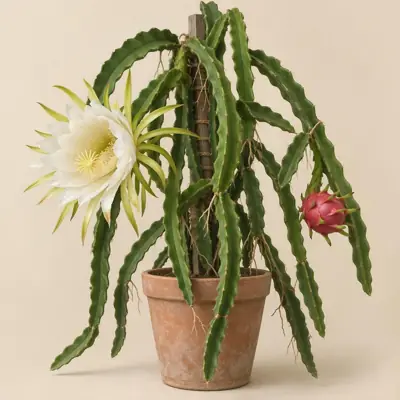
Selenicereus undatus is a perennial succulent cactus that may climb, creep, or trail, can grow terrestrially, on rocks, or semi-epiphytically, and uses aerial roots to attach to supports. It is reported to be an evergreen, perennial, shrub-like cactus and is epiphytic.
Overview
Selenicereus undatus is a perennial succulent cactus that may climb, creep, or trail, can grow terrestrially, on rocks, or semi-epiphytically, and uses aerial roots to attach to supports. It is reported to be an evergreen, perennial, shrub-like cactus and is epiphytic.
Origin and habitat
Sources differ on its native range, which is often considered to extend from southern Mexico into Central America, with some accounts specifically extending it to Honduras. It may grow terrestrially, on rocks, or semi-epiphytically in scrub, trees, rocks, and cliffs; naturalized populations also occur in tropical deciduous forest, riparian vegetation, and thorn scrub. It is suited to warm tropical to subtropical climates and is now widely cultivated in many tropical and subtropical regions worldwide.
Characteristics
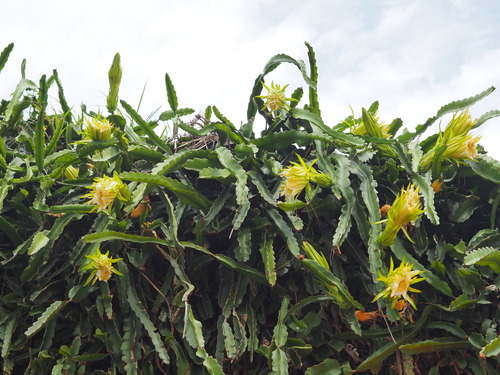
Sources differ, with limited evidence indicating a mature height of about 400 cm. Green succulent stems are the main vegetative organs; they are much-branched, usually ridged with wavy margins that become somewhat horny with age, and can form aerial roots and small spines. Sources differ in their descriptions of the large, fragrant, night-opening flowers; the perianth is mainly white, while the outer segments may be yellow-green or greenish white. The fruit usually has red to pink skin with large scale-like bracts, mainly white flesh with many small black seeds, and less commonly recorded pink flesh; the plant is reported to grow rapidly.
Light
It prefers bright light and takes full sun, while partial sun can also be suitable in very hot climates.
Watering
Use a well-drained medium and water when the soil is nearly completely dry; provide more water during spring and summer and around flowering, reduce watering in winter without allowing the plant to dry out completely, and avoid waterlogging.
Humidity and airflow
It is reported to prefer moderate humidity.
Temperature and dormancy
Sources differ, with limited evidence indicating a minimum of about 10 °C and a maximum of about 40 °C. Evidence is limited, with a reported cold minimum of about 0 °C, and the plant is generally considered not frost tolerant.
Growing medium and mounting
It is reported to grow in fertile, well-drained soil, while another description specifies loose, relatively dry soil. It is epiphytic and needs a fast-draining mix.
Feeding
Feed during the growing season; cultivation guidance favors frequent light feeding, with more nitrogen for young plants and increased phosphorus and potassium during fruiting.
Propagation
It is reported to be commonly propagated by stem cuttings, and propagation methods also include seed.
Common problems
Reported pests include mealybugs and scale insects, which may occur on the flowers and plant surfaces. Reported diseases include stem rot, canker, and sooty mold; one source reports that stem rot can involve Fusarium oxysporum entering through wounds. Poor drainage and excessive moisture increase cultivation problems, and the climbing plant generally needs a trellis, post, or other support; some cultivars may be self-incompatible and require hand pollination or pollinator plants. It prefers warm conditions, and temperate-climate cultivation sources advise protecting it from low temperatures.
Identification
It is reported to have robust, much-branched stems that are usually ridged, with wavy margins that become horny with age, along with short spines, aerial roots that aid climbing, large white night-opening flowers, and fruit with scale-like bracts.
Photos



Sources
- Wikipedia (en): Selenicereus undatus — CC BY-SA 4.0 · link
- 維基百科:量天尺 — CC BY-SA 4.0 · link
- Wikipedia (de): Selenicereus undatus — CC BY-SA 4.0 · link
- Wikipedia (fr): Selenicereus undatus — CC BY-SA 4.0 · link
- Wikipedia (es): Selenicereus undatus — CC BY-SA 4.0 · link
- GBIF descriptions: Especies introducidas, exóticas, trasplantadas, invasoras y potencialmente invasoras obtenidas a par — per dataset · link
- NC State Plant Toolbox: Selenicereus undatus — copyright (facts only) · link
- Useful Tropical/Temperate Plants: Selenicereus undatus — CC BY-NC-SA 3.0 (facts only) · link
- The Succulent Plant Page: Selenicereus (genus-level) — © R.J. Hodgkiss, facts only · link