
Krauss's Clubmoss (Selaginella kraussiana)
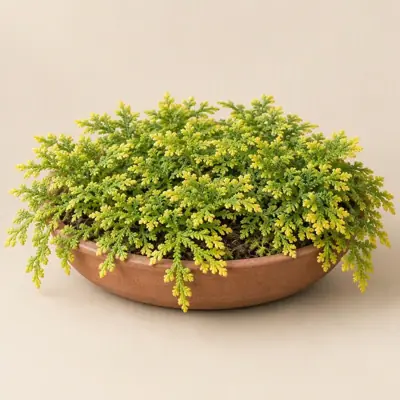
Selaginella kraussiana is a low, creeping, evergreen perennial that forms dense mats, with stems that can root and spread outward; 'Aurea' has yellow-green foliage with golden tips. It is reported to be lithophytic.
Overview
Selaginella kraussiana is a low, creeping, evergreen perennial that forms dense mats, with stems that can root and spread outward; 'Aurea' has yellow-green foliage with golden tips. It is reported to be lithophytic.
Origin and habitat
It is native to Africa and Macaronesia, including tropical, eastern, and southern Africa; prehistoric spore evidence from the Azores supports its presence there before human colonization. It occurs mainly in moist environments, including shaded places, rock faces or rock surfaces, and riverbanks, where it can form green mats over rock. Its native range is primarily associated with humid tropical environments but also includes southern Africa and Macaronesia, and in cultivation it does not tolerate the cold conditions of frost-prone areas.
Characteristics
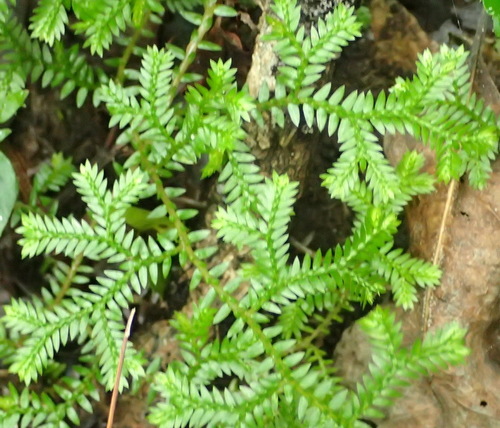
Sources differ on mature height, placing it at about 5–10 cm, while mature spread is 100–150 cm. It spreads strongly through rooting stems, forming extensive mats, and has a creeping rhizome. The small, delicate leaves are scale-like to lance-shaped with fine teeth, giving the plant a fine, fern-like appearance; 'Aurea' has yellow-green foliage with golden tips. It does not reproduce by flowers or form the fruit typical of flowering plants; its reproductive structures include sporangia and strobili, and it reproduces by spores.
Light
It grows in full to partial shade or bright, filtered indirect light, tolerates shade, and should be kept in a sheltered position away from strong direct sunlight.
Watering
Keep the growing medium evenly moist and well drained rather than waterlogged for prolonged periods; humid indoor conditions favor growth.
Humidity and airflow
It has a high humidity need.
Temperature and dormancy
The minimum temperature is 5 °C, and the plant is tender.
Growing medium and mounting
Use an organic-rich growing medium that retains moisture while draining well; loam is suitable, with acidic to neutral conditions preferred.
Propagation
Propagation can be by spores, division, or rooted stems, and stem cuttings root readily in moist growing medium. Spores are reported to be best sown immediately after they mature. Rhizomes or rooted stems can be divided in spring, and vigorous plants can also be divided into several plants.
Common problems
RHS is reported not to identify any specific major pest problem. Disease problems are generally uncommon, although prolonged excessive moisture can lead to root rot. Direct sunlight is reported to scorch the foliage, dry air to cause browning or shriveling, and prolonged excessive moisture to cause root rot. It is sensitive to cold and frost, and frost-prone areas call for greenhouse or indoor cultivation with protection from low temperatures.
Identification
Creeping, flattened stems root and form a low, dense carpet, while the small leaves have a fern-like texture; 'Aurea' is distinguished by yellow-green foliage with golden tips.
Photos



Sources
- GBIF Backbone: Selaginella kraussiana (Kunze) A.Braun — CC BY 4.0 · link
- Wikipedia (en): Selaginella kraussiana — CC BY-SA 4.0 · link
- Wikipedia (fr): Selaginella kraussiana — CC BY-SA 4.0 · link
- Wikipedia (es): Selaginella kraussiana — CC BY-SA 4.0 · link
- GBIF descriptions: Manual of the Alien Plants of Belgium; First records of Selaginella kraussiana and Selaginella subco — per dataset · link
- NC State Plant Toolbox: Selaginella kraussiana — copyright (facts only) · link
- RHS Plants: Selaginella kraussiana — © RHS, facts only · link
- USDA PLANTS Database: Selaginella kraussiana — Public domain (US Government work) · link
- NHK みんなの趣味の園芸 植物図鑑: Selaginella kraussiana — © NHK出版, facts only · link