
Krauss's Clubmoss (Selaginella kraussiana)
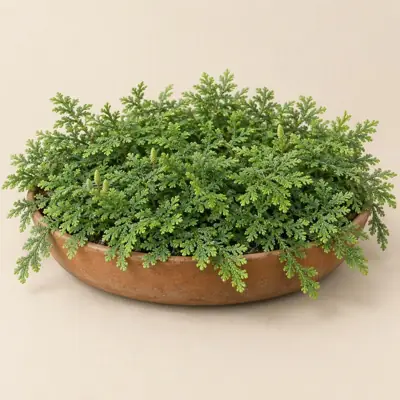
Selaginella kraussiana is a low, creeping, evergreen perennial that forms dense mats, with stems capable of rooting. It is also reported to be lithophytic.
Overview
Selaginella kraussiana is a low, creeping, evergreen perennial that forms dense mats, with stems capable of rooting. It is also reported to be lithophytic.
Origin and habitat
Sources differ on its native range, describing Macaronesia and Africa, with African records spanning North Africa, sub-Saharan Africa, East Africa, southern Africa, and some African islands. It occurs mainly in moist environments, including rock surfaces where it can form green carpets and soils along riverbanks, and horticultural and wild records also commonly place it in shade. It is suited to warm, humid, frost-free conditions and is usually grown in a greenhouse or indoors in temperate regions.
Characteristics
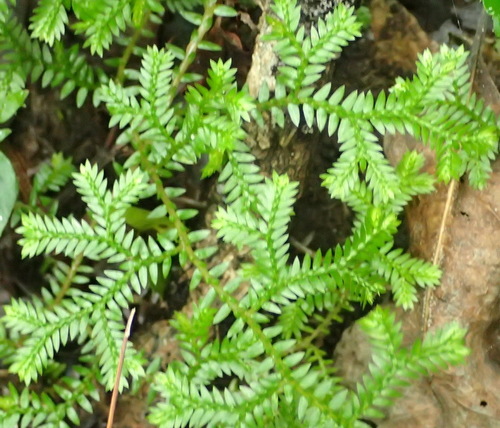
Sources differ on mature height, placing it at about 5–10 cm, while mature spread is 100–150 cm. It grows vigorously, spreading through creeping, rooting stems to form dense vegetation, and has a creeping rhizome. The leaves are small, delicate, and dimorphic, arranged to give a fern-like appearance; the lateral leaves are lance-shaped and nearly perpendicular to the stem with toothed margins, while the median leaves are lance-shaped to linear-lance-shaped with finely toothed margins.
Light
It tolerates shade and grows in full to partial shade; indoors, bright but filtered indirect light is suitable, while direct sunlight should be avoided.
Watering
Keep the growing medium evenly moist but well drained, avoiding prolonged waterlogging; dry conditions can cause the leaves to brown or shrivel. A single source reports a summer watering interval of about 1 day; sources for this figure are few.
Humidity and airflow
Selaginella kraussiana prefers high humidity and has a high humidity need, with a humidity range of 60–80%.
Temperature and dormancy
The minimum temperature is 5 °C, and the plant is tender.
Growing medium and mounting
Use an organic-rich medium that retains moisture while providing good drainage and aeration; loam is suitable, with acidic to neutral conditions preferred.
Feeding
Fertilizer needs are reported to be low; if feeding, a diluted balanced liquid fertilizer can be used during the early growth period.
Propagation
It can be propagated by division, rooted creeping stems, stem cuttings, or spores. Spores form in short terminal spike-like structures and are reported to be suitable for sowing as soon as they mature. Rhizomes or rooted stems can be divided in spring, and another source describes dividing vigorous plants.
Common problems
Indoor plants are generally reported to have few pests, and diseases are usually uncommon, although prolonged excessive moisture in the growing medium can cause root rot. Direct sunlight can scorch the leaves, dry air can cause browning or shriveling, and roots can rot if left waterlogged for long periods. It is sensitive to frost and drought; in cold regions it is best overwintered indoors or in a greenhouse, with the minimum winter temperature kept above the stated threshold.
Identification
Its creeping, flattened stems can form root-bearing structures and root along the stem, spreading into green mats; it also has small dimorphic leaves and spore-bearing spikes.
Photos



Sources
- GBIF Backbone: Selaginella kraussiana (Kunze) A.Braun — CC BY 4.0 · link
- Wikipedia (en): Selaginella kraussiana — CC BY-SA 4.0 · link
- 維基百科:小翠云 — CC BY-SA 4.0 · link
- Wikipedia (fr): Selaginella kraussiana — CC BY-SA 4.0 · link
- Wikipedia (es): Selaginella kraussiana — CC BY-SA 4.0 · link
- GBIF descriptions: Manual of the Alien Plants of Belgium; First records of Selaginella kraussiana and Selaginella subco — per dataset · link
- NC State Plant Toolbox: Selaginella kraussiana — copyright (facts only) · link
- RHS Plants: Selaginella kraussiana — © RHS, facts only · link
- USDA PLANTS Database: Selaginella kraussiana — Public domain (US Government work) · link
- NHK みんなの趣味の園芸 植物図鑑: Selaginella kraussiana — © NHK出版, facts only · link