
Christmas-cheer (Sedum rubrotinctum)
Sedum rubrotinctum is a low, shrubby to creeping ground-cover succulent whose stems can spread and root where they contact the ground, while fallen leaves can also root to form dense cover. It is reported to be perennial.
Overview
Sedum rubrotinctum is a low, shrubby to creeping ground-cover succulent whose stems can spread and root where they contact the ground, while fallen leaves can also root to form dense cover. It is reported to be perennial.
Origin and habitat
Sedum rubrotinctum is native to Mexico. In European information on invasive alien species, it is reported in association with constructed, industrial, and other artificial habitats. It is reported to adapt to some climatic variation and grow well in summer, but not tolerate frost.
Characteristics
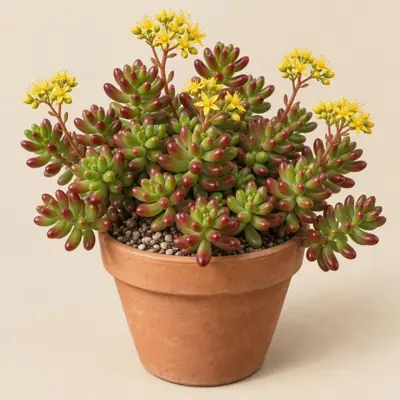
Sources differ on mature height, placing it at about 10–20 cm. The short, thick, bean-like leaves range from ovate to nearly cylindrical, are green to blue-green, can become red or copper-red under strong light, dry conditions, or seasonal change, and detach easily. The flowers are bright yellow and may have red tones, while some sources describe them as yellow to orange; sources differ on the flowering season, with mid-spring reported. It is generally reported to store water in its leaves.
Light
Sedum rubrotinctum grows in bright light to full sun and can also adapt to partial sun or more shaded conditions; ample light supports compact growth and leaf coloration, but a sudden move into intense summer sun can cause sunburn. It takes full sun.
Watering
Its water needs are low to moderate; it tolerates drought, should be watered after the growing medium dries, and should not remain wet for long periods or in poorly drained conditions.
Humidity and airflow
It is reported to prefer low humidity and need good airflow.
Temperature and dormancy
Sources differ on its USDA hardiness-zone classification. Sources are few and differ on the cold minimum, with about -4 °C reported. It tolerates brief light frost, while dormancy is reported to vary. Hot, humid conditions and intense summer sun can affect it, and partial shade in summer is recommended.
Growing medium and mounting
It is reported to adapt to various soils but requires good drainage, with poorly drained or persistently wet growing media to be avoided. It is prone to rot and needs a fast-draining mix.
Feeding
A balanced liquid fertilizer is reported to be suitable during spring and summer.
Propagation
It can be propagated from leaves; naturally fallen or removed leaves can root when placed on the soil surface, and stems touching the ground can also root and form new plants. Propagation methods include leaf cuttings, stem cuttings, division, and seed.
Common problems
Sedum species are generally reported to be susceptible to scale insects, aphids, and root mealybugs. General cultivation information for Sedum is reported not to identify especially serious major diseases. Overwatering can cause root rot, insufficient light can cause stretched growth, and leaves detach readily when touched but can then root and form new plants. It is sensitive to frost and freezing, while intense summer sun in hot regions can cause damage.
Identification
Distinctive features include short, thick, jelly-bean-like leaves that can change from green to bright red or copper-red, detach easily, and root on their own to produce new plants.
Sources
- Wikipedia (en): Sedum rubrotinctum — CC BY-SA 4.0 · link
- GBIF descriptions: DAISIE - Inventory of alien invasive species in Europe — per dataset · link
- Desert-Tropicals: Sedum rubrotinctum — © Philippe Faucon (desert-tropicals.com), facts only · link
- The Succulent Plant Page: Sedum (genus-level) — © R.J. Hodgkiss, facts only · link
- NHK みんなの趣味の園芸 植物図鑑: Sedum (genus-level) — © NHK出版, facts only · link
- LLIFLE (page for Sedum x rubrotinctum, names Sedum rubrotinctum) — CC BY-SA · link
- NC State Plant Toolbox: Sedum (genus-level) — copyright (facts only) · link
- Top Tropicals catalog: Sedum rubrotinctum — © Top Tropicals LLC (facts only) · link
- PUKUBOOK: Sedum rubrotinctum — CC BY-NC (facts only) · link
- Sedum rubrotinctum | Giromagi cactus and succulents for sale | Buy plants online (www.giromagi.com) — facts only (§12) · link