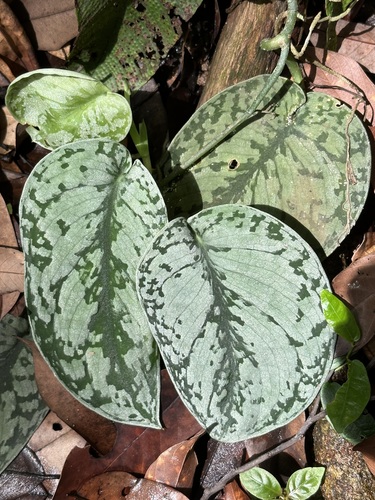
satin pothos (Scindapsus pictus)
Scindapsus pictus is an evergreen perennial climbing vine that can use aerial or attaching roots to climb supports or grow as a trailing plant.
Overview
Scindapsus pictus is an evergreen perennial climbing vine that can use aerial or attaching roots to climb supports or grow as a trailing plant.
Origin and habitat
Scindapsus pictus is native from South Asia to Southeast Asia, including Bangladesh, India, Thailand, the Malay Peninsula, Borneo, Java, Sumatra, Sulawesi, the Philippines, and Taiwan. In its native habitat, it uses attaching roots to climb tree trunks and grows along supports toward light beneath the forest canopy. It is a tropical plant suited to warm conditions and can also be grown outdoors as an ornamental plant in subtropical to tropical regions.
Characteristics
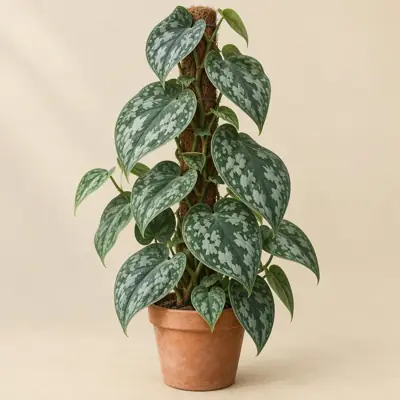
Sources differ on mature height, placing it at about 100–150 cm, while a single source reports a mature spread of about 50–100 cm. Sources differ on its growth rate, with it described as relatively slow-growing. Juvenile leaves are ovate with heart-shaped bases and entire margins, green to dark green with silver-gray markings above and a paler, unmarked underside; mature leaves may remain entire or become pinnately divided, while 'Exotica' has large, heart-shaped green leaves with extensive shimmering silver mottling that can enlarge markedly when suitably supported for climbing. The flowers are very small and inconspicuous, borne on a spadix enclosed by a spathe, and flowering is rare indoors or under ordinary cultivation; a single source reports that outdoor plants may produce inflorescences in summer, and another reports that small berries can follow flowering but fruiting is rare indoors.
Light
Sources differ in their descriptions, but Scindapsus pictus is suited to bright indirect light or bright filtered light, with hot direct sunlight avoided; outdoors, it can grow in partial shade.
Watering
During active growth, water moderately to keep the growing medium moist but well drained; reduce watering at other times and avoid prolonged waterlogging.
Temperature and dormancy
A single source reports a minimum temperature of about 15 °C, so sources are few. Sources differ on the ideal temperature, giving about 18–25 °C. A single source reports a hardiness range of about 11–12, so sources are few.
Growing medium and mounting
For containers, use a moist but well-drained growing medium; outdoors, fertile, moist, acidic, well-drained soil is suitable, while RHS also lists loamy or sandy soil and acidic, neutral, or alkaline conditions. Scindapsus pictus has aerial and soil roots.
Feeding
A single source recommends applying a balanced liquid fertilizer regularly during the growing period.
Propagation
Scindapsus pictus can be propagated by stem or tip cuttings; sources also mention vegetative propagation by root division.
Common problems
Scale insects, spider mites, mealybugs, and thrips may occur, although RHS assesses the plant as generally having few pest problems. Fungal leaf spot, gray mold, and root rot associated with poor drainage or excessive moisture may occur, although RHS assesses the plant as generally having few disease problems. A single source reports that yellowing leaves may be associated with overwatering, curled leaves with insufficient water, and root rot with an overly wet growing medium. It does not tolerate frost or low temperatures and is also unsuited to hot direct sunlight; outdoors, a more protected position is preferable.
Identification
'Exotica' is distinguished mainly by especially large leaves and conspicuous silver mottling and is a large-leaved form compared with other Scindapsus pictus cultivars.
Photos