
Fairy Fan-flower (Scaevola aemula)
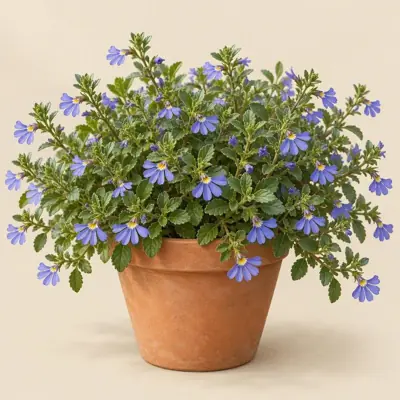
Scaevola aemula is a creeping to ascending herb that can form mats, with horizontally spreading, branching stems; sources describe its growth habit differently. It is a perennial herb and is often grown as an annual seasonal flowering plant in cold regions.
Overview
Scaevola aemula is a creeping to ascending herb that can form mats, with horizontally spreading, branching stems; sources describe its growth habit differently. It is a perennial herb and is often grown as an annual seasonal flowering plant in cold regions.
Origin and habitat
Scaevola aemula is native to Australia, with its more clearly documented distribution including Western Australia, South Australia, Victoria, New South Wales, and parts of Tasmania; sources differ on its native range. Its natural habitats are reported to include dry sclerophyll forest, dry scrub, and sandy coastal areas, commonly in dry, well-drained sandy soil and also in dry sand or loam. It is adapted to arid to semi-arid, hot and dry Australian environments, tolerates heat, periodic drought, and salt spray, and does not tolerate frost.
Characteristics
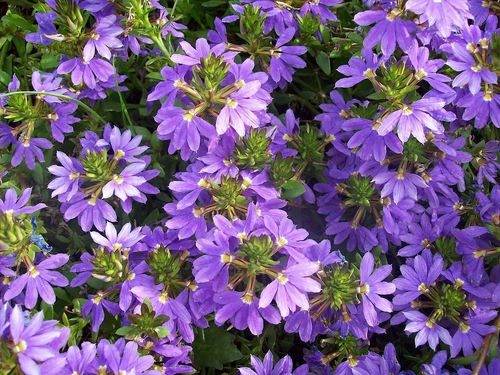
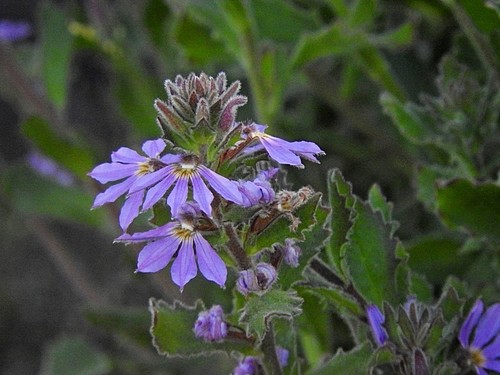
Mature height is reported at about 12–50 cm, but sources differ; mature spread is 60.96–100 cm. The leaves are reported to range from elliptic and ovate to obovate or spoon-shaped, narrowing at the base; upper leaves are smaller, the margins are usually toothed, the leaves can be nearly stalkless, and the stems and leaves may be hairy. The flowers are reported to be bilaterally asymmetrical, with the corolla lobes spreading to one side to form a fan shape; the wild type is mainly blue, blue-violet to white with a yellow center, while horticultural forms also include colors such as pink, and the inflorescences are spikes. Sources differ on flowering season, which varies with growing region; flowering can continue through the warm season until frost, while the fruit is reported to be a nearly round to ovoid, wrinkled, hairy drupe.
Light
Scaevola aemula can grow in full sun to partial sun; indoors it requires abundant bright light.
Watering
Sources differ on watering: regular watering is recommended during active growth, with one horticultural source recommending relatively ample water and not allowing it to dry out completely during overwintering, while other information notes that the plant can tolerate periods of drought.
Temperature and dormancy
A minimum temperature of about 5 °C is reported, although sources are few. Sources differ on the reported hardiness zone. It is generally reported to be frost tender; keep above freezing.
Growing medium and mounting
Well-drained soil is preferred; sandy soils are common in its native environment, and it can also grow in dry sand or loam.
Feeding
It is reported that a slow-release base fertilizer can be used, followed during active growth by diluted liquid fertilizer applied regularly.
Propagation
Scaevola aemula can be propagated from cuttings, and sources also record propagation by layering and from seed, with seed started indoors before the last frost.
Common problems
No serious pest problems are reported. No serious disease problems are reported. Overwintering outdoors is difficult in cold regions, and potting medium should not remain excessively wet for prolonged periods. The plant is sensitive to frost and low temperatures, so in cold regions it is suited to being moved indoors for winter or grown as an annual; it can also tolerate heat, drought, and salt spray.
Identification
A conspicuous identifying feature is the corolla lobes spreading to the same side to form a distinct fan-shaped flower; the plant also commonly has a creeping, spreading habit.
Photos


Sources
- Wikipedia (en): Scaevola aemula — CC BY-SA 4.0 · link
- Wikipedia (ja): ブルーファンフラワー — CC BY-SA 4.0 · link
- Wikipedia (de): Blaue Fächerblume — CC BY-SA 4.0 · link
- Wikipedia (fr): Scaevola aemula — CC BY-SA 4.0 · link
- Wikipedia (es): Scaevola aemula — CC BY-SA 4.0 · link
- GBIF descriptions: Manual of the Alien Plants of Belgium; Global Register of Introduced and Invasive Species - Belgium — per dataset · link
- NC State Plant Toolbox: Scaevola aemula — copyright (facts only) · link
- Wikipedia (pt): Scaevola aemula — CC BY-SA 4.0 · link
- TaiCOL 臺灣物種名錄: Scaevola aemula — CC BY 4.0 · link
- Top Tropicals catalog: Scaevola aemula — © Top Tropicals LLC (facts only) · link