
Bloodlily (Scadoxus multiflorus)
Scadoxus multiflorus is a perennial, bulbous, rhizomatous terrestrial herb whose sheathing leaf bases and petioles form a pseudostem, with the inflorescence borne at the tip of a leafless flowering stalk.
Overview
Scadoxus multiflorus is a perennial, bulbous, rhizomatous terrestrial herb whose sheathing leaf bases and petioles form a pseudostem, with the inflorescence borne at the tip of a leafless flowering stalk.
Origin and habitat
Sources differ on the native range, describing it broadly across sub-Saharan Africa from Senegal through tropical Africa to Somalia and south to South Africa, as well as in Saudi Arabia, Yemen and Oman on the Arabian Peninsula and in Seychelles. It is reported from diverse habitats including moist shaded places, forests near riverbanks, montane and secondary forests, forest margins, savanna and open grassland, and is often found in tree shade and near rivers. Its distribution is mainly associated with tropical through southern African climates and also extends to the Arabian Peninsula; cold tolerance varies with geographic origin, with tropical-origin plants generally requiring higher minimum temperatures.
Characteristics
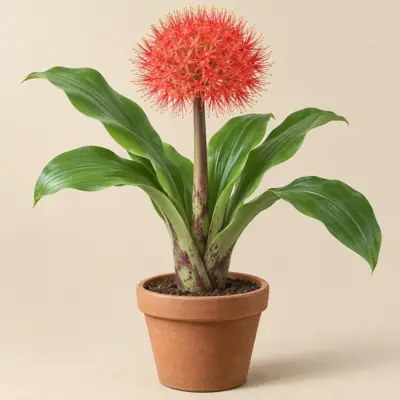
Few sources report a mature height of about 50–100 cm and a spread of about 10–50 cm. The bright green leaves are spirally arranged and range from lance-shaped to ovate; their sheathing bases and petioles form a pseudostem, and the leaves may appear with the flowers or unfold later. The terminal, nearly spherical umbels bear pinkish-red to bright red or scarlet flowers with narrow petal-like tepals and long, conspicuous stamens. Sources differ on flowering time, which is mainly from spring to summer and can vary among subspecies and growing conditions, with subsp. katharinae reported to flower in late summer; the small berries mature orange to orange-red.
Light
Grow in full sun to partial shade; under greenhouse cultivation it can receive ample light with shade during hot, intense light, while reducing light after the flower buds open can prolong flowering.
Watering
Maintain even moisture with good drainage during growth, watering generously then and keeping the medium only slightly moist during dormancy; reducing water from late summer is also recommended.
Temperature and dormancy
Sources differ on the minimum temperature, placing it at about 10 °C. It is reported to have an RHS hardiness rating of H1B.
Growing medium and mounting
Use a well-drained, organic-rich medium; recommendations include moderately moist, organic-rich, well-drained soil or a loam-based potting medium with leaf mould and grit, with acidic, neutral or alkaline pH.
Feeding
A diluted, balanced liquid fertilizer is generally applied monthly during the growing period.
Propagation
Propagation can be by seed, and offsets can also be separated in early spring; mature seed should be sown as soon as possible.
Common problems
Pest problems are generally limited, although slugs and snails should be watched for, and serious or common disease problems are generally absent. The roots dislike frequent disturbance, the growing medium needs good drainage, and outdoor bulbs in cold conditions are susceptible to low-temperature injury. It is cold-sensitive and not frost tolerant; plants from South Africa may tolerate lower minimum temperatures than those from tropical origins, which require warmer conditions.
Identification
Scadoxus multiflorus can be recognized by its rhizomatous bulb, pseudostem formed by the leaf bases, and large spherical red umbels; the pseudostem and flowering stalk are often spotted reddish-brown to deep purple, while long, projecting stamens give the inflorescence a fluffy, ball-like appearance.
Photos


Sources
- Wikipedia (en): Scadoxus multiflorus — CC BY-SA 4.0 · link
- Wikipedia (de): Scadoxus multiflorus — CC BY-SA 4.0 · link
- Wikipedia (fr): Scadoxus multiflorus — CC BY-SA 4.0 · link
- NC State Plant Toolbox: Scadoxus multiflorus — copyright (facts only) · link
- RHS Plants: Scadoxus multiflorus — © RHS, facts only · link