
summer savory (Satureja hortensis)
Satureja hortensis is an upright, densely branched, aromatic herb. Sources differ in describing its life cycle as annual.
Overview
Satureja hortensis is an upright, densely branched, aromatic herb. Sources differ in describing its life cycle as annual.
Origin and habitat
Sources differ on its native range, generally placing it from southern to southeastern Europe through the central and eastern Mediterranean, the Black Sea and Caucasus regions, and eastward into western and central Asia, including Kazakhstan and Xinjiang in China; some compilations also include North Africa. It commonly occurs on dry gravelly ground and rocky slopes, as well as in calcareous soils and as a garden escape; in cultivated settings it can be grown in herb gardens, borders, and containers. It is suited to temperate and subtropical climates and grows well under warm, dry, sunny conditions.
Characteristics
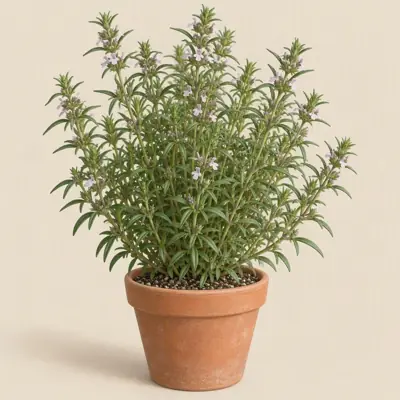
Sources differ on mature height, placing it at about 30–60 cm, while a single source reports a mature spread of about 10–50 cm. It grows rapidly and can be harvested relatively soon after sowing under suitable conditions. The aromatic, sessile leaves are narrowly linear to lanceolate, pointed and entire, usually dark green to bronze-green and sometimes tinged purple, with fine hairs, marginal hairs, and oil glands; the tubular, two-lipped flowers range from white and pale pink to pale purple and are borne in small whorls in the upper leaf axils. Sources differ on the flowering season in the Northern Hemisphere; the fruit is reported to split into dark-brown, round to ovoid, nutlet-like segments.
Light
Satureja hortensis prefers full sun and does not favor shaded conditions.
Watering
In cultivation, provide moderate moisture while maintaining well-drained soil; prolonged wetness or waterlogging is not tolerated.
Growing medium and mounting
It prefers fertile, light, well-drained soil and can grow in loamy, sandy, or chalky soils; neutral to alkaline conditions are preferred, though its adaptability is not narrow.
Propagation
Propagation is by seed, usually sown in spring; germination under suitable temperature conditions is reported to take a relatively short period.
Common problems
Significant pest problems are generally uncommon, and sources also report little damage from deer and describe companion planting as repelling aphids or other insect pests. Significant disease problems are generally uncommon. Prolonged moisture, poor drainage, and shade can hinder growth. It is generally reported to prefer hot, dry, sunny conditions and not to tolerate persistently wet soil.
Identification
Satureja hortensis is an aromatic annual herb with upright, four-angled, freely branching stems, narrow aromatic leaves, and white to pale-purple two-lipped flowers; compared with perennial winter savory, its flavor is less bitter and milder.
Photos


Sources
- Wikipedia (en): Summer savory — CC BY-SA 4.0 · link
- 維基百科:夏香薄荷 — CC BY-SA 4.0 · link
- Wikipedia (de): Sommer-Bohnenkraut — CC BY-SA 4.0 · link
- Wikipedia (fr): Satureja hortensis — CC BY-SA 4.0 · link
- Wikipedia (es): Satureja hortensis — CC BY-SA 4.0 · link
- GBIF descriptions: Manual of the Alien Plants of Belgium; Database of Vascular Plants of Canada (VASCAN); Checklist of — per dataset · link
- NC State Plant Toolbox: Satureja hortensis — copyright (facts only) · link
- Useful Tropical/Temperate Plants: Satureja hortensis — CC BY-NC-SA 3.0 (facts only) · link
- RHS Plants: Satureja hortensis — © RHS, facts only · link
- USDA PLANTS Database: Satureja hortensis — Public domain (US Government work) · link