
crimson pitcherplant (Sarracenia leucophylla)
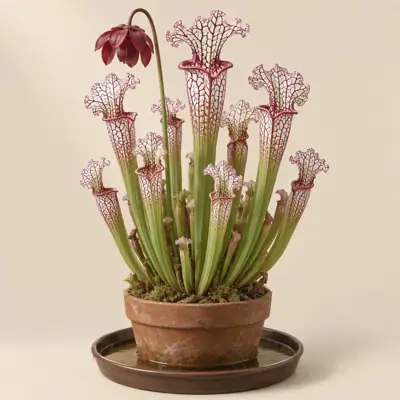
Sarracenia leucophylla is a perennial carnivorous herb with an underground rhizome, basal leaves that form upright tubular pitchers, and a clumping habit.
Overview
Sarracenia leucophylla is a perennial carnivorous herb with an underground rhizome, basal leaves that form upright tubular pitchers, and a clumping habit.
Origin and habitat
Sources differ on its native range: it is native to the Gulf Coast of the southeastern United States, with its core native range including southwestern or southern Georgia, the Florida Panhandle, southern Alabama, and southeastern Mississippi, while the population in North Carolina is regarded as introduced by people and naturalized. It is reported to grow mainly in wet, nutrient-poor, open habitats along the U.S. Gulf Coast, including longleaf pine savannas, wetlands, and boggy environments, with some information indicating that sandy peat soils are common.
Characteristics
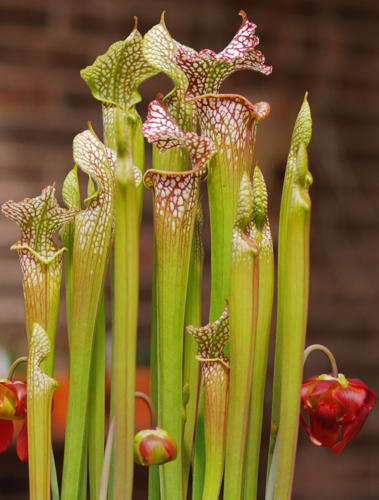
Sources differ on mature height, placing it at about 50–100 cm, while limited source information reports a mature spread of about 50–100 cm. Sources differ in their descriptions of the leaves: the upright leaves are modified into hollow tubular pitchers that broaden toward the top, typically with a white upper portion and lid marked by red, purple, or green veins forming a conspicuous network; the lid is broad with a wavy edge, and flat, non-carnivorous, sword-shaped leaves or leaf-like structures may form in summer. The nodding flowers are reported to be mainly scarlet, dark red, or chestnut-brown, with rounded petal tips and an umbrella-shaped pistil, and flower color may vary among cultivated forms; flowering occurs in spring. The fruit is reported to be a capsule characterized by splitting open from the back.
Light
Sarracenia leucophylla needs full sun and prefers abundant sunlight during the growing season; partial sun may reduce leaf coloration and cause pitchers to droop, while RHS advises avoiding excessively hot direct sunlight in greenhouse cultivation.
Watering
Keep the growing medium wet and do not allow it to dry completely; rainwater or distilled water can be used, and dissolved salt buildup should be avoided. Low-mineral water is fine. Tray (bottom) watering is reported to be suitable. Sources differ on tolerance of standing water and drainage conditions.
Humidity and airflow
Sarracenia leucophylla needs good airflow.
Temperature and dormancy
Limited source information reports a minimum temperature of about -20 °C. It is reported for a cold-hardiness zone, with the source also stating that outdoor cultivation in colder areas can be possible with appropriate winter protection. Sarracenia leucophylla requires cold winter dormancy.
Growing medium and mounting
An acidic to neutral, low-nutrient growing medium that retains moisture is suitable; RHS lists loam and sand, while NC State recommends container mixes based on peat with sand or peat with perlite. Sources differ in their recommendations for the degree of drainage.
Feeding
Fertilizer is generally unnecessary, and ordinary commercial potting media and fertilizers may harm the plant. It is reported to grow without needing to be fed insects.
Propagation
Sarracenia leucophylla can be propagated from seed or by rhizome division; rhizome division is easier in practice, and seeds can receive cold stratification before germination.
Common problems
It is reported to be susceptible to scale insects, mealybugs, aphids, and leaf-roller moths, while RHS reports that it generally has no notable disease problems. Insufficient light may cause poor pitcher coloration and drooping, while ordinary fertilizer, commercial potting media, or water high in dissolved salts may harm the plant; some sources also warn that inadequate drainage and prolonged standing water may cause root rot. Outdoor cultivation in cold areas may require winter protection; RHS recommends shelter from cold winds and avoiding excessively hot direct sunlight in greenhouse cultivation.
Identification
It is reported to be most readily distinguished by tall, upright tubular pitchers with white upper portions, red, purple, or green netted veins, and broad lids with wavy edges; pitchers can grow in spring and again from late summer into early autumn, with the autumn pitchers usually being more robust.
Photos



Sources
- Wikipedia (en): Sarracenia leucophylla — CC BY-SA 4.0 · link
- 維基百科:白瓶子草 — CC BY-SA 4.0 · link
- Wikipedia (ja): アミメヘイシソウ — CC BY-SA 4.0 · link
- Wikipedia (de): Weiße Schlauchpflanze — CC BY-SA 4.0 · link
- Wikipedia (fr): Sarracenia leucophylla — CC BY-SA 4.0 · link
- Wikipedia (es): Sarracenia leucophylla — CC BY-SA 4.0 · link
- NC State Plant Toolbox: Sarracenia leucophylla — copyright (facts only) · link
- RHS Plants: Sarracenia leucophylla — © RHS, facts only · link
- USDA PLANTS Database: Sarracenia leucophylla — Public domain (US Government work) · link
- Tom's Carnivores: Sarracenia (genus-level) — © Tom's Carnivores, facts only · link
- NHK みんなの趣味の園芸 植物図鑑: Sarracenia leucophylla — © NHK出版, facts only · link