
American pitcher plants (Sarracenia hybrid)
Sarracenia is reported to be a perennial, clump-forming, rosette-growing herbaceous carnivorous plant with underground rhizomes.
Overview
Sarracenia is reported to be a perennial, clump-forming, rosette-growing herbaceous carnivorous plant with underground rhizomes.
Origin and habitat
Sarracenia is reported to be native to North America, occurring mainly in the eastern and southeastern United States and extending to Texas, the Great Lakes region, and southeastern Canada, with most species concentrated in the southeastern United States. It is generally found in sunny, open, nutrient-poor wetlands, bogs, or acidic wetland environments. Its native habitat can have hot summers, while winter brings a distinct period of cold dormancy with temperatures that can fall below freezing.
Characteristics
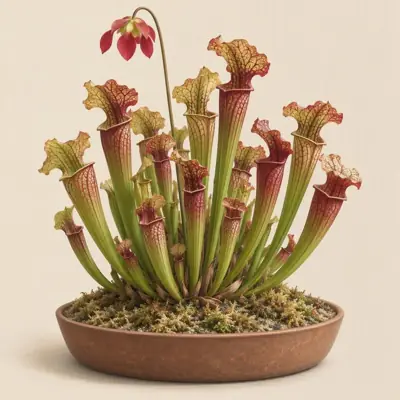
Sources differ on mature height, placing it at about 15–80 cm. The leaves are reported to form upright or nearly upright hollow tubular traps, usually with a hood-like structure and a nectar-secreting lip at the opening; depending on the species, they may be red, purple, white, green, yellow, copper-colored, or multicolored, and some species also form entire, lance-shaped phyllodes used mainly for photosynthesis. Flowers are reported to be solitary on long stalks, usually rising above the traps, with sepals, petals, numerous stamens, and an umbrella-like lobed style that gives the flower the appearance of an inverted umbrella; they may be red, pink, yellow, or green and are pollinated mainly by bees. Flowering is reported in spring, usually as or slightly before the first traps appear; after pollination, capsules form, turn brown when mature, and split to release seeds, while sources differ regarding improved germination after cold stratification.
Light
Sarracenia generally does best in full sun with abundant direct sunlight and good ventilation throughout the year, although some species can accept afternoon shade.
Watering
Sources differ on watering details, but describe keeping the growing medium moist during active growth, using tray (bottom) watering, and reducing water during winter dormancy so the medium is slightly drier while remaining somewhat moist. For potted plants, sources differ on water guidance, while specialist guidance generally calls for pure water only (rain, RO or distilled) to avoid accumulation of dissolved mineral salts.
Humidity and airflow
Sarracenia is reported to need good airflow.
Temperature and dormancy
Sarracenia is reported to be frost hardy and generally requires cold winter dormancy.
Growing medium and mounting
A low-fertility, acidic medium that remains moist is generally recommended, such as sphagnum moss or peat with lime-free horticultural sand or perlite. Peat with perlite is also reported as a substrate type.
Feeding
Specialist guidance generally advises against fertilizing because Sarracenia does not favor fertilizer and high mineral salts or fertilizer may harm the plant; artificially feeding insects is also described as unnecessary. It is reported to usually catch enough food by itself outdoors, while dried insects may be fed periodically indoors.
Propagation
Sarracenia is reported to be propagated by division or seed, with division and sowing carried out at suitable times and moist seed given cold treatment before spring sowing to promote more even germination.
Common problems
Reported pests include aphids, spider mites, scale insects, mealybugs, and moth larvae; poor airflow may favor aphids, while hot, dry conditions may increase spider-mite problems. Reported diseases include viral disease, leaf spot, and root rot, with viral disease potentially causing distorted new leaves that fail to form normally. Insufficient light is generally reported to weaken plants and reduce coloration, while mineral-rich water may cause salt accumulation and declining plant health, and improper water management may also cause growth problems. Some tall species are reported to be vulnerable to strong winds; Sarracenia has some cold tolerance and can withstand slight freezing of the growing medium in winter, while its native habitat can experience temperatures below freezing.
Identification
The most conspicuous feature is generally the hollow pitcher- or trumpet-shaped trap formed by the leaf; color, scent, and nectar attract prey, while waxy slippery surfaces, downward-growing hairs, and digestive fluid hinder escape and allow nutrients to be absorbed.