
floating watermoss (Salvinia natans)
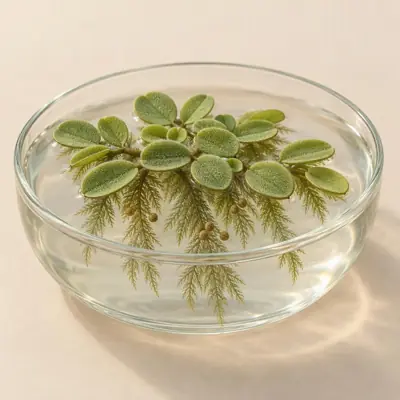
Salvinia natans is reported to be a free-floating aquatic fern that is not anchored in bottom soil, with floating leaves at the water surface and a finely divided submerged leaf that resembles roots. Sources differ on its life cycle: it is mainly annual but may be perennial in warmer regions.
Overview
Salvinia natans is reported to be a free-floating aquatic fern that is not anchored in bottom soil, with floating leaves at the water surface and a finely divided submerged leaf that resembles roots. Sources differ on its life cycle: it is mainly annual but may be perennial in warmer regions.
Origin and habitat
Its native range extends across Europe, Asia, and North Africa, including China, Taiwan, Japan, Korea, India, parts of West, Central, and Southeast Asia, countries in Central, Eastern, and Southern Europe, and Algeria, Egypt, Libya, Morocco, and Tunisia; Taiwan lists it as native. Sources differ in their habitat descriptions, which include still or slow-moving fresh water such as ponds, rice fields, and freshwater marsh wetlands, with well-lit, nutrient-rich waters having little or no current described as preferred. It is reported to occur across different climatic regions of Europe, Asia, and North Africa; in warmer regions it may persist as a perennial, while in colder regions plants may die in winter and overwinter by spores.
Characteristics
The mature spread is reported from the few available sources to be about 3–20 cm. It is reported to grow rapidly and form dense floating mats, and stem fragments can develop into new plants. Its leaves are reported to occur in whorls and differ in form, with oval to oblong floating leaves at the water surface and a slender, highly divided submerged leaf resembling roots; the floating leaves have water-repellent hairs or papillae, and internal air spaces aid buoyancy.
Light
Salvinia natans is reported to suit well-lit water surfaces with ample sunlight exposure.
Watering
It is reported to suit still or slow-moving fresh water, floating freely at the surface in settings with stable water levels such as ponds, rice fields, marshes, or large aquatic environments.
Propagation
Sources differ on propagation details: Salvinia natans can reproduce by spores and asexually when branched stems break apart, while sporocarps form megasporangia and microsporangia.
Common problems
Under suitable conditions, it is reported to spread rapidly across pond, reservoir, or lake surfaces, blocking light below the water and suppressing other photosynthetic organisms or aquatic plants. Annual populations are reported to die back in winter, and their growing environment is also associated with ample sunlight and humid air.
Identification
Sources differ in their descriptions, but report that Salvinia natans lacks true roots and has a finely divided submerged leaf that resembles roots and performs a similar absorptive function; its floating leaves have water-repellent surfaces, and the plant floats freely.
Photos


Sources
- Wikipedia (en): Salvinia natans — CC BY-SA 4.0 · link
- 維基百科:槐叶蘋 — CC BY-SA 4.0 · link
- Wikipedia (ja): サンショウモ — CC BY-SA 4.0 · link
- Wikipedia (de): Gemeiner Schwimmfarn — CC BY-SA 4.0 · link
- Wikipedia (fr): Salvinia natans — CC BY-SA 4.0 · link
- GBIF descriptions: Manual of the Alien Plants of Belgium; DAISIE - Inventory of alien invasive species in Europe; Globa — per dataset · link
- TaiCOL 臺灣物種名錄: Salvinia natans — CC BY 4.0 · link
- USDA PLANTS Database: Salvinia natans — Public domain (US Government work) · link