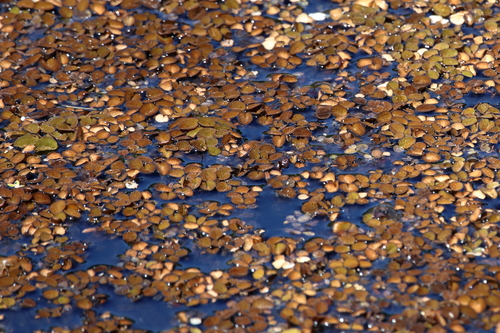
water spangles (Salvinia minima)
Salvinia minima is an aquatic herbaceous fern that floats on the water surface. It is reported to be annual or perennial.
Overview
Salvinia minima is an aquatic herbaceous fern that floats on the water surface. It is reported to be annual or perennial.
Origin and habitat
Salvinia minima is native to the Neotropics, with sources covering South America, the Amazon region, Central America, the West Indies, and a distribution extending south to Argentina. Sources describe its habitat differently: it primarily grows on the surface of still or slow-moving waters, including lakes, ponds, canals, swamps, and wetlands, while some sources also report it in low-salinity brackish water.
Characteristics
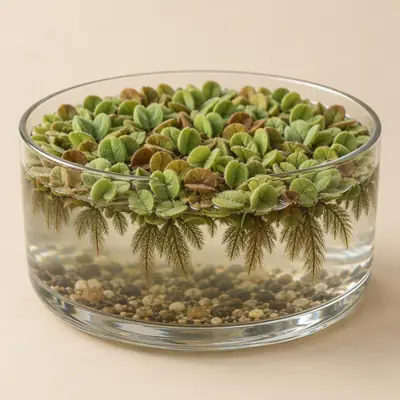
It is reported to grow rapidly, with continued vegetative reproduction allowing exponential growth and the formation of dense floating mats. Its floating leaves are reported to be small and oval; each group has floating leaves and a finely divided submerged leaf that forms a root-like structure. The leaf surface is reported to bear fine, evenly distributed white hairs arranged in groups with tips that do not touch, while the underside bears longer brown hairs. Leaf color is reported to range from bright green to brown, with leaves often turning brown as they age or after sun exposure.
Watering
Salvinia minima grows in an aquatic environment on the surface of still or slow-moving water.
Propagation
It is reported to reproduce mainly vegetatively; rhizome fragments with buds or broken rhizomes can form new plants, and fragmentation can continue to occur.
Common problems
The Salvinia weevil Cyrtobagous salviniae and larvae of the moth Samea multiplicalis are reported to feed on Salvinia minima and have been studied as biological control agents. In introduced areas, it is reported to rapidly form extensive dense floating mats that displace native aquatic plants and block light below the water surface, reducing submerged plant growth and dissolved oxygen and, in severe cases, potentially causing fish deaths. It may also hinder small boats and water-based production activities.
Identification
Salvinia minima is reported to lack true roots, with its finely divided submerged leaf serving a root-like function. The white hairs on the floating leaf surface are reported to occur in groups with tips that do not touch and to help shed water.
Photos