
scarlet sage (Salvia splendens)
Salvia splendens is an upright herb; the wild form can be somewhat shrubby and often branches, while cultivated forms are commonly compact and upright. It is inherently perennial but does not tolerate frost; sources differ, and it is commonly grown as an annual flowering plant in temperate and colder regions.
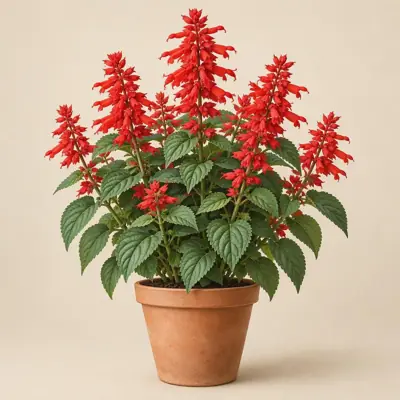
Overview
Salvia splendens is an upright herb; the wild form can be somewhat shrubby and often branches, while cultivated forms are commonly compact and upright. It is inherently perennial but does not tolerate frost; sources differ, and it is commonly grown as an annual flowering plant in temperate and colder regions.
Origin and habitat
Salvia splendens is native to Brazil, with some sources placing its native range more specifically in southeastern Brazil or the state of Rio de Janeiro. Sources differ in describing the elevation of its native habitat, but place it in high-elevation areas of Brazil. It is associated with warm subtropical conditions and does not tolerate freezing; accounts of its native habitat describe year-round warmth and high humidity.
Characteristics
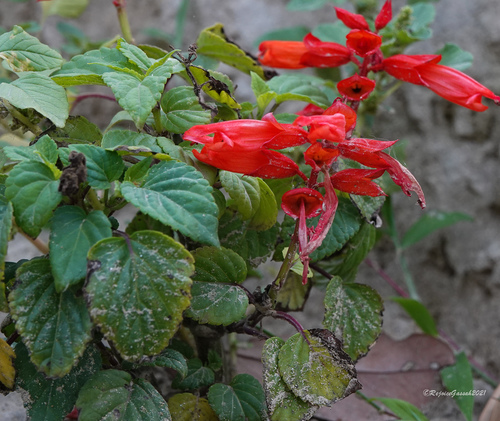
Sources are few and differ on mature size, reporting a height of about 30–100 cm, while few sources report a spread of about 10–50 cm. It is reported to grow vigorously, continually producing axillary shoots and flowers. The leaves are opposite and long-petioled, with ovate to heart-shaped or elliptic blades, serrated margins, and usually pointed tips; upright terminal inflorescences bear tubular, bell-shaped to two-lipped flowers, typically bright red to scarlet with calyces and corollas often matching in color, while cultivated forms also occur in white, pink, purple, orange, and dark purple, and the flowers may be arranged in clustered whorls. Sources differ on flowering season, but describe a long flowering period centered on summer and autumn that, depending on climate and growing region, may extend from spring through autumn or until frost.
Light
Salvia splendens grows in full sun to partial sun; ample sunlight is generally preferred, with some shade suitable during hot summers.
Watering
Maintain moderate moisture with good drainage, watering thoroughly when the soil begins to dry while avoiding prolonged waterlogging; the plant does not tolerate drought well and can weaken readily from lack of water in summer.
Humidity and airflow
Salvia splendens is reported to prefer high humidity.
Temperature and dormancy
Few sources report a minimum temperature of about 5 °C and a maximum of about 30 °C. Sources differ on the reported hardiness zone. Salvia splendens is generally frost tender; keep above freezing.
Growing medium and mounting
Salvia splendens prefers well-drained, humus-rich, fertile soil; loam or sandy soil can be suitable, it tolerates a broad range of soil acidity and alkalinity, and near-neutral soil is described as ideal.
Feeding
It is reported to need regular feeding during growth and prolonged flowering, using slow-release or liquid fertilizer, with higher phosphorus content described as beneficial for flowering.
Propagation
Salvia splendens can be propagated from seed or stem cuttings; its seeds respond positively to light and should be covered only very lightly, while cuttings can be rooted in spring and summer.
Common problems
Potential pests include slugs, aphids, moth larvae, spider mites, and whiteflies, with slugs particularly noted under humid conditions. Disease reports are generally limited, but waterlogging may lead to root rot, and southern bacterial wilt and southern blight have also been recorded. Cold conditions may cause leaf yellowing or prevent overwintering, while high heat may produce smaller flowers and leaves or reduced flowering; summer water shortage can rapidly weaken plants and wither lower leaves, whereas waterlogging carries a risk of root rot. The plant is sensitive to frost, freezing, and cold; high heat may reduce flowering performance, and some shade can be provided in hot regions.
Identification
Bright tubular flowers and matching calyces are densely arranged in upright inflorescences; after the corollas fade, the persistent calyces can retain their color, providing an important ornamental feature.
Photos


Sources
- GBIF Backbone: Salvia splendens Sellow ex Nees — CC BY 4.0 · link
- Wikipedia (en): Salvia splendens — CC BY-SA 4.0 · link
- 維基百科:一串红 — CC BY-SA 4.0 · link
- Wikipedia (ja): サルビア — CC BY-SA 4.0 · link
- Wikipedia (de): Feuersalbei — CC BY-SA 4.0 · link
- Wikipedia (fr): Salvia splendens — CC BY-SA 4.0 · link
- Wikipedia (es): Salvia splendens — CC BY-SA 4.0 · link
- GBIF descriptions: The checklist of alien seed plants of D.R. Congo, based on evidence from herbarium collections; Chec — per dataset · link
- NC State Plant Toolbox: Salvia splendens — copyright (facts only) · link
- Wikipedia (it): Salvia splendens — CC BY-SA 4.0 · link
- Wikipedia (ko): 깨꽃 — CC BY-SA 4.0 · link
- TaiCOL 臺灣物種名錄: Salvia splendens — CC BY 4.0 · link
- 農業知識入口網 植物圖鑑: Salvia splendens — © MOA, facts only · link
- RHS Plants: Salvia splendens — © RHS, facts only · link