
Chinese rose (Rosa chinensis)
Rosa chinensis is a perennial woody shrub with an upright to rounded habit, and its branches may bear prickles. Sources differ on whether it is evergreen or deciduous.
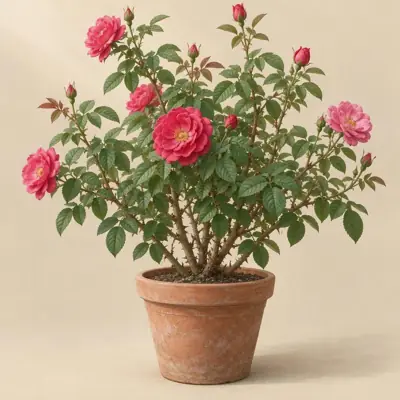
Overview
Rosa chinensis is a perennial woody shrub with an upright to rounded habit, and its branches may bear prickles. Sources differ on whether it is evergreen or deciduous.
Origin and habitat
Sources differ in describing its native range, which extends from central to southwestern China and includes Guizhou, Hubei, and Sichuan. It can grow in hedges and form thickets, and it is also widespread in cultivated settings. Its native range is classified as temperate Asia, and a fully dormant plant can briefly tolerate temperatures well below freezing.
Characteristics
Sources differ, but mature height is reported at about 100–200 cm; a single source reports a mature spread of about 183–244 cm. The pinnately compound leaves generally have several leaflets, which are commonly ovate to ovate-oblong with sharply serrated margins and may have glossy dark-green upper surfaces. Sources differ in describing the flowers: they are generally pink to red, with cultivated forms also occurring in white and purplish red; wild forms generally have a simple petal arrangement, while cultivated forms range from semi-double to double, and the flowers may be mildly fragrant and are usually clustered but sometimes solitary. It is reported to have a long flowering period with repeat or nearly continuous flowering; the hips are reported to become red when mature and to be ovate to pear-shaped.
Light
Rosa chinensis grows in full sun to partial sun, and ample sunlight favors growth and flowering.
Watering
Moderate watering is suitable, with soil kept moist but well drained; watering at the base and avoiding overhead watering are preferred.
Temperature and dormancy
A single source reports a minimum temperature of about -15 °C, so sources are few.
Growing medium and mounting
Rosa chinensis prefers moist, well-drained loam with a neutral to near-neutral soil reaction, while it can adapt to various soil textures when drainage is good.
Propagation
Rosa chinensis is reported to be propagated by grafting or stem cuttings.
Common problems
Rosa chinensis is reported to be susceptible to insect pests common to roses, with Japanese beetle damage specifically noted. Poor air circulation or overhead watering may increase the risk of foliar disease, and plants in this genus are also recorded as susceptible to diseases associated with Armillaria. Cold tolerance is limited, and a fully dormant plant is reported to withstand temperatures well below freezing only briefly.
Identification
Rosa chinensis is reported to be an upright shrub with pinnately compound leaves bearing several leaflets, while its branches may have stout curved prickles or be nearly unarmed. Wild forms are reported to have simple pink to red flowers, while cultivated forms vary widely in flower color and doubleness and are known for a long flowering period and repeat flowering.
Photos


Sources
- Wikipedia (en): Rosa chinensis — CC BY-SA 4.0 · link
- 維基百科:月季 (物种) — CC BY-SA 4.0 · link
- Wikipedia (ja): ロサ・キネンシス — CC BY-SA 4.0 · link
- Wikipedia (de): Rosa chinensis — CC BY-SA 4.0 · link
- Wikipedia (fr): Rosa chinensis — CC BY-SA 4.0 · link
- Wikipedia (es): Rosa chinensis — CC BY-SA 4.0 · link
- GBIF descriptions: Manual of the Alien Plants of Belgium; Catálogo de Plantas y Líquenes de Colombia; DAISIE - Inventor — per dataset · link
- NC State Plant Toolbox: Rosa chinensis — copyright (facts only) · link
- Useful Tropical/Temperate Plants: Rosa chinensis — CC BY-NC-SA 3.0 (facts only) · link
- USDA PLANTS Database: Rosa chinensis — Public domain (US Government work) · link