
Formosa Azalea (Rhododendron simsii)
Rhododendron simsii is a woody shrub with a many-branched, spreading habit. Sources differ on its foliage habit, describing it as evergreen or semi-evergreen, with some also reporting deciduous forms.
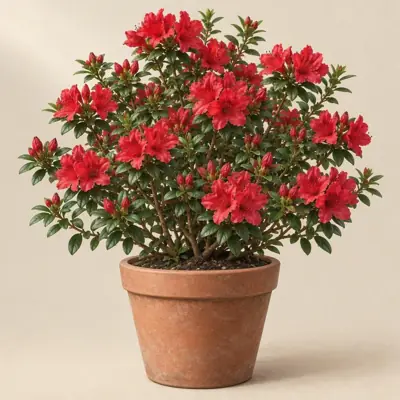
Overview
Rhododendron simsii is a woody shrub with a many-branched, spreading habit. Sources differ on its foliage habit, describing it as evergreen or semi-evergreen, with some also reporting deciduous forms.
Origin and habitat
Sources differ on details of the native range, but place Rhododendron simsii from East Asia to Southeast Asia, with shared support for China and Thailand and additional records from Taiwan, Hong Kong, Vietnam, Myanmar, Laos, Japan's southwestern islands, and Tibet; TaiCOL lists it as native but not endemic to Taiwan. Sources differ in their habitat descriptions, which include montane open scrub, beneath pine forests, forest edges, and rocky ground, extending from lowlands into mountains and favoring acidic soils. Its native distribution spans East and Southeast Asia, with wild records across a broad elevational range, while horticultural information describes it as relatively cold-sensitive among rhododendrons.
Characteristics
Sources differ, with few independent sources indicating a mature height of about 150–250 cm. A single source reports a mature spread of about 150–250 cm, so sources are few. The alternate leaves are reported to range from ovate and ovate-elliptic to obovate and oblanceolate, sometimes with a hairy surface; spring leaves are larger and may be shed in winter, while summer leaves are thicker and can persist through winter. The funnel-shaped flowers are commonly borne at branch tips, in pairs or clusters, and range from white and pink through scarlet, carmine, and deep red, with reddish-purple also reported; flowering is mainly in spring, although sources differ on its timing, and the fruit is reported to be an ovoid capsule densely covered with coarse hairs.
Light
Rhododendron simsii suits partial sun to partial shade, including semi-shaded or dappled-light conditions; a Japanese source additionally indicates that the growing position needs substantial daily sunlight.
Watering
Keep the growing medium moist but well drained; water regularly while allowing it to dry moderately between waterings, and avoid waterlogging and overwatering.
Temperature and dormancy
Rhododendron simsii is frost tender; keep above freezing. A single source reports an RHS hardiness rating.
Growing medium and mounting
Rhododendron simsii prefers well-drained, humus-rich acidic soil or an acidic growing medium for rhododendrons; clay, loam, and sand are all listed as suitable soil textures.
Feeding
A Japanese source recommends applying organic fertilizer several times a year, while avoiding feeding just before flowering because it may affect flower formation.
Propagation
Rhododendron simsii can be propagated from seed, by cuttings, or by grafting; semi-ripe cuttings in late summer or grafting in winter are also recommended.
Common problems
It is reported to be susceptible to vine weevils, rhododendron whiteflies, rhododendron leafhoppers, lace bugs, scale insects, caterpillars, and aphids. Poor drainage or overwatering can cause root rot, and calcareous or alkaline growing media are unsuitable. It is relatively cold-sensitive; outdoor cultivation in frost-free areas is recommended, while elsewhere greenhouse or container cultivation allowing winter movement indoors is advised, along with a sheltered position.
Identification
Rhododendron simsii can be recognized by its many-branched shoots, relatively small hairy leaves, and funnel-shaped flowers borne at branch tips and predominantly in shades of red. Its spring and summer leaves can differ in form, with the summer leaves thicker and able to persist through winter.
Photos


Sources
- Wikipedia (en): Rhododendron simsii — CC BY-SA 4.0 · link
- 維基百科:映山红 — CC BY-SA 4.0 · link
- Wikipedia (ja): タイワンヤマツツジ — CC BY-SA 4.0 · link
- GBIF descriptions: Lista de especies de plantas exóticas y trasplantadas de Colombia; Catálogo de Plantas y Líquenes de — per dataset · link
- Wikipedia (it): Rhododendron simsii — CC BY-SA 4.0 · link
- TaiCOL 臺灣物種名錄: Rhododendron simsii — CC BY 4.0 · link
- RHS Plants: Rhododendron simsii — © RHS, facts only · link
- NC State Plant Toolbox: Rhododendron (genus-level) — copyright (facts only) · link