
Rice cactus (Rhipsalis cereuscula)
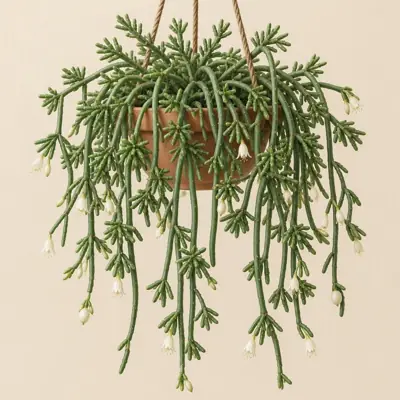
Rhipsalis cereuscula is an epiphytic, succulent cactus with a shrubby to clumping habit, profuse branching, and branches that eventually hang down; it can also grow on rocks. It is reported to be perennial.
Overview
Rhipsalis cereuscula is an epiphytic, succulent cactus with a shrubby to clumping habit, profuse branching, and branches that eventually hang down; it can also grow on rocks. It is reported to be perennial.
Origin and habitat
Sources differ on its native range, describing northeastern, eastern, and south-central Brazil, as well as Bolivia, Paraguay, Uruguay, and northern Argentina. It grows mainly as an epiphyte on tree trunks but can also grow on rocks, in tropical moist forests from lowlands to lower mountain areas, including vegetation associated with Brazil's Atlantic Forest. It is reported from tropical moist forest environments spanning lowland to submontane elevations.
Characteristics
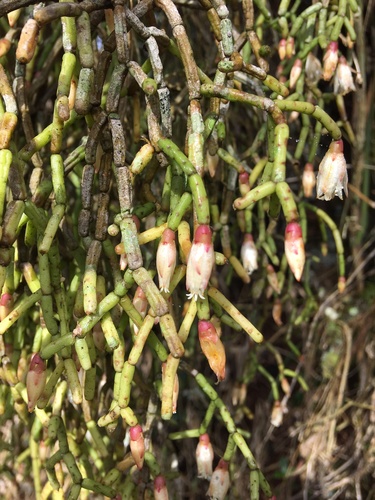
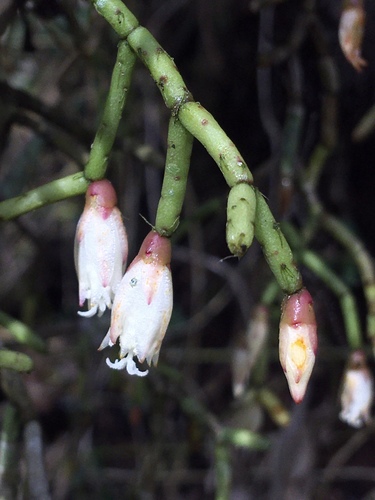
Flowers are borne at or near branch tips and are bell-shaped, white to cream-white, sometimes with a pale pink tint. Sources differ on the flowering period, describing it as winter to spring. Sources differ in descriptions of the fruit: it is a spherical to obovoid berry, usually white, with records of red fruit outside Brazil; the seeds are black. Mature height ranges from 0–60 cm.
Light
Rhipsalis cereuscula generally suits bright conditions to bright part shade; strong direct summer sun should be avoided, spring and autumn placement can be in ventilated partial shade, and filtered light through a curtain is suitable indoors. It tolerates bright light or part shade.
Watering
It is generally watered thoroughly after the growing medium dries in spring and autumn, with less water in summer and winter; standing water should be avoided, and the medium should drain well because prolonged wetness can cause rot.
Humidity and airflow
It is reported to need moderate airflow.
Temperature and dormancy
The stated minimum temperature is 5 °C. It is reported for USDA Zone conditions and is generally frost tender; keep above freezing. It rests cool in winter with a little water and is not frost tolerant.
Growing medium and mounting
As an epiphytic plant, it needs a fast-draining mix. A well-drained cactus or succulent medium is generally used; one described formulation combines fine akadama, pumice, perlite, and peat, with peat reduced or omitted where the medium tends to stay wet or watering is heavier, while a source concerning another species recommends a medium rich in mineral components such as coarse sand, pumice, or perlite.
Feeding
General Rhipsalis cultivation guidance reports feeding in spring and autumn with a compound or liquid fertilizer having roughly equal proportions of the main nutrients, following the product's specified amount.
Propagation
It can be propagated from stem cuttings, with general Rhipsalis guidance recommending that cut branch sections be allowed to dry before planting and then kept in bright shade under relatively dry conditions until they root. Division can also be done when repotting.
Common problems
Scale insects are reported to occur from spring through autumn when branches are crowded and airflow is poor. General information is reported not to identify any conspicuous common diseases. Strong sunlight can cause sunburn, while standing water in the medium, excessive watering, or an overly large or deep container can increase the risk of root rot; dense branching can reduce airflow. It does not tolerate severe frost, and strong direct summer sun should be avoided; winter cultivation guidance recommends keeping it above a minimum temperature.
Identification
Rhipsalis cereuscula has numerous small cylindrical terminal branch segments; its elongated branches are slender and end in clusters of short branches. The terminal short branches are usually club-shaped to slightly sausage-shaped, with subtle angles, and the areoles can bear short, transparent hairs that readily fall off.
Photos


Sources
- GBIF Backbone: Rhipsalis cereuscula Haw. — CC BY 4.0 · link
- Wikipedia (de): Rhipsalis cereuscula — CC BY-SA 4.0 · link
- Wikipedia (es): Rhipsalis cereuscula — CC BY-SA 4.0 · link
- GBIF descriptions: Checklist of vascular plants of the Ñeembucú Department, Paraguay — per dataset · link
- LLIFLE Encyclopedia of living forms: Rhipsalis cereuscula — CC BY-SA · link
- NHK みんなの趣味の園芸 植物図鑑: Rhipsalis (genus-level) — © NHK出版, facts only · link
- PUKUBOOK: Rhipsalis cereuscula — CC BY-NC (facts only) · link
- Rhipsalis Cereuscula - Coral Cactus | MCG™ (mountaincrestgardens.com) — facts only (§12) · link