
mistletoe cactus (Rhipsalis baccifera)
Sources differ in describing Rhipsalis baccifera as an epiphytic or rock-growing perennial succulent cactus with slender, trailing stems that can form large hanging clumps. It is a perennial with an epiphytic growth form.
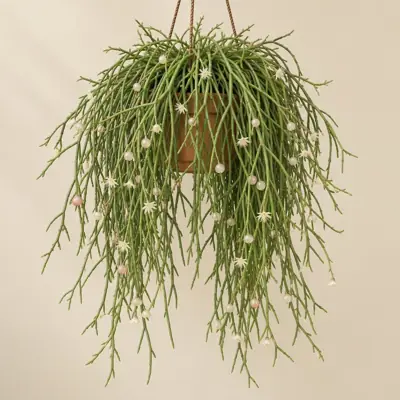
Overview
Sources differ in describing Rhipsalis baccifera as an epiphytic or rock-growing perennial succulent cactus with slender, trailing stems that can form large hanging clumps. It is a perennial with an epiphytic growth form.
Origin and habitat
Sources differ on its native range, describing a broad distribution across tropical to subtropical parts of the Americas, including Mexico, Central America, South America, the Caribbean, and Florida, as well as a natural distribution in tropical Africa, Madagascar, parts of the Indian Ocean islands, and Sri Lanka. Sources differ on habitat details, but describe it as growing mainly as an epiphyte on trunks and branches of large forest trees and also on shaded rocks, in moist environments including low- to mid-elevation forests, rainforests, riparian forests, and mangrove wetlands. It occurs mainly in moist, low- to mid-elevation environments in tropical to subtropical regions.
Characteristics
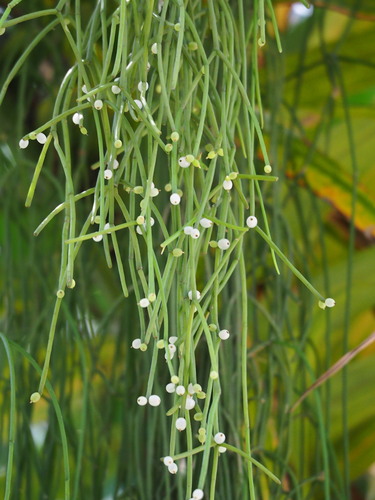
Sources differ and are few on mature size, placing height at about 250–400 cm; a single source reports a spread of about 50–100 cm. It is reported to grow vigorously and is leafless, with green stems providing its vegetative growth; mature stems are usually nearly spineless. Its small, funnel-shaped flowers are white, greenish white, or creamy white and can occur along the stems; sources differ on flowering time, describing flowering from winter to spring or potentially throughout the year. The fruit is a small, spherical, translucent berry, white to pale pink.
Light
Sources differ on light details, but describe bright, indirect light to part shade as suitable; brighter conditions can be tolerated, while strong direct summer sun should be avoided because it can cause scorching. Rhipsalis baccifera tolerates bright light or part shade.
Watering
During active growth, water thoroughly after the growing medium dries while maintaining moderate moisture, but avoid standing water and overwatering; water more sparingly in winter and during hot summer conditions, especially during winter dormancy.
Humidity and airflow
Rhipsalis baccifera prefers high humidity and needs good airflow.
Temperature and dormancy
A single source places the cold minimum at about 5 °C, and another single-source account reports its hardiness qualitatively within the stated USDA range. It is frost tender; keep above freezing, and it is not frost tolerant. It rests cool in winter with a little water.
Growing medium and mounting
Sources differ on medium details, describing a loose, porous, well-draining cactus or succulent medium that may contain peat or leaf-mold material, with some sources preferring a slightly acidic medium. As an epiphytic plant, it needs a fast-draining mix.
Feeding
It can be fed during active growth with diluted low-nitrogen fertilizer or balanced fertilizer, with the cited guidance describing regular applications during growth periods.
Propagation
Rhipsalis baccifera can be propagated by cuttings or seed; stem cuttings can root within several weeks, and NHK also provides a method using division.
Common problems
Mealybugs or other scale insects may occur and warrant more attention where airflow is poor, while conspicuous diseases are generally uncommon. Overwatering or poor drainage can damage the plant; insufficient water can make stems shrivel and lose firmness, while strong sunlight can cause sun scorch. It does not tolerate frost or low temperatures and needs protection in cold conditions; strong direct summer sun and hot, poorly ventilated conditions should also be avoided.
Identification
The main identifying features are slender, linear, heavily branched, trailing succulent stems; areoles on young stems may bear sparse wool and a few bristle-like spines, which often disappear with maturity so adult plants are usually nearly spineless.
Photos


Sources
- Wikipedia (en): Rhipsalis baccifera — CC BY-SA 4.0 · link
- 維基百科:絲葦 — CC BY-SA 4.0 · link
- Wikipedia (de): Rhipsalis baccifera — CC BY-SA 4.0 · link
- Wikipedia (fr): Rhipsalis baccifera — CC BY-SA 4.0 · link
- GBIF descriptions: Catálogo de Plantas y Líquenes de Colombia; Flora y fauna del municipio de Rionegro, Santander; Plan — per dataset · link
- NC State Plant Toolbox: Rhipsalis baccifera — copyright (facts only) · link
- LLIFLE Encyclopedia of living forms: Rhipsalis baccifera — CC BY-SA · link
- Useful Tropical/Temperate Plants: Rhipsalis baccifera — CC BY-NC-SA 3.0 (facts only) · link
- RHS Plants: Rhipsalis baccifera — © RHS, facts only · link
- USDA PLANTS Database: Rhipsalis baccifera — Public domain (US Government work) · link
- Desert-Tropicals: Rhipsalis baccifera — © Philippe Faucon (desert-tropicals.com), facts only · link
- NHK みんなの趣味の園芸 植物図鑑: Rhipsalis baccifera — © NHK出版, facts only · link
- Rhipsalis baccifera | Giromagi cactus and succulents for sale | Buy plants onlin (www.giromagi.com) — facts only (§12) · link
- PUKUBOOK: Rhipsalis baccifera — CC BY-NC (facts only) · link