
mini monstera (Rhaphidophora tetrasperma)
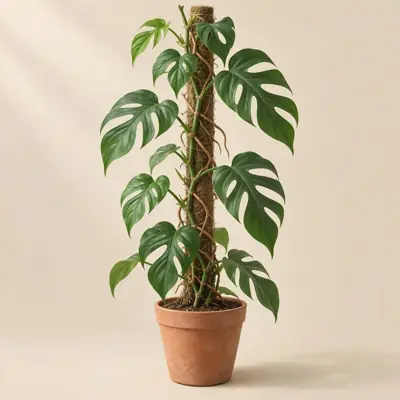
Sources describe Rhaphidophora tetrasperma somewhat differently as a climbing herbaceous perennial vine that can grow upward using aerial or clinging roots and can also be grown trailing. It is reported to be an evergreen herbaceous perennial.
Overview
Sources describe Rhaphidophora tetrasperma somewhat differently as a climbing herbaceous perennial vine that can grow upward using aerial or clinging roots and can also be grown trailing. It is reported to be an evergreen herbaceous perennial.
Origin and habitat
Sources differ on the details of its native range, describing it from southern Thailand to Peninsular Malaysia, with CATE Araceae specifically recording Kelantan and Perak in Malaysia and peninsular Thailand. It is reported from disturbed forest in settings ranging from relatively dry to damp or moist, on substrates including sandstone and granite. It occurs in humid tropical environments, while horticultural information also lists it as suitable for subtropical conditions.
Characteristics
Mature height is 500 cm, and the growth rate is fast. A single source reports a mature spread of about 30.48–121.92 cm. Sources differ somewhat in their leaf descriptions: the leaves are dark green and broadly ovate to ovate-lanceolate, progressing with maturity from undivided to deeply divided or nearly pinnately divided, sometimes with large diamond-shaped perforations near the midrib. The inflorescence consists of a spadix and spathe, described as white to creamy white, and flowering is rare when grown as a houseplant; a CATE account reports cylindrical infructescences with red-orange ripe fruit, but this fruit description is considered unreliable because its morphology is seriously inconsistent with other descriptions of Rhaphidophora tetrasperma.
Light
Rhaphidophora tetrasperma suits bright indirect light through partial shade or shade; it can accept some direct sunlight, but strong or excessive direct light may scorch the leaves.
Watering
Keep the growing medium moist but well drained, allowing the surface to dry somewhat before watering again; Top Tropicals likewise describes regular to moderate watering after the surface has dried slightly.
Humidity and airflow
It is generally reported to prefer high humidity. A single source reports about 60% humidity.
Temperature and dormancy
A single source reports a temperature range of about -1.1–26.7 °C, while sources are few. Sources differ in their hardiness-zone descriptions. It is reported to tolerate brief light frost.
Growing medium and mounting
It is reported to suit a moist, well-drained potting medium and to have aerial and soil roots.
Feeding
Top Tropicals recommends a fertilizer formulated to promote rapid growth.
Propagation
It can be propagated from stem cuttings; a cutting with an aerial root can be rooted in water before planting or inserted directly into soil and kept moist while it roots.
Common problems
When grown indoors, it is reported to be susceptible to spider mites, fungus gnats, and scale insects, as well as bacterial leaf spot and fungal diseases including root rot. Overwatering or insufficient light may cause yellow leaves, underwatering may cause leaves to droop or curl, and insufficient water or air humidity may cause brown leaf margins and spots. Excessively strong sunlight may scorch the leaves, and drafts should be avoided; mature plants can tolerate brief light frost, while young plants require protection from cold.
Identification
It is reported to be distinguished by deeply pinnately divided to nearly pinnatisect leaves, sometimes with diamond-shaped perforations near the midrib, and by the petiole sheath extending to the base of the apical geniculum. It can be distinguished from Rhaphidophora nicolsonii by characteristics of the petiole sheath and leaf blade.
Photos


Sources
- GBIF Backbone: Rhaphidophora tetrasperma Hook.f. — CC BY 4.0 · link
- Wikipedia (en): Rhaphidophora tetrasperma — CC BY-SA 4.0 · link
- Wikipedia (de): Rhaphidophora tetrasperma — CC BY-SA 4.0 · link
- GBIF descriptions: CATE Araceae — per dataset · link
- NC State Plant Toolbox: Rhaphidophora tetrasperma — copyright (facts only) · link
- Top Tropicals catalog: Rhaphidophora tetrasperma — © Top Tropicals LLC (facts only) · link