
fire crown cactus (Rebutia minuscula)
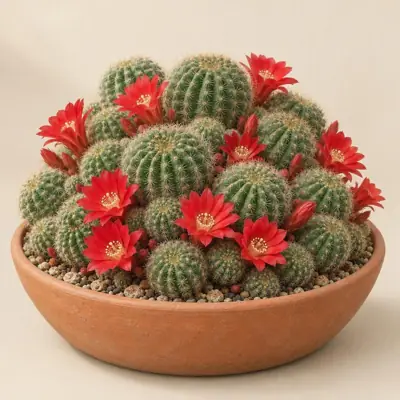
Rebutia minuscula is a small clustering cactus that may grow singly or produce offsets with age, eventually forming dense clumps; its stems remain close to the ground and range from globose and flattened-globose to globose with a depressed apex.
Overview
Rebutia minuscula is a small clustering cactus that may grow singly or produce offsets with age, eventually forming dense clumps; its stems remain close to the ground and range from globose and flattened-globose to globose with a depressed apex.
Origin and habitat
Sources differ on its South American native range: it is mainly recorded from northern to northwestern Argentina, including Catamarca, Jujuy, Salta and Tucumán, while many accounts also extend its range into Bolivia. It occurs in mountainous environments, including rocky outcrops in Yunga forest in northern Argentina, where its distribution is patchy; sources differ on the reported elevational limits.
Characteristics
The reported mature height is about 3.5 cm based on a single source, while sources differ on a mature spread of about 4–6 cm. It is reported to grow relatively slowly but flower readily, gradually forming clumps under good conditions. The slender, funnel-shaped flowers are usually bright red to purplish red, with yellow, orange or white variants, and arise abundantly from older areoles on the lower half of the stem or near the stem base; they can self-pollinate. Flowering is reported to occur in spring; sources differ in describing the globose fruit, which becomes red to scarlet when ripe and may split irregularly when dry to release seeds.
Light
Rebutia minuscula grows in bright light, with sources recording conditions from full sun to partial sun, and it takes full sun.
Watering
During the growing season it can be watered more fully after the growing medium has dried; keep it dry in winter and avoid overwatering that can cause rot.
Humidity and airflow
It is generally reported to prefer low humidity.
Temperature and dormancy
A single source reports a cold minimum of about -7 °C, while another specialist source reports about 0 °C; sources are few. It is reported to be frost hardy. It is generally reported to rest cool and dry in winter.
Growing medium and mounting
It is generally reported to suit a very loose, fast-draining, mineral growing medium that is slightly acidic, and it needs a very fast-draining mix.
Feeding
A high-potassium fertilizer is generally reported for summer use.
Propagation
Once clumps form, the plant can be propagated by division; it can also self-fertilize and produce seed. A specialist source reports propagation by seed and cuttings.
Common problems
It is generally reported to be prone to rot when overwatered, while spine number, thickness and color can change markedly with light conditions. Cool, dry winter conditions suit it, and it is sensitive to excessive winter moisture and overwatering.
Identification
The stem has ribs divided into low tubercles, with small areoles bearing numerous fine white to pale-yellow spines; central and radial spines are difficult to distinguish. A distinguishing feature is that the flowers emerge near the stem base rather than from the apex.
Photos


Sources
- Wikipedia (en): Rebutia minuscula — CC BY-SA 4.0 · link
- Wikipedia (de): Rebutia minuscula — CC BY-SA 4.0 · link
- Wikipedia (fr): Rebutia minuscula — CC BY-SA 4.0 · link
- Wikipedia (es): Rebutia minuscula — CC BY-SA 4.0 · link
- LLIFLE Encyclopedia of living forms: Rebutia minuscula — CC BY-SA · link
- Desert-Tropicals: Rebutia minuscula — © Philippe Faucon (desert-tropicals.com), facts only · link
- The Succulent Plant Page: Rebutia (genus-level) — © R.J. Hodgkiss, facts only · link
- Rebutia minuscula | Giromagi cactus and succulents | Buy plants online (www.giromagi.com) — facts only (§12) · link
- PUKUBOOK: Rebutia minuscula — CC BY-NC (facts only) · link