
Asian buttercup (Ranunculus asiaticus)
Ranunculus asiaticus is a herbaceous plant with underground tuberous storage roots and upright stems that may be unbranched or sparsely branched. It is a perennial herb but is often treated as an annual in horticultural cultivation.
Overview
Ranunculus asiaticus is a herbaceous plant with underground tuberous storage roots and upright stems that may be unbranched or sparsely branched. It is a perennial herb but is often treated as an annual in horticultural cultivation.
Origin and habitat
It is native to the eastern Mediterranean and surrounding areas, extending into southeastern Europe, southwestern Asia, and North Africa or northeastern Africa, including Crete, Rhodes, Cyprus, Turkey, Syria, Lebanon, Israel, Jordan, Iraq, Iran, Egypt, and northern Libya. Sources differ on habitat; one source reports that it can grow in wetlands or moist environments near water in its native range. It is native to areas such as the eastern Mediterranean with relatively mild winters, while horticultural forms are suited to conditions with mild winters, cool springs, and a dry summer dormancy period.
Characteristics
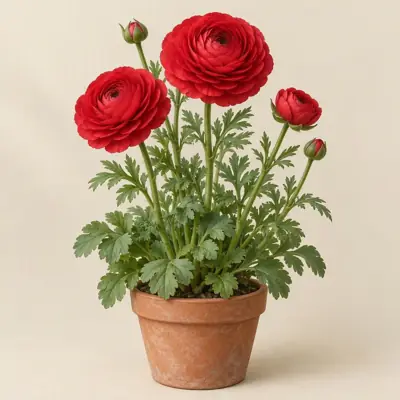
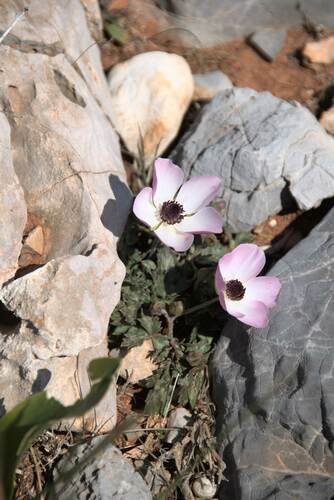
Sources differ on mature height, placing it at about 30–45 cm, while few sources report a mature spread of about 10–50 cm. Growth is generally reported to be moderate, and the leaves vary markedly in form: basal leaves may be lobed or less divided, while upper stem leaves are usually more deeply and narrowly divided; leaves may be hairy and are also described horticulturally as deeply divided and celery- or parsley-like. The species has usually cup-shaped flowers in red, pink, yellow, or white, while horticultural forms also include orange, purple, green, and multicolored flowers and forms ranging from single through semi-double to double; flower stalks may carry one or several flowers. Flowering is mainly in spring and may continue into early summer, and the fruiting structure is generally reported to be cylindrical.
Light
Full sun is preferred, although some horticultural sources also accept partial sun.
Watering
During growth, maintain moderate moisture with normal watering while ensuring good drainage; keep conditions drier during hot-weather dormancy, and keep dormant tuberous roots dry in storage.
Temperature and dormancy
Sources differ, with limited evidence placing the minimum temperature at about -10 °C. Sources also differ on its USDA hardiness-zone classification. It is generally reported to tolerate brief light frost.
Growing medium and mounting
It prefers fertile, well-drained soil; loam or sandy soil may be used across acidic, neutral, or alkaline conditions, while poorly drained heavy clay should be avoided.
Feeding
It is generally reported that plants can be fed well after sprouting.
Propagation
It is generally reported to be propagated by seed or by division in spring or autumn.
Common problems
Potential pests include aphids, leaf miners, slugs, and snails. Poor drainage and rapid water uptake by dry dormant storage organs during hot conditions may promote rot, and heavy clay is unsuitable for cultivation. It can withstand light frost but has limited cold tolerance; very low temperatures do not allow safe overwintering, while high temperatures promote dormancy.
Identification
Ranunculus asiaticus has clustered underground tuberous storage roots, often horticulturally called bulbs or claw-like tuberous roots, deeply divided leaves, and flower stalks emerging in spring; double horticultural forms have densely petaled flowers resembling small roses.
Photos


Sources
- Wikipedia (en): Ranunculus asiaticus — CC BY-SA 4.0 · link
- 維基百科:花毛茛 — CC BY-SA 4.0 · link
- Wikipedia (ja): ハナキンポウゲ — CC BY-SA 4.0 · link
- Wikipedia (de): Asiatischer Hahnenfuß — CC BY-SA 4.0 · link
- Wikipedia (fr): Renoncule des fleuristes — CC BY-SA 4.0 · link
- Wikipedia (es): Ranunculus asiaticus — CC BY-SA 4.0 · link
- NC State Plant Toolbox: Ranunculus asiaticus — copyright (facts only) · link
- Wikipedia (it): Ranunculus asiaticus — CC BY-SA 4.0 · link
- Wikipedia (nl): Ranunculus asiaticus — CC BY-SA 4.0 · link
- Wikipedia (pt): Ranunculus asiaticus — CC BY-SA 4.0 · link
- RHS Plants: Ranunculus asiaticus — © RHS, facts only · link
- Top Tropicals catalog: Ranunculus asiaticus — © Top Tropicals LLC (facts only) · link