
China doll (Radermachera sinica)
Radermachera sinica is an evergreen tree, but when grown as a houseplant it usually remains smaller and develops a shrubby, branching form. It is reported to be perennial.
Overview
Radermachera sinica is an evergreen tree, but when grown as a houseplant it usually remains smaller and develops a shrubby, branching form. It is reported to be perennial.
Origin and habitat
Sources differ on its native range: it is native to parts of Asia, including Guangdong, Guangxi, Guizhou and Yunnan in southern China, Taiwan, Bhutan, northeastern India, northern Myanmar and Vietnam, while some sources also include Japan's Ryukyu Islands and a broader range from the Himalayas to the Malay Peninsula; Taiwan's species list explicitly treats it as native to Taiwan. Sources differ in describing its natural habitats, which include hillsides, valleys, open woodland on level ground and forest environments in China. It is generally distributed naturally in tropical to subtropical Asia and is reported to be suitable for outdoor cultivation in tropical, subtropical and some Mediterranean-type climates.
Characteristics
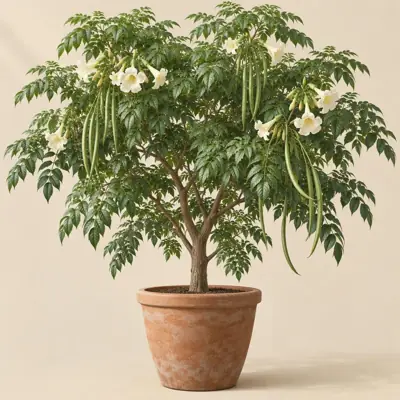
Sources differ on mature height, placing it at about 150–250 cm, while a single source reports a mature spread of about 100–150 cm. Sources differ in describing the leaves as bipinnately compound or sometimes tripinnately compound; they bear numerous glossy green leaflets and may be arranged oppositely or in whorls. Sources describe the flowers differently, but report large, fragrant, funnel- to trumpet-shaped flowers ranging from white and pale yellow to yellow; a source describing night-blooming flowers reports that they wilt by the following morning. Flowering is reported from spring into summer, while the fruit is reported to be a slender, often curved capsule that splits when mature to release flat seeds with papery wings.
Light
Radermachera sinica grows in bright light; bright indirect light is suitable indoors, while horticultural cultivation can range from full sun to partial sun.
Watering
Maintain moisture while using a well-drained growing medium; both insufficient and excessive watering can cause wilting or other leaf abnormalities, and persistently wet medium can increase the risk of root rot.
Growing medium and mounting
A fertile, well-drained growing medium is suitable; loam or peat-free multipurpose compost with sand or horticultural grit added for drainage is recommended, with a mainly neutral soil reaction.
Propagation
It can be propagated from semi-ripe cuttings, and mature capsules in natural environments also release winged seeds.
Common problems
It is reported to be susceptible to aphids, mealybugs, scale insects and greenhouse red spider mites. Persistently wet growing medium is reported to be associated with root rot. Insufficient or excessive watering can cause wilting or other leaf abnormalities, while moving the plant or other marked environmental changes can cause leaf drop. It is frost-sensitive and should be protected from dry winds, with warm, sheltered positions being more suitable.
Identification
Radermachera sinica has dense, fine-textured, glossy pinnately compound foliage; mature plants can develop large, fragrant trumpet-shaped flowers and very slender, curved capsules.
Photos


Sources
- Wikipedia (en): Radermachera sinica — CC BY-SA 4.0 · link
- 維基百科:菜豆树 — CC BY-SA 4.0 · link
- Wikipedia (de): Zimmeresche — CC BY-SA 4.0 · link
- Wikipedia (fr): Radermachera sinica — CC BY-SA 4.0 · link
- Wikipedia (es): Radermachera sinica — CC BY-SA 4.0 · link
- TaiCOL 臺灣物種名錄: Radermachera sinica — CC BY 4.0 · link
- RHS Plants: Radermachera sinica — © RHS, facts only · link
- USDA PLANTS Database: Radermachera sinica — Public domain (US Government work) · link