
pomegranate (Punica granatum)
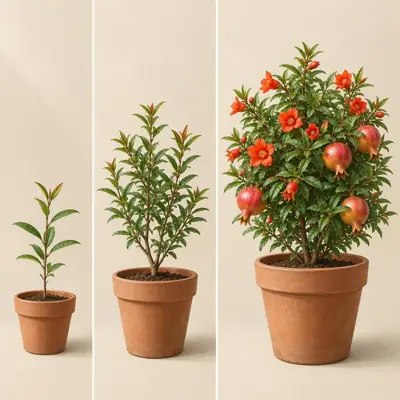
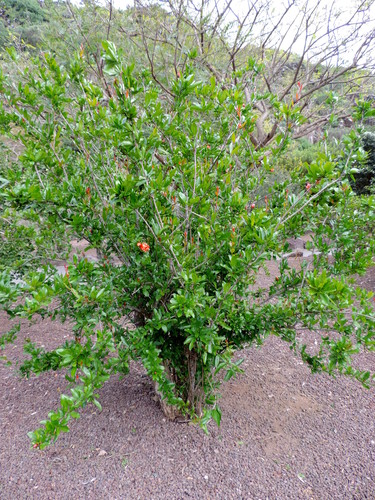
Punica granatum is a perennial deciduous woody shrub or small tree, while 'Nana' is a dwarf cultivar with a clumping habit.
Overview
Punica granatum is a perennial deciduous woody shrub or small tree, while 'Nana' is a dwarf cultivar with a clumping habit.
Origin and habitat
Sources differ on the native range, placing it broadly from western to central Asia, with a core around Iran and adjoining areas and extensions toward the Caucasus, Turkmenistan, Afghanistan, and northwestern India and the Himalayan region. Its native environments include dry hills and areas with limestone soils, and it favors relatively dry, well-drained growing conditions. It is suited to warm-temperate to subtropical climates and favors warm, relatively dry conditions; hot days with cooler nights are suitable for growth and fruiting.
Characteristics
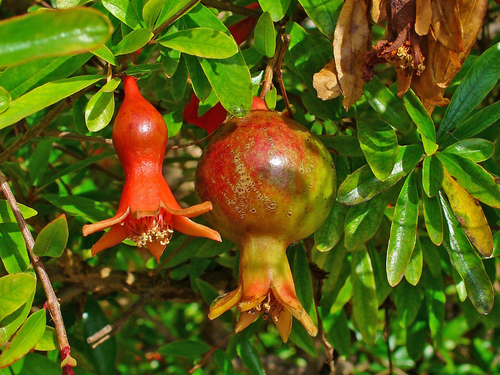
Sources differ on mature height, with the few available accounts indicating about 100–150 cm; mature spread is reported from a limited source to be about 150–250 cm. Growth is slow, and the deciduous simple leaves are often opposite but may be nearly whorled or clustered, ranging from elliptical and oblong to obovate, with smooth or glossy surfaces that are usually green. The conspicuous flowers are usually bright red to orange-red, with a thick persistent calyx, petals emerging from the calyx tube, and numerous stamens; sources differ on flowering time, describing it broadly from late spring through summer, with Japanese information emphasizing early summer. The fruit is nearly spherical, with a thick skin and persistent calyx, and may become red, reddish brown, or yellow-red when mature; it contains numerous juicy fleshy arils and seeds.
Light
Full sun is preferred, though partial shade is tolerated; outdoor plants are best placed in a sunny, relatively sheltered position.
Watering
Provide normal water during active growth while maintaining good drainage; the plant tolerates drought, and greenhouse or container plants can be watered thoroughly during active growth with watering reduced in winter.
Humidity and airflow
It is generally reported to prefer low humidity.
Temperature and dormancy
Sources differ on the lower temperature limit, with few sources indicating about -10 °C. Limited sources report an ideal temperature range of about 23–32 °C and an upper temperature of about 40 °C. Sources differ on the reported hardiness zone, while cross-source evidence describes the plant as frost hardy.
Growing medium and mounting
Sources differ in their descriptions of soil conditions, but good drainage is required; the plant can grow in various soils including loamy and sandy soils, favors fertile, well-drained soil, and has been recorded under acidic, neutral, and alkaline conditions.
Feeding
A balanced liquid fertilizer is reported to be suitable during the growing period.
Propagation
Propagation can be by seed, cuttings, or layering; semi-hardwood shoots can be used for cuttings, and some sources also identify early spring as suitable for shoot cuttings.
Common problems
Pests and diseases are generally not serious, though Japanese information notes that scale insects may occur. Scale insect infestations may be accompanied by sooty mold, and RHS also records occasional honey fungus infection. Fruiting may be poor in humid tropical regions, and fruit maturation requires relatively high autumn temperatures. Dormant plants can tolerate substantial cold, but new shoots and leaves may suffer serious cold damage; container plants in cold regions can be moved indoors for winter.
Identification
The dwarf 'Nana' is generally distinguished by its conspicuously low, shrubby habit; Punica granatum more generally has young branches that are often angular, some spine-like shoot tips, bright red flowers, and spherical fruits topped by a persistent calyx.
Photos


Sources
- Wikipedia (en): Pomegranate — CC BY-SA 4.0 · link
- 維基百科:石榴 — CC BY-SA 4.0 · link
- Wikipedia (ja): ザクロ — CC BY-SA 4.0 · link
- Wikipedia (de): Granatapfel — CC BY-SA 4.0 · link
- Wikipedia (fr): Grenadier commun — CC BY-SA 4.0 · link
- Wikipedia (es): Punica granatum — CC BY-SA 4.0 · link
- GBIF descriptions: Checklist of introduced taxa in Cyprus; Arbolado urbano de Bogotá D.C asociado a servicios ambiental — per dataset · link
- NC State Plant Toolbox: Punica granatum — copyright (facts only) · link
- Wikipedia (nl): Granaatappel — CC BY-SA 4.0 · link
- TaiCOL 臺灣物種名錄: Punica granatum — CC BY 4.0 · link
- Useful Tropical/Temperate Plants: Punica granatum — CC BY-NC-SA 3.0 (facts only) · link
- RHS Plants: Punica granatum — © RHS, facts only · link
- USDA PLANTS Database: Punica granatum — Public domain (US Government work) · link
- Top Tropicals catalog: Punica granatum — © Top Tropicals LLC (facts only) · link