
Cretan brake (Pteris cretica)
Pteris cretica is a perennial evergreen fern with a clumping habit, a short rhizome, and leaves densely arising from the rhizome.
Overview
Pteris cretica is a perennial evergreen fern with a clumping habit, a short rhizome, and leaves densely arising from the rhizome.
Origin and habitat
Sources differ on the species-level native range; it is described mainly from tropical and subtropical parts of the Old World, broadly across Europe, Africa, and Asia, including Taiwan, with records of naturalization or escape in parts of the Americas. It is reported from mountain forest floors, forest edges, shaded moist rocky slopes, rock crevices, scree, limestone areas, and moist places influenced by waterfall spray. It is mainly adapted to tropical, subtropical, and some warm regions, while horticultural cultivation favors warm, humid, shaded conditions.
Characteristics
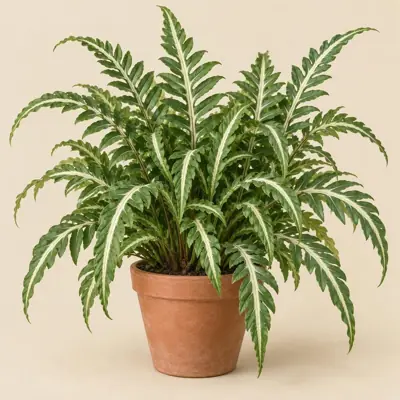
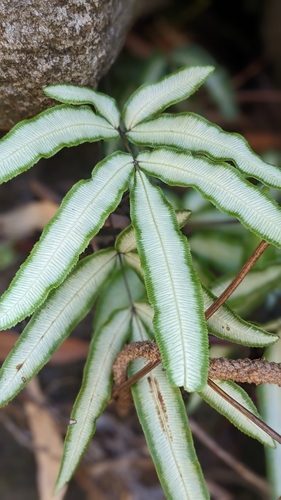
Sources differ on mature size, giving a height of about 30–90 cm and a spread of about 10–60 cm. The pinnate leaves may arch or stand upright and have narrow, elongated pinnae; typical foliage ranges from yellow-green to dark green, while fertile fronds are usually taller with narrower pinnae. 'Albolineata' is a horticultural form distinguished by a conspicuous pale marking along the center of the leaf. It is reported to have a creeping rhizome.
Light
Pteris cretica does well in bright shade to partial sun and should avoid strong direct sunlight; sources describe conditions ranging from full to partial shade for the species, while a Taipei collection records this form growing well in partial sun. It tolerates bright indirect light.
Watering
Keep evenly moist in a medium that retains moisture while draining well, avoiding prolonged waterlogging or excessive drying; during active growth from spring through autumn, the medium should especially not be allowed to dry out completely.
Humidity and airflow
Pteris cretica prefers high humidity and has a high humidity need.
Temperature and dormancy
A minimum temperature and a USDA hardiness zone are each reported by a single source. It is tender and frost tender; keep above freezing.
Growing medium and mounting
Use a humus-rich medium that stays moist but drains well; it can adapt to loamy, sandy, and calcareous media, with neutral to alkaline conditions also indicated.
Feeding
During active growth from spring through autumn, slow-release chemical fertilizer or fast-acting liquid fertilizer is reported to be suitable for periodic feeding.
Propagation
It can be propagated by spores, while species- and genus-level horticultural information also records propagation by rhizome division. Spores are reported to mature or disperse in summer and to be carried by wind. Rhizomes can be divided in spring; when dividing during repotting, soil can be removed and offsets at the plant base separated while avoiding major root damage.
Common problems
Potential pests include scale insects, spider mites, and leaf-roller moths; nematodes are also recorded as a possible greenhouse problem. Anthracnose may occur, and sooty mold is also recorded as a possible problem. Frost damage in cold conditions and insufficient humidity are expected concerns based on habitat and cultivation requirements; greenhouse conditions may additionally present scale insects, nematodes, and sooty mold. It is sensitive to frost and requires protection in cold regions, favoring warm, humid, and relatively shaded conditions.
Identification
A principal horticultural identification feature is the pale central marking on the pinnae; the species itself has narrow, elongated pinnae, sori extending along the pinna margins, and fertile fronds that are usually narrower than sterile fronds.
Photos


Sources
- Wikipedia (en): Pteris cretica — CC BY-SA 4.0 · link
- Wikipedia (ja): オオバノイノモトソウ — CC BY-SA 4.0 · link
- Wikipedia (de): Kretischer Saumfarn — CC BY-SA 4.0 · link
- Wikipedia (fr): Ptéris de Crète — CC BY-SA 4.0 · link
- Wikipedia (es): Pteris cretica — CC BY-SA 4.0 · link
- GBIF descriptions: Manual of the Alien Plants of Belgium; A first checklist of the Pteridophytes of Togo (West Africa); — per dataset · link
- Wikipedia (nl): Lintvaren — CC BY-SA 4.0 · link
- TaiCOL 臺灣物種名錄: Pteris cretica — CC BY 4.0 · link
- RHS Plants: Pteris cretica — © RHS, facts only · link
- USDA PLANTS Database: Pteris cretica — Public domain (US Government work) · link
- 臺北典藏植物園 植物資料庫: Pteris cretica — © 臺北典藏植物園, facts only · link
- NHK みんなの趣味の園芸 植物図鑑: Pteris cretica — © NHK出版, facts only · link
- NC State Plant Toolbox: Pteris (genus-level) — copyright (facts only) · link
- Top Tropicals catalog: Pteris cretica — © Top Tropicals LLC (facts only) · link