
guava (Psidium guajava)
Psidium guajava is a perennial evergreen shrub or small tree, usually with a spreading crown and an often curved, much-branched trunk; sources differ in their descriptions of its habit.
Overview
Psidium guajava is a perennial evergreen shrub or small tree, usually with a spreading crown and an often curved, much-branched trunk; sources differ in their descriptions of its habit.
Origin and habitat
Sources differ on the native range, which is broadly described as tropical America, encompassing Mexico, Central America, the Caribbean, northern South America, and the area around Peru. It occurs in grasslands, pastures, roadsides, cultivated areas, and other disturbed environments, from lowlands to higher elevations. It is suited to warm tropical to subtropical environments, can also be cultivated in some cooler areas, and is widely grown throughout tropical and subtropical regions worldwide.
Characteristics
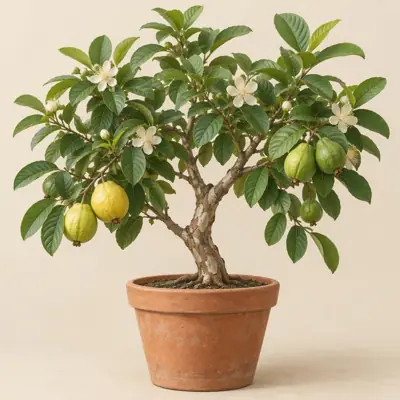
Sources differ on mature size, with height reported at about 300–1000 cm; the few available sources for spread report about 250–400 cm. Growth is moderate; seedlings grow very slowly at first and can later accelerate noticeably. The simple, opposite, dark green leaves are mainly ovate, elliptic, or oblong, with prominent veins and an aroma when crushed; the white flowers have petals and numerous stamens and may occur singly or in small groups in the leaf axils. Flowering can occur at multiple times of the year under suitable environmental and cultivation conditions, though sources differ on flowering season; the fruits are berries that are often globose, ovoid, or pear-shaped, with skin changing from green to yellow-green or yellow at maturity, while some cultivars are pink to red, and the flesh varies by cultivar from white, pale green, yellow, or orange to pink or red and usually contains many small seeds.
Light
Full sun is suitable; greenhouse or indoor cultivation requires ample light, although RHS recommends avoiding excessively intense, hot direct sunlight.
Watering
The growing medium should be kept moist but well drained; the plant has some tolerance of low to moderate rainfall and moderate drought, while good fruiting requires more ample moisture.
Temperature and dormancy
The few available sources report a minimum temperature of about -5 °C.
Growing medium and mounting
Loamy or sandy, well-drained growing media can be used; the plant adapts to acidic, neutral, or alkaline conditions and to coarse, medium, or fine soil textures.
Propagation
Propagation can be by seed, cuttings, air layering, grafting, or root suckers; commercial orchards more commonly use vegetative methods such as cuttings, grafting, and air layering.
Common problems
RHS reports that pest problems are generally uncommon, although some pests may still affect the plant. In suitable tropical environments it can escape cultivation and become invasive, invading pastures, wild areas, and other disturbed environments and displacing native plants. It is frost-sensitive; dormant mature plants may briefly tolerate some frost, while tender new growth can be severely damaged, so container-grown plants require frost protection during cold periods.
Identification
Identification features include opposite aromatic leaves with prominent veins, white flowers with numerous stamens, berries, and bark that is often reddish-brown to gray and peels in flakes or strips.
Photos


Sources
- Wikipedia (en): Psidium guajava — CC BY-SA 4.0 · link
- 維基百科:番石榴 — CC BY-SA 4.0 · link
- Wikipedia (ja): グアバ — CC BY-SA 4.0 · link
- Wikipedia (de): Echte Guave — CC BY-SA 4.0 · link
- Wikipedia (fr): Goyavier — CC BY-SA 4.0 · link
- Wikipedia (es): Psidium guajava — CC BY-SA 4.0 · link
- GBIF descriptions: The checklist of alien seed plants of D.R. Congo, based on evidence from herbarium collections; Chec — per dataset · link
- Useful Tropical/Temperate Plants: Psidium guajava — CC BY-NC-SA 3.0 (facts only) · link
- RHS Plants: Psidium guajava — © RHS, facts only · link
- USDA PLANTS Database: Psidium guajava — Public domain (US Government work) · link