
peach (Prunus persica)
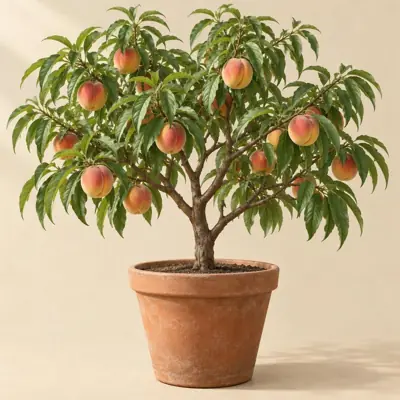
Prunus persica is a deciduous fruit-bearing woody plant that may grow as a small tree, tree, or tree-like shrub, with cultivated forms including dwarf, columnar, spreading, and weeping habits. It is a perennial deciduous woody plant with a relatively short lifespan; sources differ in their descriptions of its longevity.
Overview
Prunus persica is a deciduous fruit-bearing woody plant that may grow as a small tree, tree, or tree-like shrub, with cultivated forms including dwarf, columnar, spreading, and weeping habits. It is a perennial deciduous woody plant with a relatively short lifespan; sources differ in their descriptions of its longevity.
Origin and habitat
Sources differ on its native range, describing China, China and other parts of Asia, or a region extending from China toward Persia. It is reported to be widely cultivated in warm-temperate and subtropical regions. Its habitat in a truly wild state is reported to be unknown, and one account suggests that the modern peach may have arisen through cultivation.
Characteristics
Sources differ on mature height, placing it at about 300–800 cm, while mature spread is 400–800 cm. It is reported to grow rapidly, with alternate, narrow leaves that are mainly lance-shaped to narrowly elliptical, have serrated margins, and are usually dark green, with some descriptions noting a glossy surface. Flowers are usually solitary or occasionally paired on very short stalks, typically pink to red but sometimes white, with both ordinary and double-flowered forms; flowering occurs in spring to early spring, usually before or around the beginning of leaf emergence. The fruit is a usually nearly spherical stone fruit with commonly fuzzy skin and juicy flesh that may be white, yellow, or reddish; nectarines are a smooth-skinned form of the same species without conspicuous fuzz.
Light
Prunus persica grows in full sun.
Watering
Water regularly, keeping the soil moist but well drained and allowing the surface soil to dry slightly before watering again.
Temperature and dormancy
A limited source reports cold tolerance around -10 °C; sources are few. An ideal temperature range is reported, and a USDA hardiness-zone range is also reported. It is generally described as tolerating brief light frost.
Growing medium and mounting
Sources differ on soil preferences: clay, loam, sand, and chalk-containing soils are described as suitable, with moist but well-drained conditions preferred and acidic, neutral, or alkaline soils supported, while Dutch cultivation information favors aerated loam and advises avoiding calcareous soil.
Common problems
Reported common pests include white peach scale, peach gall midge, and peach trunk-boring pests. Common disease problems are reported, although the supplied account does not name specific diseases. Peach is reported to experience replant problems, with growth potentially being poor when planted again where peach previously grew. A sheltered planting position is generally recommended to reduce exposure to adverse environmental conditions.
Identification
Prunus persica can be identified by its deciduous habit, narrow serrated leaves, flowers appearing before or around leaf emergence in spring, and nearly spherical stone fruits that are typically fuzzy; its branches lack thorns and it usually does not produce root suckers.
Photos


Sources
- GBIF Backbone: Prunus persica (L.) Stokes — CC BY 4.0 · link
- Wikipedia (en): Peach — CC BY-SA 4.0 · link
- 維基百科:桃 — CC BY-SA 4.0 · link
- Wikipedia (ja): モモ — CC BY-SA 4.0 · link
- Wikipedia (de): Pfirsich — CC BY-SA 4.0 · link
- Wikipedia (es): Prunus persica — CC BY-SA 4.0 · link
- NC State Plant Toolbox: Prunus persica — copyright (facts only) · link
- Wikipedia (it): Prunus persica — CC BY-SA 4.0 · link
- Wikipedia (nl): Perzik — CC BY-SA 4.0 · link
- Wikipedia (pt): Pessegueiro — CC BY-SA 4.0 · link
- Wikipedia (ko): 복숭아 — CC BY-SA 4.0 · link
- TaiCOL 臺灣物種名錄: Prunus persica — CC BY 4.0 · link
- Useful Tropical/Temperate Plants: Prunus persica — CC BY-NC-SA 3.0 (facts only) · link
- RHS Plants: Prunus persica — © RHS, facts only · link