
Japanese apricot (Prunus mume)
Prunus mume is a deciduous small tree to tree, sometimes taking the form of a tall shrub, with a crown that may be spreading, rounded, or ovate. It is reported to be a perennial deciduous woody plant.
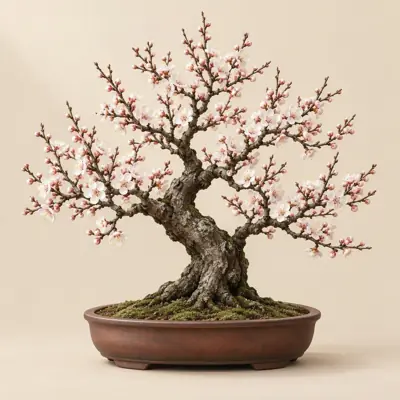
Overview
Prunus mume is a deciduous small tree to tree, sometimes taking the form of a tall shrub, with a crown that may be spreading, rounded, or ovate. It is reported to be a perennial deciduous woody plant.
Origin and habitat
Sources differ on details of its native range: it is native to China, with accounts pointing to central to south-central China or areas around the Yangtze River basin, and it was later introduced and widely cultivated in East Asian regions including Japan, Korea, and Vietnam. It occurs in open woodland, near streams, on wooded slopes, along mountain paths, and in mountainous areas; another account describes woodland and rocky hills, with wild records extending to high elevations.
Characteristics
Sources differ on mature size, indicating a height of about 400–1200 cm and, from few sources, a spread of about 800–800 cm. The alternate, simple leaves are ovate to broadly ovate, with pointed tips and serrated margins, and usually emerge after flowering. The fragrant flowers are generally borne on the branches before the leaves expand; they are typically petalled, with colors ranging from white and pale pink through pink to red, while cultivated forms also include double flowers and other color forms. Flowering occurs from late winter to early spring and varies by region; the nearly spherical drupes have a shallow groove on one side, change in appearance as they mature, and sources differ on their early-summer ripening period and other fruit details.
Light
It is reported to grow in full sun to partial sun.
Watering
It is reported to grow in soil kept moist but well drained, and it can also be cultivated in ordinary well-drained soil.
Temperature and dormancy
Its reported RHS hardiness rating is H5.
Growing medium and mounting
It can adapt to clay, loam, and sandy soils provided drainage is good, and can grow in acidic, neutral, or alkaline soil.
Propagation
It is reported to be propagated by cuttings or grafting; plants raised from fruit seed may not retain the parent plant's traits and may take longer to flower.
Common problems
The RHS is reported to recommend a sheltered growing position rather than an overly exposed site.
Identification
Reported distinguishing features include flowers appearing before the leaves around late winter to early spring, conspicuously fragrant flowers, branch tips that can sometimes appear thorn-like, and nearly spherical drupes with a longitudinal shallow groove.
Photos


Sources
- Wikipedia (en): Prunus mume — CC BY-SA 4.0 · link
- 維基百科:梅 — CC BY-SA 4.0 · link
- Wikipedia (ja): ウメ — CC BY-SA 4.0 · link
- Wikipedia (de): Ume — CC BY-SA 4.0 · link
- Wikipedia (fr): Abricotier du Japon — CC BY-SA 4.0 · link
- Wikipedia (es): Prunus mume — CC BY-SA 4.0 · link
- NC State Plant Toolbox: Prunus mume — copyright (facts only) · link
- Useful Tropical/Temperate Plants: Prunus mume — CC BY-NC-SA 3.0 (facts only) · link
- RHS Plants: Prunus mume — © RHS, facts only · link