
Fuji Cherry (Prunus incisa)
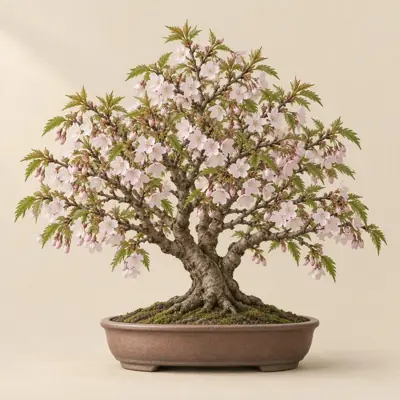
Prunus incisa is a perennial deciduous woody plant, growing as a shrub to small tree. Sources differ in their descriptions of habit; with appropriate pruning, potted 'Kojo-no-mai' can form a rounded crown of dense fine branches.
Overview
Prunus incisa is a perennial deciduous woody plant, growing as a shrub to small tree. Sources differ in their descriptions of habit; with appropriate pruning, potted 'Kojo-no-mai' can form a rounded crown of dense fine branches.
Origin and habitat
Prunus incisa is endemic to Japan and native to Honshu, with records covering Kanto, Chubu and Kinki and particular abundance around Mount Fuji and Hakone. It occurs in mountain and hill forests; around Mount Fuji it is found from cool-temperate to subalpine zones, with some populations growing on volcanic rocky substrates. It is adapted to temperate and colder mountain environments in Japan, with some populations occurring in subalpine climates, and has strong cold tolerance.
Characteristics
Sources differ and are few on mature dimensions, placing height at about 150–200 cm and spread at about 400–800 cm. Growth is slow, and the alternate, deciduous leaves are obovate to ovate with conspicuously deeply incised, doubly serrated margins and can develop bright autumn color. Sources differ on the flowers: they are small, with the species ranging from pale pink to nearly white, while 'Kojo-no-mai' is described as having early-opening white flowers; flowering is generally reported in spring. The mature fruit is described as red-black, while another source describes it as purple-black and oval, with a single large seed.
Light
It grows in full sun to partial sun, with a sunnier position preferred when fruit production is the goal.
Watering
The growing medium should remain moderately moist but well drained, avoiding prolonged waterlogging.
Temperature and dormancy
Prunus incisa is frost hardy, with a minimum temperature of -20 °C. It is generally reported by RHS as having an H6 hardiness rating.
Growing medium and mounting
It grows in moist but well-drained, moderately fertile soil and can tolerate loam, clay, sand and chalky soils, with support for acidic, neutral and alkaline conditions. One source additionally indicates a preference for some lime, while excessive lime may cause chlorosis.
Propagation
Propagation can be by seed, semi-ripe cuttings, softwood cuttings or spring layering. Seed can be sown outdoors in containers in autumn, while stored seed requires cold stratification.
Common problems
Potential pests include aphids and caterpillars, while genus-level information for Prunus also lists scale insects and borers. Reported diseases include peach leaf curl, silver leaf, bacterial canker, blossom rot and honey fungus, and RHS also lists it as a high-risk host of Xylella fastidiosa. Excessive lime in the soil may cause chlorosis, damaged roots may produce suckers, and pruning needs to take the risk of silver leaf infection into account. It is cold tolerant, and RHS recommends a relatively sheltered position.
Identification
Prunus incisa is generally reported to have a relatively small plant stature and flowers within Prunus, together with deeply incised leaf margins. 'Kojo-no-mai' is generally described as slow-growing and densely fine-branched, suitable for small gardens and large containers, with vivid autumn color.
Photos


Sources
- Wikipedia (en): Prunus incisa — CC BY-SA 4.0 · link
- 維基百科:富士櫻 — CC BY-SA 4.0 · link
- Wikipedia (ja): マメザクラ — CC BY-SA 4.0 · link
- Wikipedia (nl): Fujikers — CC BY-SA 4.0 · link
- Useful Tropical/Temperate Plants: Prunus incisa — CC BY-NC-SA 3.0 (facts only) · link
- RHS Plants: Prunus incisa — © RHS, facts only · link