
German primrose (Primula obconica)
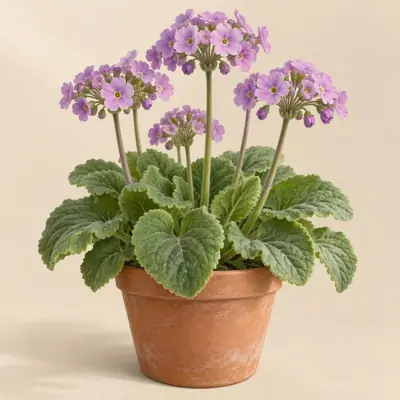
Primula obconica is a clumping herbaceous plant with a basal rosette and upright flower stalks topped by umbel-like or dome-shaped flower clusters. It is a short-lived evergreen perennial, but because it is not cold-hardy it is often grown horticulturally as an annual.
Overview
Primula obconica is a clumping herbaceous plant with a basal rosette and upright flower stalks topped by umbel-like or dome-shaped flower clusters. It is a short-lived evergreen perennial, but because it is not cold-hardy it is often grown horticulturally as an annual.
Origin and habitat
Primula obconica is native to China, with more detailed accounts listing Guangdong, Guangxi, Guizhou, Hubei, Hunan, Jiangxi, Sichuan, Yunnan, and Tibet, while another source also reports its occurrence in Thailand; sources differ. In the wild, it is reported from scrub, forests, rocky montane forest environments, and dry limestone cliffs, with habitat and elevation differing among subspecies. It is not cold-hardy and favors cool conditions; horticulturally it is suited to cool greenhouse or indoor cultivation and can be grown as a perennial in frost-free areas.
Characteristics
Sources differ on mature size, placing both height and spread at about 10–50 cm. The coarse, simple leaves form a basal rosette and range from ovate or nearly round to elliptic or oblong, often with a heart-shaped base; the leaves and petioles may bear glandular or multicellular hairs. The radially symmetrical flowers are borne in umbel-like or dome-shaped clusters atop upright flower stalks; the wild type is mainly pink to lavender-pink-purple, with some white forms, while cultivated varieties also include red, blue, and white. Flowering occurs mainly from winter through spring, while some wild subspecies are recorded as flowering later; the fruit is reported to be a capsule.
Light
Sources differ: bright filtered or indirect light is recommended, while RHS also considers full sun to partial shade acceptable.
Watering
Keep it well supplied with water during growth while ensuring good drainage; RHS recommends conditions that remain moist without becoming waterlogged.
Growing medium and mounting
Indoors, a peat-based or peat-free, loam-based potting medium amended with grit and leaf mould can be used, while outdoors it favors well-drained sandy loam. It can adapt to chalk, clay, loam, or sand and to acidic, neutral, or alkaline conditions, with moist but well-drained conditions being important.
Feeding
During active growth, it is reported to benefit from regular applications of diluted balanced liquid fertilizer.
Propagation
It is reported to be propagated from seed.
Common problems
RHS reports that it generally has no significant pest problems. Sources differ on disease problems: grey mould, root rot, damping off, and crown rot may occur, and good air circulation can help reduce the risk of grey mould, while RHS generally describes the plant as having no significant disease problems. Poor drainage associated with root rot, damping off, or crown rot can lead to wilting and death, inadequate ventilation may increase grey mould problems, and leaf contact may cause dermatitis. It is not cold-hardy and prefers cool, sheltered conditions; in areas with frost it is generally grown as an annual, indoor plant, or greenhouse plant.
Identification
Primula obconica can be recognized by its coarse basal rosette leaves and stout upright flower stalks topped by umbel-like clusters; hairs on the leaves or petioles may cause skin reactions.
Photos


Sources
- Wikipedia (en): Primula obconica — CC BY-SA 4.0 · link
- Wikipedia (de): Becher-Primel — CC BY-SA 4.0 · link
- GBIF descriptions: Lista de especies de plantas exóticas y trasplantadas de Colombia; Catálogo de Plantas y Líquenes de — per dataset · link
- NC State Plant Toolbox: Primula obconica — copyright (facts only) · link
- RHS Plants: Primula obconica — © RHS, facts only · link