
elephant bush (Portulacaria afra)
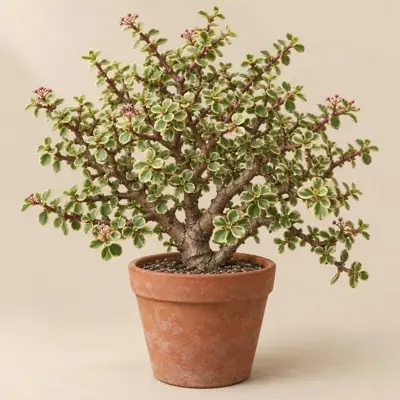
Portulacaria afra is a perennial succulent shrub or small tree; sources differ in describing 'Variegata', with finer branches than the species and, in some accounts, a more creeping habit.
Overview
Portulacaria afra is a perennial succulent shrub or small tree; sources differ in describing 'Variegata', with finer branches than the species and, in some accounts, a more creeping habit.
Origin and habitat
Sources agree that the species is native from southern Africa into parts of East Africa, including South Africa and Eswatini, while some also include Mozambique and Kenya. It commonly occurs on dry rocky slopes and outcrops, in dry river valleys, scrub, shrub grassland, and succulent shrubland, and in some areas can form dense dominant populations. It is adapted to dry subtropical to tropical environments, favoring warm, dry conditions and showing strong drought tolerance.
Characteristics
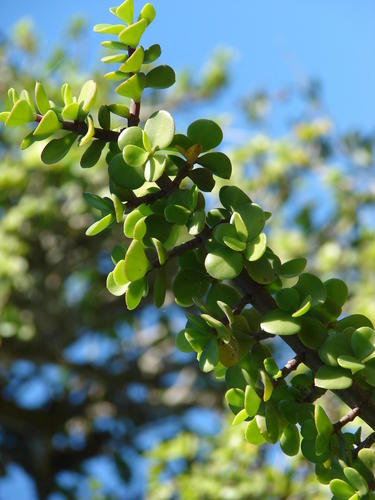
Sources differ on mature height, placing it at about 150–500 cm, while the few sources for mature spread report about 100–150 cm. Sources also differ on growth rate, describing it as either faster-growing or slow-growing. The thick, fleshy leaves are opposite; the species typically has green leaves that are obovate to nearly round, while 'Variegata' has yellow variegation, with one source specifically describing yellow leaf margins. The small flowers are usually pink to pale pink, though white and purplish-pink flowers are also reported, and they commonly cluster at branch tips during spring to summer; the small fruit is winged, indehiscent, and single-seeded, and the plant stores water in several organs.
Light
Portulacaria afra grows in bright conditions to full sun, takes full sun, tolerates partial sun or partial shade, and is suited to a bright location when grown indoors.
Watering
It is drought tolerant; during active growth, water thoroughly after the growing medium dries, while in winter or cool conditions watering should be substantially reduced and conditions kept on the dry side rather than persistently wet.
Humidity and airflow
It is generally reported to prefer low humidity and needs good airflow.
Temperature and dormancy
The few sources describing a cold minimum place it at about -1 °C, although sources differ, and the plant tolerates brief light frost. One source generally places it in the stated USDA hardiness-zone range. It has strong heat tolerance, but good ventilation is important during hot summer conditions.
Growing medium and mounting
It needs a loose, fast-draining mix; sandy loam, loam, or a succulent or cactus-type growing medium can be used, and information for the species indicates adaptation to acidic, neutral, and alkaline soils.
Feeding
During active growth from spring through autumn, slow-release chemical fertilizer may be applied periodically; feeding is reduced or stopped in winter.
Propagation
Propagation is mainly by stem cuttings; spring is suitable, while other information reports that cuttings can be taken throughout the year with spring and autumn preferred and that they can root under suitable conditions.
Common problems
Scale insects may occur and are more likely under hot, dry conditions, while disease is generally reported to be uncommon. Prolonged dark, wet conditions or excessive watering in cool conditions can cause poor growth, and cool, overly wet conditions can lead to root rot. Although drought tolerant, it is sensitive to cold and persistent wetness; in cold regions it is best moved to a bright indoor location in winter.
Identification
Small fleshy leaves combined with reddish-brown fleshy stems are identifying features; 'Variegata' is distinguished especially by its variegated leaves and finer branches and may have a more creeping habit.
Photos


Sources
- Wikipedia (en): Portulacaria afra — CC BY-SA 4.0 · link
- 維基百科:樹馬齒莧 — CC BY-SA 4.0 · link
- Wikipedia (de): Portulacaria afra — CC BY-SA 4.0 · link
- Wikipedia (fr): Portulacaria afra — CC BY-SA 4.0 · link
- Wikipedia (es): Portulacaria afra — CC BY-SA 4.0 · link
- Wikipedia (it): Portulacaria afra — CC BY-SA 4.0 · link
- LLIFLE Encyclopedia of living forms: Portulacaria afra — CC BY-SA · link
- Useful Tropical/Temperate Plants: Portulacaria afra — CC BY-NC-SA 3.0 (facts only) · link
- RHS Plants: Portulacaria afra — © RHS, facts only · link
- The Succulent Plant Page: Portulacaria (genus-level) — © R.J. Hodgkiss, facts only · link
- 臺北典藏植物園 植物資料庫: Portulacaria afra — © 臺北典藏植物園, facts only · link
- NHK みんなの趣味の園芸 植物図鑑: Portulacaria afra — © NHK出版, facts only · link