
rose moss (Portulaca grandiflora)
Portulaca grandiflora is a low-growing, branching, succulent herb with prostrate to ascending stems. Sources differ on its life cycle: it is usually treated as an annual herb, but in warm environments it may behave as a weak perennial or persist from year to year.
Overview
Portulaca grandiflora is a low-growing, branching, succulent herb with prostrate to ascending stems. Sources differ on its life cycle: it is usually treated as an annual herb, but in warm environments it may behave as a weak perennial or persist from year to year.
Origin and habitat
Sources differ on its native range in South America: the core range includes southern Brazil, Argentina, and Uruguay, while some accounts also include Paraguay, Peru, or a broader part of South America. It occurs in sandy soils, roadsides, wasteland, rock crevices, and other dry, well-drained open environments, and is also widespread in cultivation and as an escape. It is suited to warm, sunny, relatively dry conditions, can be cultivated from tropical to warm-temperate climates, and may escape cultivation in frost-free areas.
Characteristics
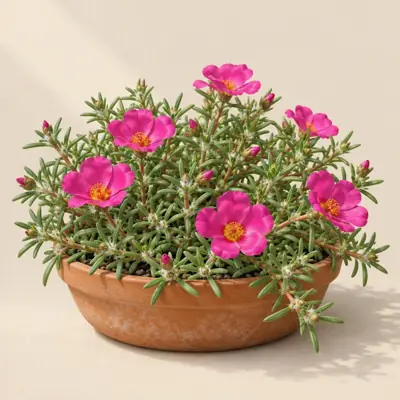
Sources differ on mature height, with reports of about 10–30 cm, while mature spread is 10–50 cm. It is reported to grow quickly and has thick, succulent, linear to nearly cylindrical or needle-like leaves that are alternate or clustered near branch tips or in small groups, with white woolly hairs visible in the leaf axils. Sources differ in descriptions of the flowers; single forms are common, while semi-double and double cultivars also occur, in red, orange, yellow, white, pink, purple, and multicolored forms. Flowering is reported in spring, summer, and autumn, with RHS specifically recording summer flowering; the fruit is reported to be a capsule that splits transversely and contains small gray-black to black or blue-black seeds.
Light
Portulaca grandiflora prefers full sun; abundant sunlight supports flowering, while flowers may remain closed in cloudy or rainy conditions.
Watering
It is drought-tolerant, and watering should be controlled to avoid prolonged wetness or standing water; poor drainage may lead to rot.
Temperature and dormancy
A single source reports an ideal temperature range of about 15–25 °C, so sources are few.
Growing medium and mounting
Well-drained soil is suitable, including sandy, gravelly, and relatively poor soils; prolonged wetness should be avoided.
Propagation
It can be propagated by seed or cuttings; cuttings root readily in a loose, well-drained medium, and spring and summer are more suitable for taking cuttings.
Common problems
Aphids and slugs may occasionally cause damage. Disease is generally limited, but poor drainage may lead to crown rot, and seedlings may develop damping-off. Overly wet growing medium and poor drainage can readily cause rot, and care is needed around the roots when transplanting seedlings. It tolerates heat and drought but not persistent wetness; overwintering ability is limited in cold regions, and flowers may remain closed on cloudy or rainy days.
Identification
Portulaca grandiflora can be recognized by its narrow succulent leaves, low, highly branched form, and brightly colored flowers; the flowers open better in abundant sunlight and may close in cloudy or rainy weather or at night.
Photos


Sources
- Wikipedia (en): Portulaca grandiflora — CC BY-SA 4.0 · link
- 維基百科:大花马齿苋 — CC BY-SA 4.0 · link
- Wikipedia (ja): マツバボタン — CC BY-SA 4.0 · link
- Wikipedia (de): Portulakröschen — CC BY-SA 4.0 · link
- Wikipedia (fr): Portulaca grandiflora — CC BY-SA 4.0 · link
- Wikipedia (es): Portulaca grandiflora — CC BY-SA 4.0 · link
- GBIF descriptions: Manual of the Alien Plants of Belgium; The checklist of alien seed plants of D.R. Congo, based on ev — per dataset · link
- NC State Plant Toolbox: Portulaca grandiflora — copyright (facts only) · link
- TaiCOL 臺灣物種名錄: Portulaca grandiflora — CC BY 4.0 · link
- 農業知識入口網 植物圖鑑: Portulaca grandiflora — © MOA, facts only · link
- Useful Tropical/Temperate Plants: Portulaca grandiflora — CC BY-NC-SA 3.0 (facts only) · link
- RHS Plants: Portulaca grandiflora — © RHS, facts only · link
- USDA PLANTS Database: Portulaca grandiflora — Public domain (US Government work) · link