
geranium aralia (Polyscias guilfoylei)
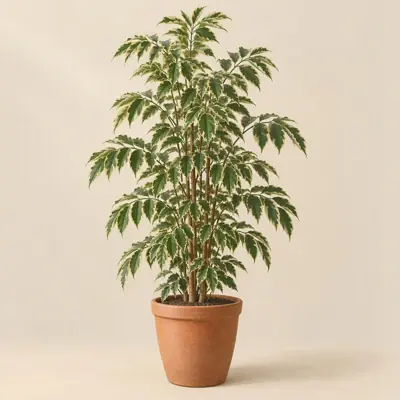
Polyscias guilfoylei is a woody perennial and an evergreen, upright shrub to small tree; when grown indoors, it can retain a tree-like or shrubby form.
Overview
Polyscias guilfoylei is a woody perennial and an evergreen, upright shrub to small tree; when grown indoors, it can retain a tree-like or shrubby form.
Origin and habitat
Sources differ on its native range, which is described as extending from the eastern Malesian floristic region to the western Pacific. It is reported to be commonly grown in tropical lowland cultivated settings as an ornamental, hedge, or windbreak, while sources dispute whether genuinely wild populations exist. It is suited to warm tropical environments and is not cold tolerant.
Characteristics
Sources differ on mature height, reporting about 100–730 cm, while the few available sources report a mature spread of about 50–100 cm. Growth is slow, and the glossy, pinnately compound leaves usually have ovate to elliptic leaflets with coarsely toothed, irregular, or lobed margins; they may be dark green or commonly edged in white or pale yellow. The small, inconspicuous flowers form umbels; sources differ in describing them as green or, in horticultural accounts, white to off-white. Small, black, berry-like fruits may form after flowering.
Light
Bright, indirect light is the main recommendation for indoor cultivation, with morning sun also acceptable; in other growing settings it can be placed in full sun to partial sun.
Watering
Use a well-drained medium and water thoroughly during the growing period, allowing part of the soil or its surface to dry somewhat between waterings; reduce watering in winter and avoid prolonged wetness.
Humidity and airflow
It is generally reported to prefer high humidity.
Temperature and dormancy
Sources differ, with the limited available information indicating a minimum temperature of about 10 °C. Hardiness is described using USDA and RHS classifications. It is generally frost tender and should be kept above freezing.
Growing medium and mounting
A moist but well-drained loamy medium is suitable; loam or sandy soil may be used across acidic, neutral, or alkaline conditions, while indoor plants can use a peat-free, loam-based potting medium.
Feeding
Apply a balanced liquid fertilizer during the growing period; sources recommend either regular feeding or occasional feeding during the growing season.
Propagation
Propagation can be by seed, cuttings, or air layering; RHS also records softwood cuttings in early summer and leafless stem sections with bottom heat in summer.
Common problems
Greenhouse red spider mites and mealybugs are reported as possible pests. Overwatering or a medium that stays wet for prolonged periods can lead to root rot, although RHS generally describes the plant as having few disease problems. It is sensitive to cold and frost, and low temperatures may cause leaf drop or cold damage and can kill the plant under sufficiently severe conditions.
Identification
Upright branches and pinnate leaves with irregularly toothed or lobed margins are distinguishing features; the leaves often have white or pale yellow margins, though some plants are entirely dark green.
Photos


Sources
- Wikipedia (en): Polyscias guilfoylei — CC BY-SA 4.0 · link
- NC State Plant Toolbox: Polyscias guilfoylei — copyright (facts only) · link
- Useful Tropical/Temperate Plants: Polyscias guilfoylei — CC BY-NC-SA 3.0 (facts only) · link
- RHS Plants: Polyscias guilfoylei — © RHS, facts only · link
- USDA PLANTS Database: Polyscias guilfoylei — Public domain (US Government work) · link
- Top Tropicals catalog: Polyscias guilfoylei — © Top Tropicals LLC (facts only) · link