
yew plum pine (Podocarpus macrophyllus)
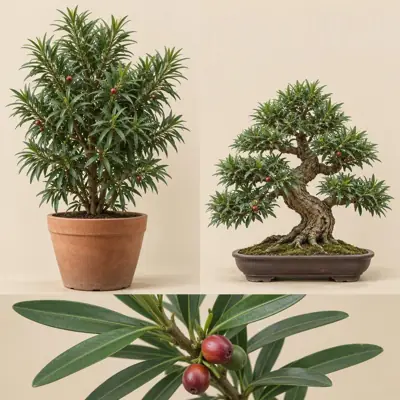
Podocarpus macrophyllus is an evergreen coniferous tree that can also grow as a large shrub and is suitable for container growing and bonsai shaping. It is reported to be perennial.
Overview
Podocarpus macrophyllus is an evergreen coniferous tree that can also grow as a large shrub and is suitable for container growing and bonsai shaping. It is reported to be perennial.
Origin and habitat
Sources differ on its native range, describing East Asia and adjacent regions, mainly southern China, southern Japan, and Taiwan, while some taxonomic treatments include varieties extending into northern Myanmar. It occurs in forests, open scrub, roadsides, and evergreen broadleaf forests in coastal mountain areas, from near sea level to higher elevations. It favors a warm, humid climate with warmer summers, has some shade tolerance, and can adapt to coastal environments.
Characteristics
Sources differ on mature height, placing it at about 500–2000 cm, while a single source reports a mature spread of about 150–250 cm. Sources differ on its growth rate, describing it as slow; the evergreen, leathery leaves are linear to narrowly elongated, spirally alternate, and have a prominent midrib, with darker green upper surfaces and paler undersides, although sources differ in descriptions of typical leaf size. Plants are dioecious; male reproductive structures are cylindrical, yellowish white to yellow, and may occur in clusters in the leaf axils, while female reproductive structures are usually solitary in the leaf axils; flowering is reported from spring to early summer. As the seed matures, associated scales or the receptacle are reported to develop into a fleshy structure ranging from red or reddish purple to purplish black, producing a berry-like appearance; the fleshy part can attract birds that feed on it and disperse the seeds.
Light
It can grow in full sun to partial shade and tolerates shadier conditions, although it generally grows better with good light.
Watering
Keep it moderately moist but well drained, watering regularly and moderately after the surface soil has dried somewhat and avoiding prolonged waterlogging.
Humidity and airflow
It is reported to prefer moderate humidity.
Temperature and dormancy
Sources differ on the minimum temperature, placing it at about 0 °C. Hardiness classifications are reported under both USDA and RHS systems. It is reported to tolerate brief light frost.
Growing medium and mounting
It favors fertile, well-drained soil kept moderately moist and can adapt to various soil types; NC State favors slightly acidic fertile soil, while RHS includes acidic, neutral, and alkaline soils.
Propagation
It can be propagated by seed or cuttings; RHS recommends semi-ripe cuttings in late summer.
Common problems
Reported pests include whiteflies, orange-banded geometrid moths, spider mites, aphids, scarab beetles, longhorn beetles, and leafrollers, with the orange-banded geometrid moth reported to cause substantial damage. Japanese sources report white leaf blight, Pestalotia-related diseases, and sooty mold, while RHS describes the plant as generally having few diseases. Prolonged wet soil or poor drainage is unsuitable; container plants in cold conditions require attention to low temperatures, and in some regions particular leaf-feeding pests can cause severe damage. It tolerates sea winds, salt spray, heat, and some drought, but sources vary greatly on cold tolerance, and young plants need more protection from cold.
Identification
It is reported to have evergreen, narrow, flat, leathery leaves with a very prominent central vein; mature seeds accompanied at the base by a red to purplish-black fleshy receptacle are another conspicuous identifying feature.
Photos


Sources
- Wikipedia (en): Podocarpus macrophyllus — CC BY-SA 4.0 · link
- 維基百科:羅漢松 — CC BY-SA 4.0 · link
- Wikipedia (ja): イヌマキ — CC BY-SA 4.0 · link
- Wikipedia (de): Großblättrige Steineibe — CC BY-SA 4.0 · link
- Wikipedia (fr): Podocarpus macrophyllus — CC BY-SA 4.0 · link
- Wikipedia (es): Podocarpus macrophyllus — CC BY-SA 4.0 · link
- NC State Plant Toolbox: Podocarpus macrophyllus — copyright (facts only) · link
- TaiCOL 臺灣物種名錄: Podocarpus macrophyllus — CC BY 4.0 · link
- Useful Tropical/Temperate Plants: Podocarpus macrophyllus — CC BY-NC-SA 3.0 (facts only) · link
- RHS Plants: Podocarpus macrophyllus — © RHS, facts only · link
- USDA PLANTS Database: Podocarpus macrophyllus — Public domain (US Government work) · link
- Top Tropicals catalog: Podocarpus macrophyllus — © Top Tropicals LLC (facts only) · link