
Platycerium willinckii (Platycerium willinckii)
Platycerium willinckii is reported to be a perennial herbaceous epiphytic fern that readily produces offsets and forms clumps. It is a wild species, not a hybrid or cultivar.
Overview
Platycerium willinckii is reported to be a perennial herbaceous epiphytic fern that readily produces offsets and forms clumps. It is a wild species, not a hybrid or cultivar.
Origin and habitat
Sources differ on its native range, with Java in Indonesia, Southeast Asia, given in the accounts. It grows epiphytically; staghorn ferns typically attach to trees and can also grow on rocks. It is reported to be native to the tropics, to suit warm conditions in cultivation, and to need warmth in winter.
Characteristics
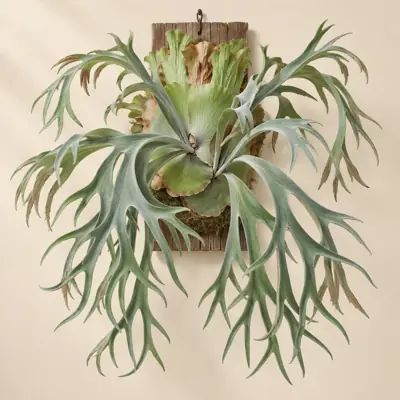
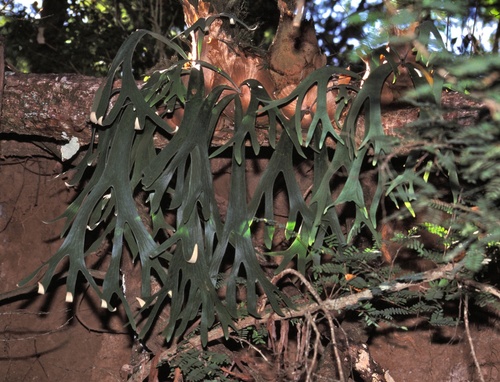
With ample water, it grows rapidly and more readily forms offsets. The fronds occur in distinct forms: shield fronds are shield-shaped, often yellow-brown, and may develop fringe-like lobes along their edges, while fertile fronds are narrow, strap-like, and pendent, with hairs on both surfaces that are more conspicuous on new fronds and become sparser as they mature. The mature spread is reported by a limited source at about 100–100 cm. Shield fronds lie against the base and have fringe-like marginal lobes, while fertile fronds are strap-like and pendent with antler-like branching at their tips; in ample light they may stand upright before curving downward in a parabolic form.
Light
Sources differ on light guidance, describing bright indirect light to partial sun; abundant indirect light can promote growth, while summer conditions call for shade and ventilation. It tolerates some direct sun.
Watering
Ample water can promote rapid growth and offset formation; cultivation can follow wet-dry cycles, watering thoroughly while avoiding a medium that remains waterlogged. A limited source reports a summer watering interval of about 2–7 days. It is generally recommended to let the root zone dry between waterings.
Humidity and airflow
It is reported to prefer high humidity and needs good airflow.
Temperature and dormancy
A limited source reports an ideal temperature range of about 24–33 °C. It is reported to be frost tender, to require conditions above freezing, and to be sensitive to cold. A single source also reports lower and upper temperature limits without a confirmed quantitative range here.
Growing medium and mounting
It is reported to suit epiphytic cultivation and can be fixed to surfaces such as boards, with sphagnum moss or another moisture-retentive but well-draining medium around the roots. It grows on trees as an epiphyte and is reported to suit mounting on a board.
Feeding
Sources differ on feeding: balanced fertilizer can be used for staghorn ferns, with recommendations ranging from more frequent feeding during active growth to much less frequent feeding, and mature plants may be fed less often.
Propagation
Platycerium willinckii readily produces offsets and forms clumps, and can be propagated from offsets or by division; staghorn ferns can also be propagated by spores. It often produces offsets. The sori are reported to occur on the underside of the antler-like branches at the tips of fertile fronds.
Common problems
Staghorn ferns are reported to be susceptible to scale insects, mealybugs, and aphids. Staghorn ferns are reported to develop anthracnose, and overwatering may cause root rot. Overwatering may cause root rot, insufficient water may cause brown or curled frond tips, and poor airflow together with persistently wet medium increases the risk of cultivation problems. As a tropical plant it needs warmth in winter; summer calls for attention to shade and ventilation, while frost and low temperatures should be avoided.
Identification
Platycerium willinckii is a clumping staghorn fern that readily produces offsets; its fertile fronds are notably narrow, elongated, and pendent, with sori on the underside of their terminal antler-like branches, while the fringe-like lobes along the edges of the shield fronds are also identifying features.
Photos


Sources
- GBIF Backbone: Platycerium willinckii T.Moore — CC BY 4.0 · link
- Wikipedia (en, genus): Platycerium — CC BY-SA 4.0 · link
- UF/IFAS Gardening Solutions — Staghorn Ferns: Platycerium (genus-level) — © University of Florida IFAS Extension, facts only · link
- Rainforest Flora care guide: Platycerium (genus-level) — © Rainforest Flora, facts only · link
- 臺北典藏植物園 植物資料庫: Platycerium willinckii — © 臺北典藏植物園, facts only · link
- NHK みんなの趣味の園芸 植物図鑑: Platycerium (genus-level) — © NHK出版, facts only · link
- NC State Plant Toolbox: Platycerium (genus-level) — copyright (facts only) · link
- 爪哇鹿角蕨 - PlatyWiki 鹿角蕨百科 (platywiki.org) — facts only (§12) · link
- 爪哇鹿角蕨有什麼品種?短手&侏儒爪哇鹿角蕨照顧分辨指南 - 微體溫室 Micro Oasis (micro-oasis.com) — facts only (§12) · link
- 侏儒爪哇鹿角蕨 cv. '玉女' (P. willinckii dwarf cv. 'Jade Girl') - PlatyWiki 鹿角蕨百科 — facts only (§12) · link
- 侏儒爪哇鹿角蕨 cv. 'OMG' (P. willinckii dwarf cv. 'OMG') - PlatyWiki 鹿角蕨百科 — facts only (§12) · link
- 侏儒爪哇鹿角蕨 cv. 'Nano' (P. willinckii dwarf cv. 'Nano') - PlatyWiki 鹿角蕨百科 — facts only (§12) · link
- 侏儒爪哇鹿角蕨 cv. '金童' (P. willinckii dwarf cv. 'Golden Boy') - PlatyWiki 鹿角蕨百科 — facts only (§12) · link
- 爪哇鹿角蕨 - PlatyWiki 鹿角蕨百科 — facts only (§12) · link