
Queen staghorn fern (Platycerium wandae)
Platycerium wandae is a large, perennial, epiphytic staghorn fern that naturally grows on trees. It grows as a single plant rather than a colony and is a wild species, not a hybrid or cultivar.
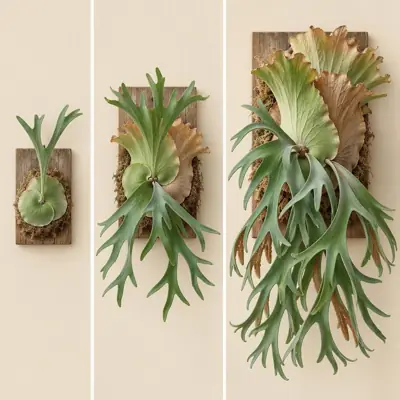
Overview
Platycerium wandae is a large, perennial, epiphytic staghorn fern that naturally grows on trees. It grows as a single plant rather than a colony and is a wild species, not a hybrid or cultivar.
Origin and habitat
Sources differ in their accounts of its native range in New Guinea, including western New Guinea in Indonesia and Papua New Guinea. It grows as an epiphyte on large trees in tropical rainforest, with some information placing it in low- to mid-elevation rainforest. Its habitat has a tropical, warm, humid rainforest climate.
Characteristics
Sources differ, but its mature height is reported at about 150–250 cm. Young plants develop conspicuous shield fronds before fertile fronds appear, and growth is faster with ample light. The shield fronds are tall and shield-shaped, with lobes in the upper portion, while the fertile fronds are strap-shaped, oblique or pendent and branch into unequal long and short lobes, with the longer lobe hanging down. The shield fronds are reported to have whisker-like lobes near them and to trap fallen leaves, dead twigs, and other organic matter that accumulates and decomposes as nutrients.
Light
Sources differ on light conditions: it can grow in full sun to partial sun and grows faster in full sun, but needs shade from strong summer exposure; young or indoor plants can receive bright, diffuse light, while mature plants suit medium to moderately strong light. It is reported to tolerate some direct sun.
Watering
It is reported to benefit from thorough watering followed by a brief drying of the medium before watering again, avoiding prolonged wetness; watering is more frequent in the warm season and reduced in winter. The few available sources report watering about every 2–3 days in summer and about every 7 days in winter. Generally, keep the root zone slightly dry.
Humidity and airflow
Platycerium wandae prefers high humidity and needs good airflow.
Temperature and dormancy
The few available sources report an ideal temperature of about 26–30 °C. It is reported as frost tender and should be kept above freezing. It is sensitive to cold but not very sensitive to heat. It is also reported within a warm USDA hardiness-zone range.
Growing medium and mounting
It grows on trees as an epiphyte and suits mounting on a board. It is reported to suit epiphytic culture on supports such as wooden boards, tree-fern boards, or bark, with roots wrapped in a medium such as sphagnum that provides both moisture retention and drainage; in pots, a humus-rich, well-drained medium is used.
Feeding
A balanced fertilizer is reported to be suitable, with feeding more frequent during active growth than in winter or for mature plants.
Propagation
It is reported to be propagated mainly by spores; because it grows as a single plant and produces few offsets, division is not considered the main propagation method. It is reported to rarely produce offsets, and its spore clusters occur near the base of the fertile fronds.
Common problems
In cultivation, staghorn ferns are reported to develop scale insects, with mealybugs also mentioned by some sources. Anthracnose is reported in cultivated staghorn ferns, while overwatering may cause root rot. Overwatering may lead to rot, insufficient water may cause browning or curling of frond tips, and low light may increase pest and disease problems. Because it is native to the tropics, warmth is important in winter, and general staghorn fern cultivation information advises protection from frost and low temperatures.
Identification
Platycerium wandae is among the largest staghorn ferns, with tall, crown-like shield fronds bearing conspicuous whisker-like or wrinkled structures near the growth center. Its strap-shaped fertile fronds have unequal long and short lobes, with spore clusters near the base of the fertile fronds.
Photos


Sources
- UF/IFAS Gardening Solutions — Staghorn Ferns: Platycerium (genus-level) — © University of Florida IFAS Extension, facts only · link
- Rainforest Flora care guide: Platycerium (genus-level) — © Rainforest Flora, facts only · link
- 臺北典藏植物園 植物資料庫: Platycerium wandae — © 臺北典藏植物園, facts only · link
- NHK みんなの趣味の園芸 植物図鑑: Platycerium (genus-level) — © NHK出版, facts only · link
- Claessen Orchids & Plants: Platycerium wandae — © Claessen Orchids & Plants (facts only) · link
- NC State Plant Toolbox: Platycerium (genus-level) — copyright (facts only) · link
- Top Tropicals catalog: Platycerium wandae — © Top Tropicals LLC (facts only) · link
- Platycerium (wistuba.com) — facts only (§12) · link
- �v���e�B�P���E���E�����_�G (Platycerium wandae) (botanic.jp) — facts only (§12) · link
- Naturalis Institutional Repository: Notes on Platycerium desv. II. P. wilhelmina (repository.naturalis.nl) — facts only (§12) · link
- 女王鹿角蕨 - PlatyWiki 鹿角蕨百科 (platywiki.org) — facts only (§12) · link
- 女王鹿角蕨怎麼照顧?品種價格、上板方向、生長速度 4 重點一篇搞懂! - 微體溫室 Micro Oasis (micro-oasis.com) — facts only (§12) · link