
Platycerium wallichii (Platycerium wallichii)
Platycerium wallichii is a perennial epiphytic fern that typically grows attached to trees. It is a wild species (not a hybrid or cultivar) and is generally reported to grow as a single plant rather than a colony.
Overview
Platycerium wallichii is a perennial epiphytic fern that typically grows attached to trees. It is a wild species (not a hybrid or cultivar) and is generally reported to grow as a single plant rather than a colony.
Origin and habitat
Sources differ on its native range, describing it across South Asia, Southeast Asia, and southwestern China, with records including northeastern India or Assam, Bangladesh, Yunnan in China, Myanmar, Thailand, Vietnam, and Malaysia. It grows as an epiphyte on tree trunks in less-dense forest, with records from moist mixed forest near streams in northern Thailand and from lower elevations there; other accounts describe it on trees in moist Southeast Asian forests. Its native growing season is warm, while winter in the wild is drier and associated with pronounced dry-season dormancy.
Characteristics
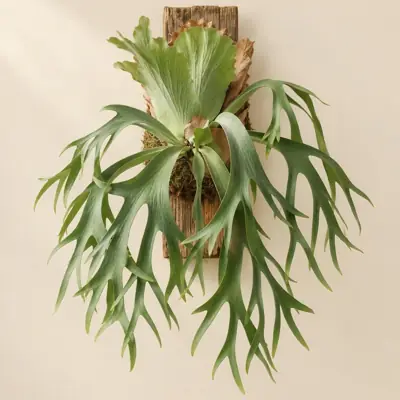
It has broad basal shield fronds that envelop the plant base and collect water and organic matter, and long, pendent fertile fronds that are wavy and deeply divided, becoming broadly fan-branched at maturity and bearing spore patches. Few sources report a mature spread of about 100–100 cm. The tall, spreading shield fronds have many rounded lobes along their upper edge, forming a distinct basket-like structure, while the broad shield fronds enclose the base and collect humus and water. Mature fertile fronds are broad and fan-branched, with pendent main fronds that may also form lateral fronds and curve gracefully downward.
Light
Sources differ in their descriptions of light: bright light is indicated, while a species account recommends bright indirect light and avoiding intense midday direct sun. It tolerates some direct sun.
Watering
It is reported to benefit from thorough watering or misting that moistens the medium around the base, while allowing the medium to dry moderately between waterings to reduce the risk of root rot. Few sources report winter watering at about 7–7 days. Let the root zone dry between waterings.
Humidity and airflow
Few sources report humidity of about 65–85 %. It is generally reported to prefer high humidity. It is generally reported to need moderate airflow and good airflow.
Temperature and dormancy
Few sources report a minimum of about 15 °C and an ideal range of about 18–28 °C. It is generally reported to be frost tender; keep above freezing, and it is sensitive to cold. It is generally reported to be not very sensitive to heat.
Growing medium and mounting
It is reported to suit mounting on wood or cork with sphagnum moss at the base, or growing in an open basket with an airy medium, with emphasis on root aeration and good drainage. It grows on trees as an epiphyte and is generally reported to suit mounting on a board.
Feeding
Sources differ on feeding; small amounts of fertilizer may be used during growth, and a Platycerium wallichii species source suggests applying it by misting or to the sphagnum moss at the base.
Propagation
Staghorn ferns are reported to be propagable from spores, while kinds that form offsets or colonies may also be propagated vegetatively from offsets or by division. Platycerium wallichii is generally reported not to produce offsets. Its fertile fronds are reported to bear spore patches: the main frond has a main spore patch, lateral fronds may have spore patches, and another lobe may lack them.
Common problems
Overwatering may cause root rot, while dormancy may be followed by a prolonged lack of resumed growth, making moisture management during dormancy a major cultivation risk. It prefers warm conditions; staghorn ferns generally need protection from cold and frost, while a Platycerium wallichii species source recommends warmer, stable conditions. Scale insects may occur in cultivated staghorn ferns, and another source reports mealybugs. Cultivation information for staghorn ferns reports that anthracnose may occur and that overwatering may also cause root rot.
Identification
Mature fertile fronds are broad and deeply divided, spreading like butterfly wings with prominent veins, while the tall, spreading shield fronds can form multiple rounded lobes along their upper edge. During the dry season it enters dormancy, when the fronds become brown, shriveled, and curled.
Sources
- 維基百科:鹿角槲 — CC BY-SA 4.0 · link
- Wikipedia (en, genus): Platycerium — CC BY-SA 4.0 · link
- UF/IFAS Gardening Solutions — Staghorn Ferns: Platycerium (genus-level) — © University of Florida IFAS Extension, facts only · link
- Rainforest Flora care guide: Platycerium (genus-level) — © Rainforest Flora, facts only · link
- NHK みんなの趣味の園芸 植物図鑑: Platycerium (genus-level) — © NHK出版, facts only · link
- Claessen Orchids & Plants: Platycerium wallichii — © Claessen Orchids & Plants (facts only) · link
- NC State Plant Toolbox: Platycerium (genus-level) — copyright (facts only) · link
- Thbif :: Onep.Go.Th (thbif.onep.go.th) — facts only (§12) · link
- Platycerium wallichii – eFlora of India (efloraofindia.com) — facts only (§12) · link
- 蝴蝶鹿角蕨 - PlatyWiki 鹿角蕨百科 (platywiki.org) — facts only (§12) · link