
silver elkhorn (Platycerium veitchii)
Platycerium veitchii is a perennial, evergreen epiphytic fern that grows in clumps and can attach to trees, boards, or other supports. It is a wild species, not a hybrid or cultivar.
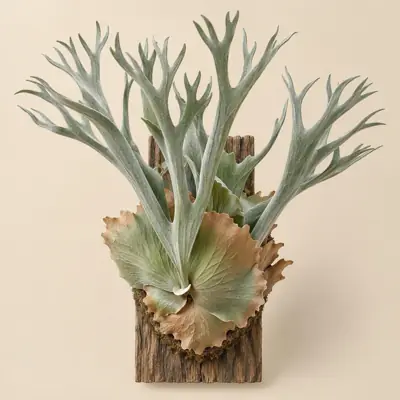
Overview
Platycerium veitchii is a perennial, evergreen epiphytic fern that grows in clumps and can attach to trees, boards, or other supports. It is a wild species, not a hybrid or cultivar.
Origin and habitat
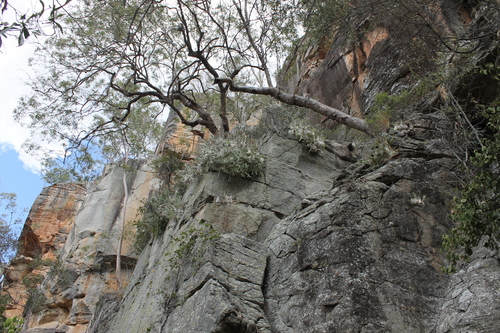
It is native to eastern Australia, explicitly including Queensland. It is reported to grow on trees and other supports and also on rocks, with its roots making use of accumulated organic matter and moisture around them. Its native areas include relatively sunny parts of Queensland, and in cultivation it favors bright, well-ventilated conditions where the growing medium does not remain waterlogged.
Characteristics
Sources differ on mature height, with the few available reports suggesting about 50–100 cm; mature spread is reported from few sources at about 10–50 cm. Young plants gradually develop fertile fronds and shield fronds, while some cultivated forms later develop a more pronounced mature crown and full maturity takes substantially longer. It has both shield fronds and fertile fronds; the fertile fronds can grow upright, branch repeatedly, and bear conspicuous silvery-white hairs that give the plant a silvery appearance. The relatively small, flat shield fronds are reported to cover the roots, collect water and fallen plant debris, and form a nest-like structure, while fertile fronds branch repeatedly and grow upright in ample light.
Light
Sources differ on light conditions: seedlings favor bright indirect light, while mature plants can receive medium to moderately strong light and, after gradual acclimation, can tolerate longer direct exposure; greenhouse cultivation can use bright filtered light while avoiding sudden exposure. Platycerium veitchii tolerates strong direct sun.
Watering
During active growth, water thoroughly and let the root zone dry between waterings rather than remaining waterlogged; mature plants are relatively drought tolerant, watering is reduced in winter, and drainage and airflow remain important under humid conditions. A few sources report a summer watering interval of about 3–5 and a winter interval of about 5–8.
Humidity and airflow
Platycerium veitchii prefers high humidity and is generally reported to need good airflow.
Temperature and dormancy
Sources differ on its minimum temperature tolerance, while one source assigns it an RHS hardiness classification. A single source reports an upper temperature limit, and it is also reported to tolerate brief light frost. It is sensitive to cold and is reported to be not very sensitive to heat.
Growing medium and mounting
It grows on trees as an epiphyte and suits mounting on a board. A well-drained, airy epiphytic medium is suitable; sphagnum moss can be used, mature plants can also be grown with bark or coconut fiber, and an RHS growing mixture includes coarse leaf mold, loam, and charcoal.
Feeding
Sources differ on feeding details, but describe regular use of diluted balanced fertilizer during active growth, with feeding reduced in winter.
Propagation
Platycerium veitchii can be propagated by separating offsets or from spores, with offsets generally easier for home cultivation. It is reported to produce offsets often, while spores form in brown patches on the backs of fertile fronds and can be used for propagation.
Common problems
Sources differ on pests: RHS describes this species as generally having few pest problems, while genus-level information lists scale insects, mealybugs, and aphids as possible pests. Sources differ on disease problems: RHS describes the species as generally having few, while genus-level information associates overwatering with root rot and NHK also records anthracnose as a possibility. Overwatering can cause root rot, insufficient water can lead to brown or curled leaf tips, and strong direct light can bleach or mottle the fronds. Protection from frost and severe cold is advised; Platycerium veitchii can withstand brief low-temperature exposure but is generally cultivated with protection from cold.
Identification
Forked, antler-like fertile fronds contrast conspicuously with shield-shaped sterile fronds that lie against the base; English common names for Platycerium veitchii include silver elkhorn fern and silver staghorn fern.
Photos
Sources
- Wikipedia (en): Platycerium veitchii — CC BY-SA 4.0 · link
- RHS Plants: Platycerium veitchii — © RHS, facts only · link
- UF/IFAS Gardening Solutions — Staghorn Ferns: Platycerium (genus-level) — © University of Florida IFAS Extension, facts only · link
- Rainforest Flora care guide: Platycerium (genus-level) — © Rainforest Flora, facts only · link
- NHK みんなの趣味の園芸 植物図鑑: Platycerium (genus-level) — © NHK出版, facts only · link
- NC State Plant Toolbox: Platycerium (genus-level) — copyright (facts only) · link
- 立葉/銀鹿鹿角蕨 - PlatyWiki 鹿角蕨百科 (platywiki.org) — facts only (§12) · link
- 銀鹿鹿角蕨 3 品種:澳銀、夜銀、野銀鹿角蕨照顧&分辨介紹 - 微體溫室 Micro Oasis (micro-oasis.com) — facts only (§12) · link