
staghorn fern (Platycerium superbum)
Platycerium superbum is a large evergreen perennial epiphytic fern that usually grows on tree trunks or branches, may occasionally grow on rocks, and can form a large nest-like mass of fronds. It grows as a single plant rather than a colony and is a wild species, not a hybrid or cultivar.
Overview
Platycerium superbum is a large evergreen perennial epiphytic fern that usually grows on tree trunks or branches, may occasionally grow on rocks, and can form a large nest-like mass of fronds. It grows as a single plant rather than a colony and is a wild species, not a hybrid or cultivar.
Origin and habitat
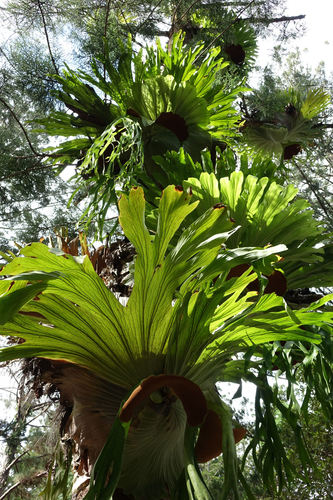
Sources differ on its native range; it is described as native to eastern Australia, mainly Queensland and northern New South Wales. It occurs in and around lowland rainforest, chiefly as an epiphyte on rainforest trunks, branches, or in the canopy, and occasionally on rocks. It is adapted to warm, humid rainforest conditions and in cultivation suits high humidity, shelter from strong winds, and frost-free conditions.
Characteristics
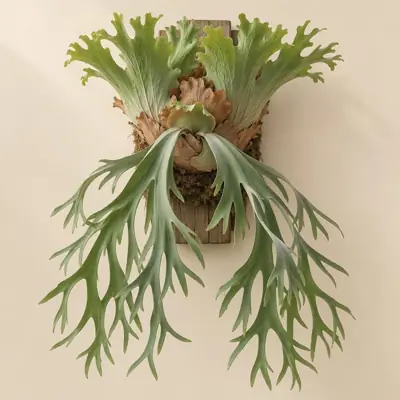
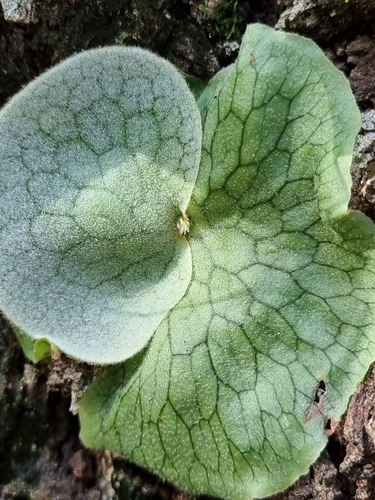
With few sources available, mature height and spread are each reported at about 150–250 cm. It has distinct sterile and fertile fronds: the sterile shield fronds grow upward into a nest-like structure that can collect humus, while the broad, much-branched fertile fronds hang downward and bear sori on their undersides. The large shield fronds grow upward around the host to form a nest-like structure that catches fallen leaves, insects, and other debris, while mature fertile fronds are broad, forked, long, and pendent. It is reported to grow slowly.
Light
Sources differ on light conditions, describing partial shade to bright filtered light, avoidance of intense direct sunlight, and lower light intensity during hot weather. It does not tolerate direct sun.
Watering
During active growth, keep it moist with good drainage, watering thoroughly and allowing it to become slightly dry between waterings; reduce watering in winter and avoid prolonged waterlogging around the roots. With few sources available, watering in summer is reported at about every 4–7 days, while winter watering is reported at about every 7 days. It is generally recommended to let the root zone dry between waterings.
Humidity and airflow
It prefers high humidity. It is reported to need moderate airflow.
Temperature and dormancy
With few sources available, the reported minimum is about 15 °C and the reported ideal range is about 15–27 °C. Sources differ on the reported maximum, with limited evidence placing it at about 27 °C. It is generally described as frost tender and should be kept above freezing; it is sensitive to cold and is also reported to be sensitive to heat.
Growing medium and mounting
Its habit is best matched by securing it epiphytically to bark or a board, though a well-drained growing medium can also be used; RHS recommends a moist but well-drained mixture of equal parts coarse leaf mould, loam, and charcoal. It grows on trees or rocks and suits mounting on a board.
Feeding
It can be fed during active growth; RHS recommends regular feeding, while general Platycerium sources variously recommend diluted balanced liquid fertilizer or diluted fertilizer more frequently, with feeding reduced in winter.
Propagation
Sources differ on propagation: spores can be used, and RHS also lists replanting small plants, while other species-specific sources describe Platycerium superbum as generally solitary and unlikely to produce offsets, making spore propagation the more consistent approach. It is reported not to produce offsets. It produces many tiny spores that can disperse to nearby trees and reproduce, and the spores form in brown sori on the fertile fronds.
Common problems
In colder areas, excessive winter moisture can lead to rot; during hot weather, high temperatures, overly strong light, and unsuitable watering can cause heat injury or frond damage. It is sensitive to frost and cold and is best kept sheltered and frost-free; in hot, bright summer conditions, shade and ventilation require attention. Sources differ on pests: the species is generally described as having few pest problems, while cultivation information for Platycerium reports occasional scale insects or mealybugs. Sources differ on disease problems: the species is generally described as having few diseases, while genus-level cultivation information associates excessive watering with root rot.
Identification
Platycerium superbum has a large staghorn-like form, with sterile shield fronds forming a conspicuous nest-like crown and broad, branched fertile fronds hanging downward. Mature fertile fronds have a single main soral area, one feature used to distinguish it from some similar large staghorn ferns.
Photos


Sources
- Wikipedia (en): Platycerium superbum — CC BY-SA 4.0 · link
- Wikipedia (fr): Platycerium superbum — CC BY-SA 4.0 · link
- RHS Plants: Platycerium superbum — © RHS, facts only · link
- USDA PLANTS Database: Platycerium superbum — Public domain (US Government work) · link
- UF/IFAS Gardening Solutions — Staghorn Ferns: Platycerium (genus-level) — © University of Florida IFAS Extension, facts only · link
- Rainforest Flora care guide: Platycerium (genus-level) — © Rainforest Flora, facts only · link
- NHK みんなの趣味の園芸 植物図鑑: Platycerium superbum — © NHK出版, facts only · link
- NC State Plant Toolbox: Platycerium (genus-level) — copyright (facts only) · link
- Platycerium superbum - Growing Native Plants (anbg.gov.au) — facts only (§12) · link
- Platycerium superbum | Chicago Botanic Garden (www.chicagobotanic.org) — facts only (§12) · link
- Platycerium superbum”Staghorn” - Paten Park Native Nursery (ppnn.org.au) — facts only (§12) · link
- Staghorn Fern (tooheyforesteec.eq.edu.au) — facts only (§12) · link
- Platycerium superbum (Staghorn fern) – Rainforest Flora (rainforestflora.com) — facts only (§12) · link
- 巨大鹿角蕨 - PlatyWiki 鹿角蕨百科 (platywiki.org) — facts only (§12) · link