
Ridley's staghorn fern (Platycerium ridleyi)
Platycerium ridleyi is a wild species that grows on trees as an epiphyte and can also be mounted on a board. It grows as a single plant rather than a colony. It is reported to be perennial.
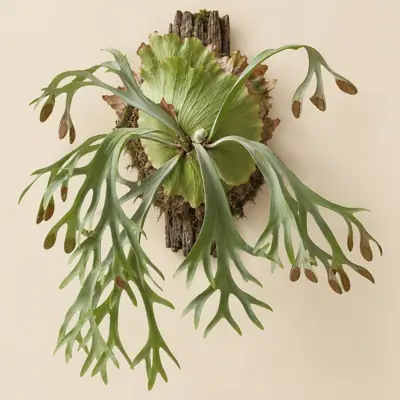
Overview
Platycerium ridleyi is a wild species that grows on trees as an epiphyte and can also be mounted on a board. It grows as a single plant rather than a colony. It is reported to be perennial.
Origin and habitat
Sources differ on its native range: accounts include Thailand, Malaysia, and Indonesia, while some also include Myanmar and Singapore. It grows epiphytically on other plants, trees, or similar supports without extracting nutrients from the host; Platycerium generally grows attached to trees in nature. It prefers a warm, humid tropical environment with good airflow.
Characteristics
Sources differ on mature spread, placing it at about 60–100 cm. With few sources available, mature height is reported at about 10–150 cm. It has distinct shield and fertile fronds: the basal shield frond has conspicuous raised, brain-like veins, while the fertile frond grows upward from a single stalk, branches, and can produce spores when mature. A single source reports that seedlings first develop conspicuous shield fronds, later form fertile fronds, then gradually develop more distinct shield-frond venation before reaching a mature reproductive stage.
Light
It grows mainly in bright indirect to moderately strong light; seedlings should avoid direct sunlight, while mature plants need ample light but should avoid strong direct summer sun. It does not tolerate direct sun.
Watering
It is reported to do well with rainwater or filtered water; water thoroughly, then let the root zone dry briefly or partially between waterings, avoiding prolonged excess moisture that can cause rot. With few sources available, summer watering is reported at about every 2–5 days. With few sources available, winter watering is reported at about every 7–7 days.
Humidity and airflow
It is reported to prefer high humidity and needs good airflow.
Temperature and dormancy
With few sources available, the ideal temperature is reported at about 26–30 °C. It is reported to be frost tender and sensitive to cold, while not being very sensitive to heat.
Growing medium and mounting
It grows on trees as an epiphyte and suits mounting on a board. It is reported to suit cultivation on a board, tree-fern support, or similar support, with moisture-retentive but well-drained material such as sphagnum around the roots; organic-rich, well-drained sphagnum- or peat-based media can also be used.
Feeding
Sources differ, but excessive nutrients should be avoided; Platycerium is described as generally accepting diluted balanced fertilizer, applied more frequently during the growing season and less in winter.
Propagation
Sources differ on propagation practices: Platycerium can be propagated from spores, while kinds that form offsets or young plants can also be divided or separated; propagation from spores is described as slower and more difficult. Platycerium ridleyi does not produce offsets. A source reports that spores form on the underside of fertile fronds and can germinate naturally on surrounding trees under suitable conditions.
Common problems
Scale insects are a reported pest. Soft rot and fungal problems can occur under humid, hot conditions with insufficient airflow, and cultivation information for staghorn ferns also records anthracnose. Persistently wet medium or water collecting in the center can lead to blackening shield fronds and root rot, while excessive dryness can damage roots, making moisture cycling and airflow important. It is sensitive to cold and frost; staghorn ferns generally need protection from frost, and Platycerium ridleyi needs more light during cold winters with insufficient sunlight.
Identification
It is distinguished by very conspicuous raised, brain-like veins on the shield fronds; the fertile fronds extend mainly upward and branch, and young plants gradually develop a staghorn-like appearance.
Photos


Sources
- Wikipedia (en, genus): Platycerium — CC BY-SA 4.0 · link
- UF/IFAS Gardening Solutions — Staghorn Ferns: Platycerium (genus-level) — © University of Florida IFAS Extension, facts only · link
- Rainforest Flora care guide: Platycerium (genus-level) — © Rainforest Flora, facts only · link
- NHK みんなの趣味の園芸 植物図鑑: Platycerium (genus-level) — © NHK出版, facts only · link
- Claessen Orchids & Plants: Platycerium ridleyi — © Claessen Orchids & Plants (facts only) · link
- NC State Plant Toolbox: Platycerium (genus-level) — copyright (facts only) · link
- HOW TO ENJOY TERRA BASE “Terra Base Examples Vol.3” | en (www.adana.co.jp) — facts only (§12) · link
- ผลของอาหารเพาะเลี้ยงต่อการเจริญเติบโตของสปอร์เฟินชายผ้าสีดาเขากวางตั้ง (Platycer (li01.tci-thaijo.org) — facts only (§12) · link
- Platycerium ridleyi - – Jungle Leaves (www.jungle-leaves.de) — facts only (§12) · link
- 亞洲猴腦鹿角蕨 - PlatyWiki 鹿角蕨百科 (platywiki.org) — facts only (§12) · link
- 亞猴鹿角蕨 6 品種:細葉、圓葉、侏儒亞猴鹿角蕨照顧全指南 - 微體溫室 Micro Oasis (micro-oasis.com) — facts only (§12) · link
- Platycerium ridleyi 亞猴鹿角蕨:養護與辨識 · 鹿的手手 LDS² — facts only (§12) · link
- 亞猴、非猴怎麼養不爛:通風、澆水與介質台灣版|LDS² — facts only (§12) · link
- 亞猴鹿角蕨 6 品種:細葉、圓葉、侏儒亞猴鹿角蕨照顧全指南 - 微體溫室 Micro Oasis — facts only (§12) · link