
Platycerium madagascariense (Platycerium madagascariense)
Platycerium madagascariense is an epiphytic staghorn fern that naturally grows attached to trees; staghorn ferns may also occur on rocks, and in cultivation it can be mounted on a board or grown in a pot. It is reported to be perennial and to form colonies. It is a wild species (not a hybrid or cultivar).
Overview
Platycerium madagascariense is an epiphytic staghorn fern that naturally grows attached to trees; staghorn ferns may also occur on rocks, and in cultivation it can be mounted on a board or grown in a pot. It is reported to be perennial and to form colonies. It is a wild species (not a hybrid or cultivar).
Origin and habitat
Platycerium madagascariense is native to Madagascar. It occurs as an epiphyte in humid forests and cloud forests of Madagascar, including on tall trees; records include tall Albizia trees in the northeast and humid forests in the central part of the island. It is generally associated with tropical, warm, humid environments; the genus as a whole also extends into some temperate regions.
Characteristics
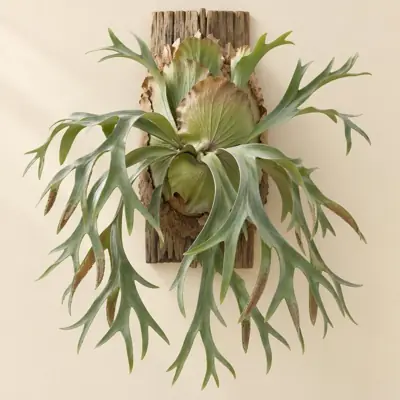
Sources differ, with the few available estimates placing mature spread at about 30–60 cm, while a limited source reports mature height at about 10–150 cm. It is reported to have two frond types: shield fronds lie close to the base, protecting the roots and collecting water and organic debris, while fertile fronds extend outward or upward, are often forked or antler-like, and bear reproductive structures including sporangia on their undersides. The shield fronds are reported to be flat and shield- or kidney-shaped, covering and protecting the roots against the tree, with some forms developing open, crown-like upper lobes that can catch rain and fallen leaves. The thick fertile fronds spread to the sides, have an inverted triangular shape, and fork at their tips.
Light
Sources differ in their descriptions of suitable light, but indicate bright indirect to medium-low light and avoidance of strong direct sunlight, with outdoor shade used in summer. A limited source reports a suitable light level of about 6000–10000, while Platycerium madagascariense does not tolerate direct sun.
Watering
Maintain relatively high ambient humidity without leaving the growing medium persistently wet or waterlogged; in hot weather, allow it to become slightly dry before watering thoroughly, maintain good airflow, and do not let the roots dry out completely. Sources differ, with a limited estimate reporting summer watering about every 4–6 days. A limited source reports winter watering about every 5–7 days. It is generally recommended to let the root zone dry between waterings.
Humidity and airflow
Platycerium madagascariense prefers high humidity, with a limited source suggesting about 60–70 %. It needs good airflow.
Temperature and dormancy
A limited source reports about 10 °C at the low end and about 33 °C at the high end. Sources differ on the ideal temperature range, with the few available estimates placing it at about 16–28 °C. It is reported to be sensitive to cold and is also sensitive to heat.
Growing medium and mounting
It is generally reported to suit a well-drained growing medium; mounted plants can use materials such as sphagnum moss that provide both moisture retention and drainage, while potted plants can use a humus-rich, well-drained medium. Platycerium madagascariense grows on trees (epiphyte) and suits mounting on a board.
Feeding
Balanced fertilizer is reported to be suitable, but recommendations for feeding frequency vary widely among sources, including both repeated feeding during the growing season and infrequent use of slow-release fertilizer.
Propagation
It is reported to be propagated from spores, while plants that form offsets or colonies can also be divided or propagated by removing offsets. It generally often produces offsets. Spores are reported to form in sporangia or brown patches on the undersides of fertile fronds and, under suitable conditions, can germinate naturally on surrounding trees.
Common problems
Reported pests include scale insects, with some cultivation sources also mentioning mealybugs. Reported problems include anthracnose and root rot associated with excessive moisture. Major problems include root decay when high temperatures coincide with persistently wet growing medium, black-brown water-damage marks on shield fronds, and browning of leaf margins associated with excessive fertilizer or poor water quality. It is reported to be vulnerable to low temperatures and frost and to require protection in cold conditions; NHK rates staghorn ferns as having weak cold tolerance and strong heat tolerance.
Identification
Platycerium madagascariense is among the smallest staghorn ferns and is especially distinguished by shield fronds with deep, three-dimensional, brain-like raised and recessed veins; its fertile fronds fork at their tips, and the shield fronds can also form cavities inhabited by ants.
Photos


Sources
- Wikipedia (en, genus): Platycerium — CC BY-SA 4.0 · link
- UF/IFAS Gardening Solutions — Staghorn Ferns: Platycerium (genus-level) — © University of Florida IFAS Extension, facts only · link
- Rainforest Flora care guide: Platycerium (genus-level) — © Rainforest Flora, facts only · link
- NHK みんなの趣味の園芸 植物図鑑: Platycerium (genus-level) — © NHK出版, facts only · link
- Claessen Orchids & Plants: Platycerium madagascariense — © Claessen Orchids & Plants (facts only) · link
- Platycerium madagascariense from €69.99 - Jungle Leaves (www.jungle-leaves.de) — facts only (§12) · link
- Platycerium (wistuba.com) — facts only (§12) · link
- 非洲猴腦/馬達加斯加鹿角蕨 - PlatyWiki 鹿角蕨百科 (platywiki.org) — facts only (§12) · link
- 非猴鹿角蕨難養嗎?非洲猴腦鹿角蕨 3 大照顧關鍵與 2 居家種植環境! - 微體溫室 Micro Oasis (micro-oasis.com) — facts only (§12) · link