
elkhorn ferns (Platycerium hybrid)
Platycerium is reported to be a perennial epiphytic fern that can grow attached to trunks, branches, rocks, or artificial boards. It is reported to be a hybrid.
Overview
Platycerium is reported to be a perennial epiphytic fern that can grow attached to trunks, branches, rocks, or artificial boards. It is reported to be a hybrid.
Origin and habitat
The native range of the genus Platycerium is reported to include Africa, South America, Southeast Asia, Australia, New Guinea, and other tropical to subtropical regions, but available information is insufficient to assign a native range to this artificial hybrid itself. It is reported to occur mainly in epiphytic habitats, attached to forest tree trunks or branches or growing on rocks, with its roots making use of accumulated surrounding organic matter. The genus is reported to occur mainly in warm, humid tropical environments, with drought and cold tolerance differing among its kinds.
Characteristics
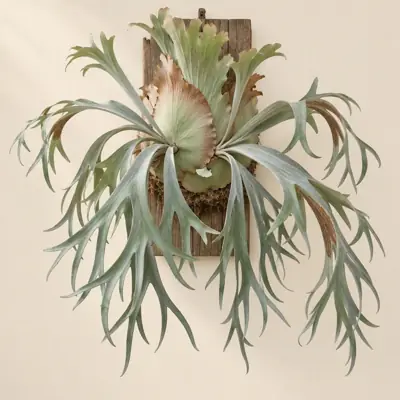
With few sources available, reported mature height is about 10–150 cm, while reported mature spread is about 100–100 cm. It is reported to have distinct sterile, flat basal shield fronds that cover the roots and collect water and plant debris, while fertile fronds generally extend and may branch or take a staghorn-like form, with sporangia forming on their undersides. The fertile fronds are reported to be forked or staghorn-like and may extend outward, rise, or hang downward; those of willinckii are long and pendent.
Light
Sources differ: bright indirect light or bright, shaded conditions are recommended, darkness should be avoided, and some sources also recommend avoiding strong direct sunlight.
Watering
It is generally recommended to water thoroughly, allow the medium to dry somewhat briefly before watering again, and avoid prolonged wetness; watering is more frequent during warm, dry seasons and less frequent in winter or during cool, cloudy conditions. Sources differ on summer watering frequency, giving a range of about 2–7 days. The root zone is generally kept slightly dry.
Humidity and airflow
Platycerium is reported to prefer high humidity and need moderate airflow.
Temperature and dormancy
Sources differ on the lower temperature limit, while an upper temperature limit is also reported. It is reported to be frost tender; keep above freezing, and it is sensitive to cold but not very sensitive to heat.
Growing medium and mounting
For epiphytic cultivation, it is reported to grow in moisture-retentive but well-drained material such as sphagnum moss, secured to a wooden board, tree-fern board, bark, or basket; potted plants use a humus-rich, well-drained medium. It is reported to grow on trees (epiphyte) and can be mounted, grown in a basket or potted.
Feeding
Sources differ, but balanced fertilizer is recommended, with diluted liquid fertilizer applied regularly during the growing period, reduced in winter, and applied less frequently to mature plants.
Propagation
It is reported to be propagated by spores, while types that produce offsets or form colonies can also be propagated by division or by separating offsets; separating offsets is generally easier in home cultivation. Spores are reported to form in brown areas on the undersides of fertile fronds and may germinate naturally under suitable conditions, though propagation from spores is slow and difficult.
Common problems
It is reported to be susceptible to scale insects, mealybugs, and aphids. Overwatering can cause root rot; insufficient water may cause frond tips to brown or curl, darkness may increase pest and disease problems, and strong direct light may bleach or mottle the fronds. It is generally sensitive to cold and frost, although cold tolerance differs markedly within the genus; P. bifurcatum is reported to be more cold tolerant.
Identification
Its most distinctive features are reported to be its contrasting shield fronds and fertile fronds, with fertile fronds often forked and staghorn-like; the shield fronds cover the roots and intercept water and organic debris.
Sources
- Wikipedia (en): Platycerium — CC BY-SA 4.0 · link
- UF/IFAS Gardening Solutions — Staghorn Ferns: Platycerium (genus-level) — © University of Florida IFAS Extension, facts only · link
- Rainforest Flora care guide: Platycerium (genus-level) — © Rainforest Flora, facts only · link
- NHK みんなの趣味の園芸 植物図鑑: Platycerium (genus-level) — © NHK出版, facts only · link
- NC State Plant Toolbox: Platycerium (genus-level) — copyright (facts only) · link