
elkhorn ferns (Platycerium hybrid)
Platycerium is reported to be a perennial epiphytic fern that commonly grows attached to tree trunks, branches, rocks, or artificial boards.
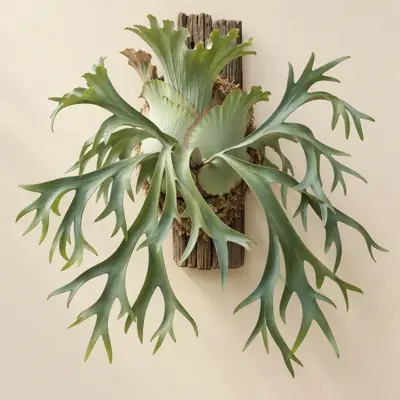
Overview
Platycerium is reported to be a perennial epiphytic fern that commonly grows attached to tree trunks, branches, rocks, or artificial boards.
Origin and habitat
Platycerium is reported from Africa, South America, Southeast Asia, Australia, New Guinea, and other tropical or subtropical regions, with some sources also listing Madagascar and Pacific islands. It is reported to occur mainly in epiphytic settings, growing on rainforest tree trunks and branches or on rocks and using accumulated organic matter, water, and moisture from the air. It is generally associated with warm tropical to subtropical environments with some humidity, and most kinds are reported to have poor cold tolerance.
Characteristics
With few sources, reported mature height is about 10–150 cm, while reported mature spread is about 100–100 cm. Platycerium is reported to have distinct frond forms: basal sterile shield fronds lie flat over the roots and collect water and plant debris, while fertile fronds usually extend outward or upward and may be forked or antler-like, with sporangia forming on their undersides; in some kinds, fertile fronds may instead be fan-shaped or elephant-ear-like. The shield fronds are reported to be small and flat, covering the roots and collecting water and fallen plant debris. Fertile fronds are reported to be forked or antler-like and may extend outward, grow upward, or hang downward.
Light
Sources describe light requirements differently, including bright light, bright indirect light, and shaded to partly shaded conditions, while advising avoidance of strong direct sunlight.
Watering
Platycerium is generally watered thoroughly after the growing medium becomes slightly dry and kept from remaining overly wet; from spring through autumn, water is supplied as the medium begins to dry, while winter conditions are kept drier, as overwatering may cause rot. Sources differ, with a reported summer watering interval of about 2–3 days. With few sources, the reported winter watering interval is about 7–7 days. The root zone is generally kept slightly dry.
Humidity and airflow
Platycerium is generally reported to prefer high humidity. It generally needs moderate airflow.
Temperature and dormancy
Sources differ on the lower temperature limit, while a source also reports an upper temperature limit; these qualitative claims do not establish numerical limits here. Platycerium is generally frost tender; keep above freezing, and it is sensitive to cold. It is generally reported to be not very sensitive to heat.
Growing medium and mounting
Platycerium is generally suited to a well-drained growing medium; reported options include sphagnum moss or, for pot culture, a humus-rich, well-drained medium such as peat with perlite and fine pumice. As an epiphyte, it is also reported to be commonly attached directly to wood boards, tree-fern boards, bark, or rocks, and it suits mounting on a board.
Feeding
Sources describe feeding differently: a balanced fertilizer is reported, with recommendations ranging from diluted fertilizer applied periodically during the growing season to slow-release fertilizer applied much less frequently; mature plants are also reported to be fed infrequently.
Propagation
Platycerium is reported to be propagated by spores, division, or separation of lateral offsets; in home cultivation, offsets or division are generally easier, while spore propagation is slower and more difficult. Spores are reported to form in sporangia or brown patches on the undersides of fertile fronds and may germinate naturally under suitable conditions.
Common problems
Reported pests include scale insects, mealybugs, and aphids. Reported problems include rot from overwatering, brown or curled frond tips from insufficient water, impaired growth from insufficient humidity, and bleached or mottled fronds from strong direct light. Overall cold tolerance is reported to be weak, with frost and low temperatures to be avoided, although cold tolerance varies among kinds.
Identification
Platycerium is reported to be distinguished by contrasting sterile shield fronds and antler-like fertile fronds; the shield fronds cover the roots and accumulate water and organic matter, while spores are produced on the undersides of the fertile fronds.
Sources
- Wikipedia (en): Platycerium — CC BY-SA 4.0 · link
- UF/IFAS Gardening Solutions — Staghorn Ferns: Platycerium (genus-level) — © University of Florida IFAS Extension, facts only · link
- Rainforest Flora care guide: Platycerium (genus-level) — © Rainforest Flora, facts only · link
- NHK みんなの趣味の園芸 植物図鑑: Platycerium (genus-level) — © NHK出版, facts only · link
- NC State Plant Toolbox: Platycerium (genus-level) — copyright (facts only) · link