
elkhorn fern (Platycerium hillii)
Platycerium hillii is a perennial fern that grows attached to surfaces such as tree trunks and branches. It is a wild species, not a hybrid or cultivar, and is reported to form colonies.
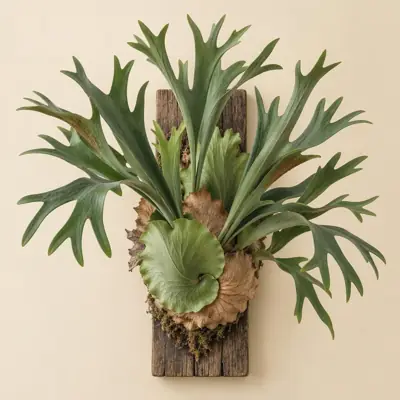
Overview
Platycerium hillii is a perennial fern that grows attached to surfaces such as tree trunks and branches. It is a wild species, not a hybrid or cultivar, and is reported to form colonies.
Origin and habitat
Platycerium hillii is native to Australia. It is reported to grow epiphytically on tree trunks and branches and can sometimes grow on rock surfaces, in tropical, warm and humid climates.
Characteristics
Sources are few and report a mature spread of about 60–100 cm and a mature height of about 10–150 cm. It is reported to have distinct shield fronds and fertile fronds; the shield fronds lie close to the base, cover the roots, and collect water and fallen organic matter, while brown spore-bearing structures can form on the undersides of the fertile fronds. The fertile fronds are large and broad, extend into the air, and branch at their tips into an antler-like form.
Light
Sources describe light requirements differently, ranging from bright indirect light to moderate or lower light, while advising against excessively strong direct sunlight. It is reported not to tolerate direct sun.
Watering
Water thoroughly when the growing medium is nearly dry, maintain a wet-dry cycle, avoid standing water, and reduce watering frequency in winter; overwatering or poor drainage can cause rot. Let the root zone dry between waterings. Sources differ, with few sources indicating watering intervals of about 3–5 in summer and about 5–7 in winter.
Humidity and airflow
It is generally described as preferring moderate humidity, while another report indicates a preference for high humidity. It is generally reported to need good airflow.
Temperature and dormancy
It is reported to be frost tender, to require conditions above freezing, and to be sensitive to cold. It is reported to be not very sensitive to heat.
Growing medium and mounting
It needs an airy, well-drained growing medium; mature mounted plants can use sphagnum moss with bark or coconut fiber, or can be secured to a board with a medium such as sphagnum moss. It grows on trees as an epiphyte and is reported to be suitable for mounting, basket culture, or pot culture.
Feeding
Sources differ on feeding, but balanced fertilizer can be used during the growing period, with less fertilizer applied in winter.
Propagation
It can be propagated by dividing offsets or young plants; Platycerium can also be propagated from spores, although spore propagation is slower and more difficult. It is reported to often produce offsets, while spores form in brown patches or spore-bearing structures on the undersides of fertile fronds.
Common problems
Reported pests include scale insects, and staghorn ferns may also develop mealybugs. Reported problems include anthracnose and root rot associated with overwatering; excessive watering or poorly drained growing medium can cause rot, while excessively strong sunlight may scorch the fronds. It is reported to be sensitive to frost and low temperatures, so frost should be avoided; the source also describes most staghorn fern species as having limited cold tolerance but does not identify Platycerium hillii as a cold-hardy exception.
Identification
Its most conspicuous identifying features are its epiphytic habit and its distinctly different shield and fertile fronds; spore-bearing fronds are often antler-like.
Photos


Sources
- Wikipedia (en): Platycerium hillii — CC BY-SA 4.0 · link
- UF/IFAS Gardening Solutions — Staghorn Ferns: Platycerium (genus-level) — © University of Florida IFAS Extension, facts only · link
- Rainforest Flora care guide: Platycerium (genus-level) — © Rainforest Flora, facts only · link
- NHK みんなの趣味の園芸 植物図鑑: Platycerium (genus-level) — © NHK出版, facts only · link
- NC State Plant Toolbox: Platycerium (genus-level) — copyright (facts only) · link
- 深綠鹿角蕨 - PlatyWiki 鹿角蕨百科 (platywiki.org) — facts only (§12) · link
- 深綠鹿角蕨怎麼養?深綠龍&綴化&侏儒深綠鹿角蕨照顧一次掌握! - 微體溫室 Micro Oasis (micro-oasis.com) — facts only (§12) · link