
Platycerium ellisii (Platycerium ellisii)
Platycerium ellisii is reported to be a perennial epiphytic fern that can grow on tree trunks, branches, and rocks. It is generally described as clumping and as a wild species (not a hybrid or cultivar).
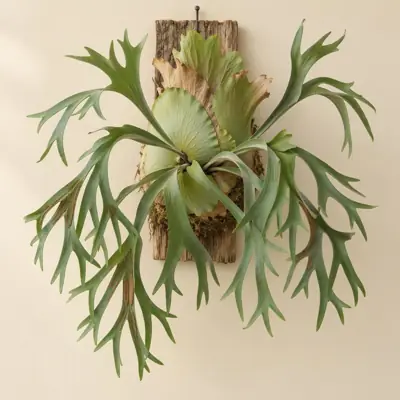
Overview
Platycerium ellisii is reported to be a perennial epiphytic fern that can grow on tree trunks, branches, and rocks. It is generally described as clumping and as a wild species (not a hybrid or cultivar).
Origin and habitat
The available sources do not provide a confirmed species-level native range for Platycerium ellisii; genus-level information places Platycerium in tropical or some temperate regions of Africa, Madagascar, Asia, Southeast Asia, the Pacific islands, Australia, New Guinea, and South America. It is reported to use trees as an epiphytic substrate and can also grow on rocks. Genus-level information mainly describes tropical environments and adaptation to warm conditions, while horticultural information reports good growth under hot, humid conditions.
Characteristics
Sources differ on mature height, reporting about 10–150 cm. A single source reports a mature spread of about 100–100 cm, so sources are few. It is reported to have basal sterile shield fronds that cover and protect the roots and collect water and organic debris, while fertile fronds grow outward or upward, are often forked or antler-like, and bear sporangia on their undersides. Shield fronds are reported to be shield-shaped or kidney-shaped and closely attached to the tree, with some forms developing open crown-like lobes along the upper edge that can catch rainwater and fallen leaves; fertile fronds may fork, extend outward, grow upward, or hang downward, with spores borne on the lower surface.
Light
Sources differ, but cultivation information for Platycerium ellisii favors shade with bright, indirect light and cautions against directly applying stronger-sun recommendations used for staghorn ferns generally. It is reported to not tolerate direct sun.
Watering
Watering should combine high ambient humidity with rapid drainage, allowing the medium to dry briefly before watering thoroughly and avoiding prolonged wetness that can cause rot; the shield fronds of Platycerium ellisii dry relatively quickly, and sources also mention placing sphagnum moss in gaps between shield fronds to help retain moisture. Sources differ on summer watering intervals, giving about 2–7 days, while a single source reports about 7–7 days in winter, so sources are few. It is generally recommended to let the root zone dry between waterings.
Humidity and airflow
Platycerium ellisii prefers high humidity.
Temperature and dormancy
Temperature information reports warm-growing conditions without a confirmed numerical range here, and sources differ on the lower-temperature information. It is reported to be sensitive to cold and not very sensitive to heat.
Growing medium and mounting
For epiphytic cultivation, it is reported to be attachable to supports such as wooden boards or tree-fern boards with sphagnum moss or another moisture-retentive but well-drained medium; when potted, a humus-rich, well-drained medium is recommended. It grows on trees (epiphyte) and is reported to be suitable for mounting, basket culture, or pot culture.
Feeding
Sources differ on feeding: balanced fertilizer is recommended, but reported schedules range from more frequent feeding during the growing season to occasional slow-release or mature-plant feeding.
Propagation
Platycerium ellisii can be propagated from spores, while forms that produce offsets or multiple growing points can also be propagated by division or by separating offsets; it is described as having multiple growing points, providing a morphological basis for division. It is reported to often produce offsets. Spores are reported to form in sporangial clusters on the underside of fertile fronds and, under suitable conditions, may germinate naturally on surrounding trees.
Common problems
Cultivated Platycerium species are reported to be susceptible to scale insects, mealybugs, and aphids. Overwatering may cause rot, while insufficient water may cause browning or curling of frond tips; inadequate humidity can make it difficult for the thinner fertile fronds of Platycerium ellisii to remain in good condition. Platycerium species are generally sensitive to low temperatures and frost, while information specific to Platycerium ellisii indicates a need for high humidity and shade.
Identification
The most conspicuous identifying features are the coexistence of basal shield fronds and antler-like fertile fronds; mature fertile fronds are reported to show patches of sporangia on their undersides.
Photos

Sources
- Wikipedia (en, genus): Platycerium — CC BY-SA 4.0 · link
- UF/IFAS Gardening Solutions — Staghorn Ferns: Platycerium (genus-level) — © University of Florida IFAS Extension, facts only · link
- Rainforest Flora care guide: Platycerium (genus-level) — © Rainforest Flora, facts only · link
- NHK みんなの趣味の園芸 植物図鑑: Platycerium (genus-level) — © NHK出版, facts only · link
- NC State Plant Toolbox: Platycerium (genus-level) — copyright (facts only) · link
- 愛麗絲鹿角蕨 - PlatyWiki 鹿角蕨百科 (platywiki.org) — facts only (§12) · link