
Angola staghorn fern (Platycerium elephantotis)
Platycerium elephantotis is a clumping epiphytic fern that can grow attached to trees and can also be cultivated mounted on a board or hanging. It is reported to be perennial. It is a wild species, not a hybrid or cultivar.
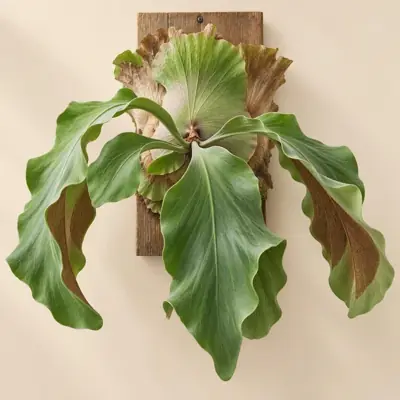
Overview
Platycerium elephantotis is a clumping epiphytic fern that can grow attached to trees and can also be cultivated mounted on a board or hanging. It is reported to be perennial. It is a wild species, not a hybrid or cultivar.
Origin and habitat
It is native to tropical Africa, with its main distribution reported in the Congo River basin and records also from East Africa. In its natural habitat it grows on trees as an epiphyte. It prefers warm, humid tropical conditions with high temperatures and relatively high air humidity, and does not tolerate prolonged low temperatures.
Characteristics
Sources differ, with the reported mature height ranging about 60.96–152.4 cm. Young plants grow relatively quickly, and growth is faster under suitable indirect light, with plants reaching maturity after a period of growth. It has two types of fronds: the shield fronds are tall and upright with wavy, unlobed upper margins and sparse hairs that give a somewhat silvery appearance, while the fertile fronds are broad, pendent, and unbranched, forming nearly symmetrical broad blades with spore-bearing areas on their undersides. As a fern, it does not flower and reproduces sexually by spores.
Light
Sources differ in their descriptions of light needs, but bright to medium indirect light is suitable; prolonged indirect sunlight can be accepted, while strong direct light should be avoided, with shade and ventilation important in summer. It does not tolerate direct sun.
Watering
Let the root zone partly dry between waterings and then water thoroughly; mounted plants can be soaked or have their roots thoroughly sprayed, while continuously wet conditions should be avoided and winter conditions should be kept drier. A few sources report summer watering intervals of about 2–7 and winter intervals of about 4–7, with the available evidence limited.
Humidity and airflow
It is generally reported to prefer high humidity, with the few available sources suggesting about 55–80 %. It needs good airflow.
Temperature and dormancy
Sources differ on the lower temperature figure, reported at about 15 °C, while a limited source reports an upper figure of about 30 °C. It is generally reported as frost tender and should be kept above freezing; it is sensitive to cold but not very sensitive to heat. A single source reports its hardiness in a warm USDA zone range.
Growing medium and mounting
It is generally reported to suit an open, airy, well-drained epiphytic medium such as fine bark or a small amount of sphagnum moss; when mounted, sphagnum moss can help keep the roots moderately moist. It grows on trees as an epiphyte and suits mounting on a board.
Feeding
Sources differ, but diluted orchid fertilizer can be applied periodically during the growing season, while genus-level information also supports using diluted fertilizer during active growth.
Propagation
It can primarily be propagated by separating basal offsets once they have grown to roughly palm size, and it often produces offsets. It can also be propagated from spores; a single source reports dense, broad patches of spore-bearing structures on the underside near the tips of the fertile fronds, becoming brown at maturity.
Common problems
Scale insects and mealybugs may occur. Anthracnose may occur in cultivated staghorn ferns, while persistently wet medium may increase root rot or fungal problems. Overwatering may cause root rot, and cold, wet conditions are especially unfavorable; insufficient water may cause frond tips to brown or curl. It is sensitive to frost and prolonged cold, does not tolerate persistent wetness during cold conditions, and in hot conditions requires good airflow and protection from drying out.
Identification
Its main distinguishing feature is its broad, pendent, unbranched fertile fronds resembling elephant ears; the shield fronds have wavy upper margins and sparse hairs that can give them a silvery appearance.
Photos


Sources
- GBIF Backbone: Platycerium elephantotis Schweinf. — CC BY 4.0 · link
- Wikipedia (en, genus): Platycerium — CC BY-SA 4.0 · link
- UF/IFAS Gardening Solutions — Staghorn Ferns: Platycerium (genus-level) — © University of Florida IFAS Extension, facts only · link
- Rainforest Flora care guide: Platycerium (genus-level) — © Rainforest Flora, facts only · link
- 臺北典藏植物園 植物資料庫: Platycerium elephantotis — © 臺北典藏植物園, facts only · link
- NHK みんなの趣味の園芸 植物図鑑: Platycerium elephantotis — © NHK出版, facts only · link
- Claessen Orchids & Plants: Platycerium elephantotis — © Claessen Orchids & Plants (facts only) · link
- NC State Plant Toolbox: Platycerium (genus-level) — copyright (facts only) · link
- Top Tropicals catalog: Platycerium elephantotis — © Top Tropicals LLC (facts only) · link
- 象耳鹿角蕨 - PlatyWiki 鹿角蕨百科 (platywiki.org) — facts only (§12) · link
- 象耳鹿角蕨有哪些?猛瑪象&三角象鹿角蕨 8 品種照顧圖鑑 - 微體溫室 Micro Oasis (micro-oasis.com) — facts only (§12) · link