
elkhorn fern (Platycerium bifurcatum)
Platycerium bifurcatum is a perennial evergreen epiphytic fern that can grow on tree trunks, branches or rock surfaces and forms colonies through offsets. It is a wild species, not a hybrid or cultivar.
Overview
Platycerium bifurcatum is a perennial evergreen epiphytic fern that can grow on tree trunks, branches or rock surfaces and forms colonies through offsets. It is a wild species, not a hybrid or cultivar.
Origin and habitat
Sources differ on its native range, describing Australia and areas extending from Indonesia and New Guinea to Pacific islands and New Caledonia. It grows mainly on tree trunks and branches and is also recorded in and near rainforest, moist coastal forest, and on rocks and rock faces. It occurs in tropical to warm, humid environments, preferring warmth and higher humidity, with protection from frost needed in cold areas.
Characteristics
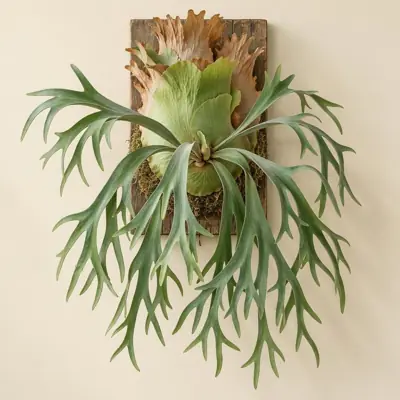
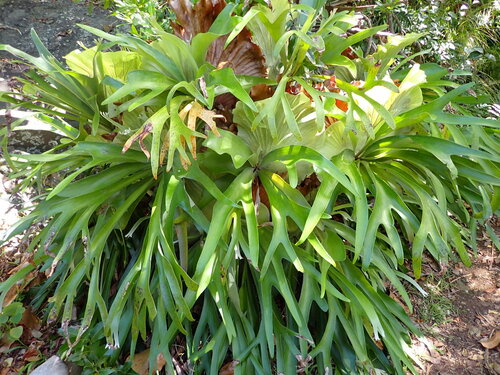
Mature plants reach 50–100 cm in height and 50–120 cm in spread. Growth is vigorous to fast, and ample water can support rapid growth and the production of offsets. Sources differ in their descriptions of the dimorphic fronds: sterile shield fronds lie against the substrate, range from rounded, kidney-shaped or heart-shaped to shield-shaped, can turn brown and persist when mature, and overlap on host bark with deeply lobed upper margins that can trap plant debris. The gray-green to green fertile fronds are narrow and strap-like, repeatedly fork, and may progress from upright or semi-upright to arching or pendent, with sori toward the terminal regions on their undersides.
Light
Sources differ somewhat on light conditions, describing bright indirect light to partial sun; several horticultural sources recommend partial shade or avoiding strong direct light, while acclimated plants can tolerate higher light levels. Platycerium bifurcatum tolerates some direct sun.
Watering
During active growth, water thoroughly while maintaining good drainage and allowing the roots or medium to become slightly dry between waterings; reduce watering in winter and avoid prolonged waterlogging. For epiphytic cultivation, it can be thoroughly watered or soaked and then allowed to drain well. A limited number of sources report a summer watering interval of about 2–7 days.
Humidity and airflow
Platycerium bifurcatum prefers high humidity and needs good airflow. It is also reported to need good airflow.
Temperature and dormancy
Sources differ on its minimum-temperature and hardiness classifications. It is sensitive to cold, while a single source reports that it tolerates brief light frost and another reports that it is not very sensitive to heat.
Growing medium and mounting
It needs a well-drained epiphytic medium that retains some moisture; sphagnum moss or epiphytic orchid medium can be used, as can supports such as boards or bark, while RHS also lists a loam-based growing mix. It grows on trees as an epiphyte and can be mounted, grown in a basket or potted.
Feeding
Sources differ on feeding frequency and methods: balanced liquid fertilizer can be applied during the growing season, slow-release fertilizer is another described approach, and feeding should be reduced in winter.
Propagation
Platycerium bifurcatum can be propagated from spores or by separating offsets or plantlets produced by the plant, with separation of plantlets described as simpler in horticultural cultivation. It often produces offsets, while spores develop on the undersides of terminal sections of fertile fronds as brown patches or spore-bearing areas.
Common problems
Scale insects may occur, and general cultivation information for Platycerium also mentions mealybugs. Disease may generally be uncommon, although anthracnose has been recorded in cultivation. Overwatering may lead to root rot or winter leaf spotting, while insufficient water may cause brown or curling frond tips; mature shield fronds naturally turning brown can be part of their normal life cycle rather than necessarily indicating disease. It is sensitive to frost and low temperatures and should be kept warm and protected from freezing in winter; although it can tolerate lower temperatures than many staghorn ferns, it remains a warm-climate plant.
Identification
Characteristic features include strongly dimorphic fronds, shield fronds that lie against the substrate and collect fallen leaves, and repeatedly forked fertile fronds resembling antlers, with brown spore-bearing areas on their undersides.
Photos



Sources
- GBIF Backbone: Platycerium bifurcatum (Cav.) C.Chr. — CC BY 4.0 · link
- Wikipedia (en): Platycerium bifurcatum — CC BY-SA 4.0 · link
- 維基百科:二歧鹿角蕨 — CC BY-SA 4.0 · link
- Wikipedia (fr): Platycerium bifurcatum — CC BY-SA 4.0 · link
- NC State Plant Toolbox: Platycerium bifurcatum — copyright (facts only) · link
- TaiCOL 臺灣物種名錄: Platycerium bifurcatum — CC BY 4.0 · link
- RHS Plants: Platycerium bifurcatum — © RHS, facts only · link
- USDA PLANTS Database: Platycerium bifurcatum — Public domain (US Government work) · link
- UF/IFAS Gardening Solutions — Staghorn Ferns: Platycerium (genus-level) — © University of Florida IFAS Extension, facts only · link
- Rainforest Flora care guide: Platycerium (genus-level) — © Rainforest Flora, facts only · link
- 臺北典藏植物園 植物資料庫: Platycerium bifurcatum — © 臺北典藏植物園, facts only · link
- NHK みんなの趣味の園芸 植物図鑑: Platycerium bifurcatum — © NHK出版, facts only · link
- Top Tropicals catalog: Platycerium bifurcatum — © Top Tropicals LLC (facts only) · link
- Platycerium bifurcatum - Growing Native Plants (anbg.gov.au) — facts only (§12) · link