
Japanese cheesewood (Pittosporum tobira)
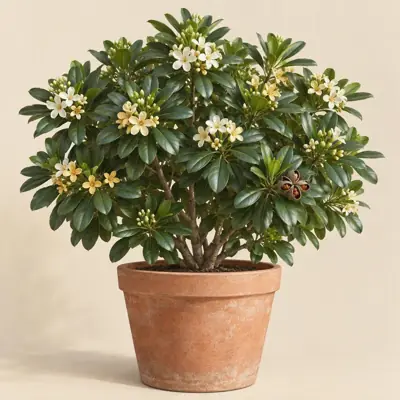
Pittosporum tobira is an evergreen shrub to small tree that can form a dense, spreading habit. It is generally reported to be perennial.
Overview
Pittosporum tobira is an evergreen shrub to small tree that can form a dense, spreading habit. It is generally reported to be perennial.
Origin and habitat
Sources differ on its native range: it is described as native to East Asia, mainly from eastern to southern China, Japan, Korea, and Taiwan, where a Taiwanese checklist lists it as native. It occurs in forests, limestone areas, slopes, rocky places, sandy coasts, and roadsides, and is especially common along warm coasts. It is adapted to warm and coastal environments and tolerates drought, heat, salt spray, and sea winds; sources also report cold tolerance in mature dormant plants.
Characteristics
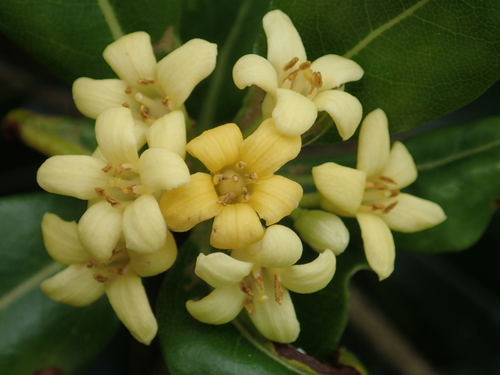
Sources differ on mature height, giving a range of about 250–1000 cm, while mature spread is 150–300 cm. Sources differ on growth rate, describing it from moderate to fast or as slow-growing. The alternate leaves are often crowded at branch tips; they are thick, leathery, glossy, mainly elliptic, oblong to obovate, with entire margins that may curl inward. The strongly fragrant flowers are mostly clustered at branch tips, opening white and gradually becoming creamy white to pale yellow, while the woody capsules split at maturity to expose multiple seeds coated with a sticky substance.
Light
It grows in full sun to partial shade; some sources indicate tolerance of deeper shade, but general horticultural cultivation favors full sun or bright partial shade.
Watering
It favors well-drained soil with moderate moisture under normal cultivation, becomes drought tolerant once established, and should not remain waterlogged for long periods.
Temperature and dormancy
Sources differ on minimum temperature, with the limited evidence indicating about -10 °C. Sources also differ on its hardiness-zone classification. It is generally reported to be frost hardy.
Growing medium and mounting
It is suited to well-drained loam, sandy, or calcareous soil, tolerates a broad range of soil acidity and alkalinity, and is not suited to persistently waterlogged conditions.
Propagation
It can be propagated by seed or semi-ripe cuttings.
Common problems
Potential pests include greenhouse red spider mites, aphids, mealybugs, and Pittosporum psyllids; Japanese records also report that psyllid insects may occur in large numbers on urban plantings. Leaf margins may curl inward under environmental stress, and persistently wet soil is unsuitable for growth. It tolerates drought, heat, and salt spray, but sources and growing conditions differ regarding cold tolerance; some sources advise protection from cold, dry winds or freezing.
Identification
Pittosporum tobira is evergreen and dense, with thick, leathery, glossy leaves clustered at branch tips, sweetly fragrant white flowers that later turn yellow, and mature woody capsules that split open to reveal sticky-coated seeds.
Photos



Sources
- Wikipedia (en): Pittosporum tobira — CC BY-SA 4.0 · link
- 維基百科:海桐花 — CC BY-SA 4.0 · link
- Wikipedia (ja): トベラ — CC BY-SA 4.0 · link
- Wikipedia (de): Chinesischer Klebsame — CC BY-SA 4.0 · link
- Wikipedia (fr): Pittosporum tobira — CC BY-SA 4.0 · link
- Wikipedia (es): Pittosporum tobira — CC BY-SA 4.0 · link
- NC State Plant Toolbox: Pittosporum tobira — copyright (facts only) · link
- Wikipedia (it): Pittosporum tobira — CC BY-SA 4.0 · link
- TaiCOL 臺灣物種名錄: Pittosporum tobira — CC BY 4.0 · link
- Useful Tropical/Temperate Plants: Pittosporum tobira — CC BY-NC-SA 3.0 (facts only) · link
- RHS Plants: Pittosporum tobira — © RHS, facts only · link
- USDA PLANTS Database: Pittosporum tobira — Public domain (US Government work) · link
- Top Tropicals catalog: Pittosporum tobira — © Top Tropicals LLC (facts only) · link