
water lettuce (Pistia stratiotes)
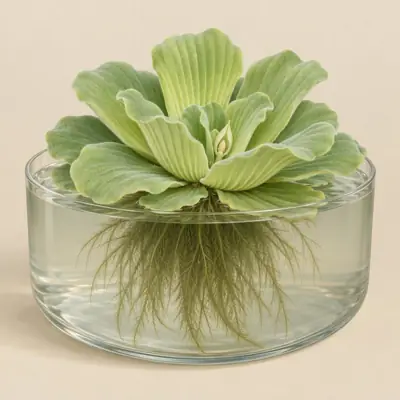
Pistia stratiotes is a perennial aquatic herb that floats freely on the water surface, forming rosettes of leaves with roots hanging in the water.
Overview
Pistia stratiotes is a perennial aquatic herb that floats freely on the water surface, forming rosettes of leaves with roots hanging in the water.
Origin and habitat
Sources differ on its native range: it has been broadly described as pantropical and is now widespread in tropical and subtropical regions worldwide. It inhabits freshwater, commonly floating on ponds, lakes, ditches, rice fields, swamps, and still or slow-moving rivers and waterways. It occurs in tropical to subtropical climates and prefers warm conditions.
Characteristics
Mature height is 10–50 cm; sources differ on mature spread, which is about 10–50 cm. Growth is rapid, with stolons capable of quickly producing dense colonies that cover large areas of water. The thick, soft leaves are pale green to whitish green, obovate to transversely elliptic, and arranged in rosettes; they have dense fine hairs and prominent nearly parallel veins or longitudinal ridges, and the hairs trap air bubbles that increase buoyancy. Sources differ in their descriptions of the small, inconspicuous inflorescences hidden among the leaves; they have a spathe and spadix, with a single female flower and several male flowers, and flowering is reported from spring through summer, with a horticultural source specifically reporting summer flowering; the fruit is generally reported to be a small ovoid berry containing multiple seeds at maturity, with seed shape described as ovoid or cylindrical.
Light
It grows in full sun to partial sun, requires bright light indoors, and tolerates some direct sun.
Watering
As an aquatic plant, it requires a freshwater environment and can grow in still or slow-moving water.
Humidity and airflow
It is generally reported to prefer high humidity.
Temperature and dormancy
Its ideal temperature is 22–30 °C. It is associated with USDA and RHS hardiness classifications, and is frost tender; keep above freezing.
Growing medium and mounting
Pistia stratiotes is primarily a free-floating aquatic plant and does not depend on ordinary terrestrial potting soil; when stranded on moist soil, it can survive in a dwarfed form.
Propagation
Sources differ on propagation details: it reproduces mainly vegetatively through surface stolons that form daughter plants at their ends, and it can also flower, fruit, and reproduce sexually by seed.
Common problems
Horticultural information generally reports no serious pest problems, although aphids may occur; sources likewise generally do not indicate serious disease problems. In regions that remain warm throughout the year, it can reproduce rapidly into dense floating mats that cover the water surface, obstruct waterways and water activities, reduce light, and lower dissolved oxygen in the water; it is regarded as invasive in many places. It is sensitive to frost and freezing and is better suited to tropical and subtropical environments that remain warm throughout the year.
Identification
It can be recognized by floating rosettes resembling lettuce, thick hairy buoyant leaves, numerous long slender roots hanging underwater, and daughter plants produced by stolons across the water surface.
Photos


Sources
- Wikipedia (en): Pistia — CC BY-SA 4.0 · link
- 維基百科:大薸 — CC BY-SA 4.0 · link
- Wikipedia (ja): ボタンウキクサ — CC BY-SA 4.0 · link
- Wikipedia (de): Wassersalat — CC BY-SA 4.0 · link
- Wikipedia (fr): Pistia stratiotes — CC BY-SA 4.0 · link
- Wikipedia (es): Pistia stratiotes — CC BY-SA 4.0 · link
- GBIF descriptions: Manual of the Alien Plants of Belgium; Database of Vascular Plants of Canada (VASCAN); Checklist of — per dataset · link
- NC State Plant Toolbox: Pistia stratiotes — copyright (facts only) · link
- Wikipedia (it): Pistia stratiotes — CC BY-SA 4.0 · link
- Wikipedia (nl): Watersla — CC BY-SA 4.0 · link
- Useful Tropical/Temperate Plants: Pistia stratiotes — CC BY-NC-SA 3.0 (facts only) · link
- RHS Plants: Pistia stratiotes — © RHS, facts only · link
- USDA PLANTS Database: Pistia stratiotes — Public domain (US Government work) · link
- Top Tropicals catalog: Pistia stratiotes — © Top Tropicals LLC (facts only) · link